

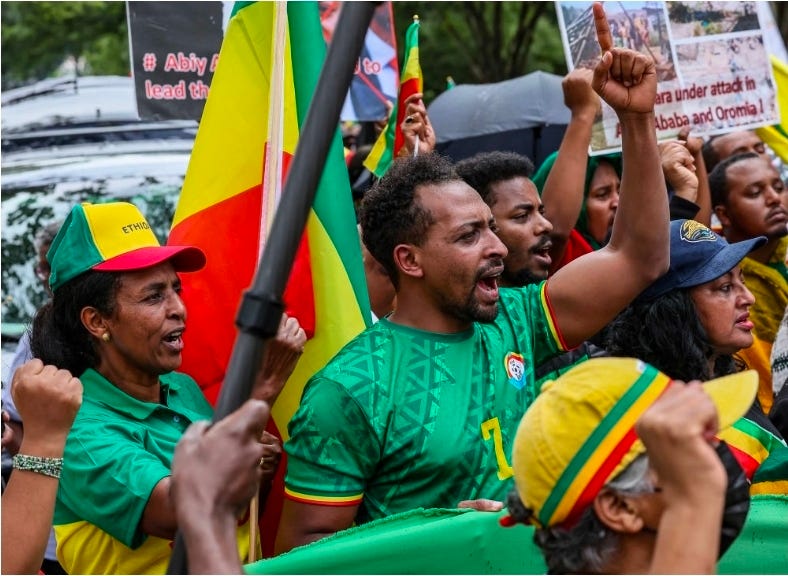
More than 5,000 Ethiopian immigrants are losing the federal protection that allowed them to work legally and remain in the United States without being deported. Their home country did not suddenly become safe, and their lives in the United States did not disappear. Trump’s Department of Homeland Security changed their legal status and opened another population to the deportation machinery.
U.S. District Judge Brian Murphy lifted the remaining court stay blocking DHS from carrying out its termination of Temporary Protected Status for Ethiopia on August 18. The ruling removed the final judicial barrier protecting Ethiopian TPS holders, but the court did not terminate their status. DHS made that decision in December 2025 under then-Homeland Security Secretary Kristi Noem.
That distinction matters. Describing the ruling as a judge “revoking” TPS hides the administration responsible for creating the danger. Murphy’s order allowed Trump’s policy to proceed after the Supreme Court sharply restricted judicial review of TPS terminations. It did not originate the policy.
TPS protected Ethiopian immigrants from deportation and authorized them to work legally in the United States. For anyone without another lawful status, its termination transforms an established life into an enforcement target. A job can be lost when employment authorization disappears. Contact with immigration authorities can lead to detention. Families can be forced to prepare for separation and removal.
The Biden administration first designated Ethiopia for TPS in December 2022 because armed conflict, widespread displacement, climate shocks, and disrupted access to food, water, and healthcare prevented Ethiopian nationals from returning safely. The designation was later extended through December 12, 2025, according to the Federal Register.
Trump’s DHS announced the termination on December 15, 2025, with an effective date of February 13, 2026. The administration claimed conditions in Ethiopia had improved enough to permit safe returns. That assertion remains contested by Ethiopian immigrants and African Communities Together, whose attorneys argue that armed instability and humanitarian danger continue.
The administration’s decision did more than end a temporary program. It withdrew a legal barrier between thousands of people and the immigration-enforcement system. Once TPS protection disappears, immigrants without another status can be arrested, detained, and deported by the same government that previously acknowledged they could not safely return.
African Communities Together and three Ethiopian TPS holders sued the administration in January. In April, Murphy postponed the termination after finding that the plaintiffs were likely to prove DHS disregarded required procedures and that the administration’s explanation appeared pretextual.
The legal landscape changed after the Supreme Court ruled on June 25 that federal law restricts judicial review of nonconstitutional challenges to TPS terminations. The First Circuit then reversed Murphy’s earlier order and returned the Ethiopian case to his court for reconsideration.
Murphy’s August 18 order dismissed the plaintiffs’ statutory, administrative, and procedural due-process claims under the Supreme Court’s controlling decision. He denied their renewed request to postpone the termination and lifted the administrative stay.
One major claim survived. Murphy allowed the plaintiffs’ equal-protection claim alleging racial and national-origin discrimination to move forward into discovery.
That surviving claim keeps the administration’s intent under examination. The plaintiffs argue that Trump’s government has concentrated its TPS terminations on immigrants from nonwhite and non-European countries while disregarding evidence that returning them remains dangerous. The court has not decided whether that allegation is proven, but it found that the claim could proceed.
Ethiopia is not an isolated case. Trump’s administration has moved to terminate TPS protections for immigrants from countries including South Sudan, Somalia, and Myanmar. Reuters reported that DHS has pursued terminations covering at least 13 countries.
Each termination expands the population that ICE can target. The mechanism begins with an administrative announcement, passes through courts whose power to intervene has been narrowed, and ends with immigrants losing work authorization and protection from removal.
DHS celebrated Murphy’s ruling. Department general counsel James Percival declared online that “all TPS terminations are in effect.” African Communities Together warned that the crisis in Ethiopia remains unresolved and that thousands of people are now exposed to severe danger.
The government calls the action a termination of temporary status. Ethiopian immigrants carry the actual consequences: jobs placed at risk, families destabilized, possible detention, and deportation to conditions the United States previously recognized as unsafe.
More than 5,000 Ethiopian immigrants did not suddenly become a threat to the United States. Trump’s administration removed the protection that kept the deportation system from reaching them.
More than 5,000 Ethiopian immigrants now face lost work authorization, family separation, detention, and deportation.
Paid subscriptions help Americans Against ICE provide emergency resources to Ethiopian immigrants and their families, document the harm, and strengthen the support infrastructure that helps keep people safe.
Upgrade to support Ethiopian immigrants and their families ↓
We are so fucking disgusting! So sad, we are a shithole