

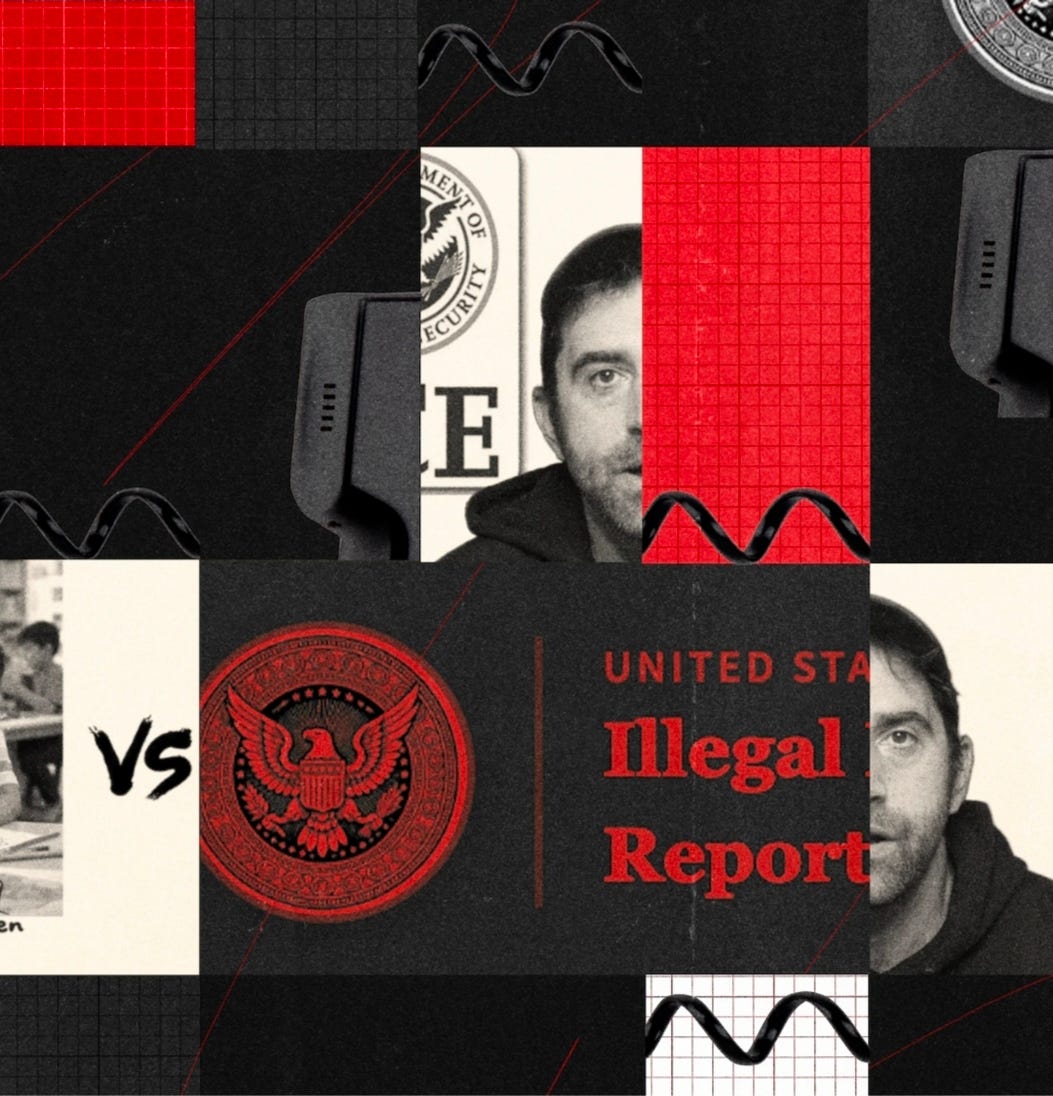
The Department of Homeland Security did not need a violent threat to put comedian Ben Palmer’s name into a law-enforcement alert. It only needed a parody website that embarrassed immigration enforcement. According to reporting from Injustice Watch and The Guardian, DHS issued a “Be on the Lookout” alert, known as a BOLO, after Palmer’s fake ICE tip site went viral and his videos of callers trying to report immigrants spread across TikTok and YouTube. The alert was not about a weapon, an attack, or a direct danger to public safety. It was about satire that made ICE culture visible.
Palmer, a Nashville-based comedian and prankster, created a parody anti-immigration tip website that looked enough like an official reporting channel for some members of the public to believe they were contacting the government. His videos exposed callers who thought they were reporting immigrants to U.S. Immigration and Customs Enforcement. That is what made the site powerful. It did not create the cruelty. It revealed the cruelty already sitting in public, waiting for a form to validate it.
DHS reportedly issued the BOLO through its Nashville field office in February. The alert was later shared by Illinois State Police to a distribution list of state and local law-enforcement agencies. Injustice Watch obtained the alert through a public-records request, which means this was not just some loose internal note sitting on one desk. Palmer’s name, image, parody site, and YouTube screenshots were moved through law-enforcement channels because his joke hit too close to the machinery.
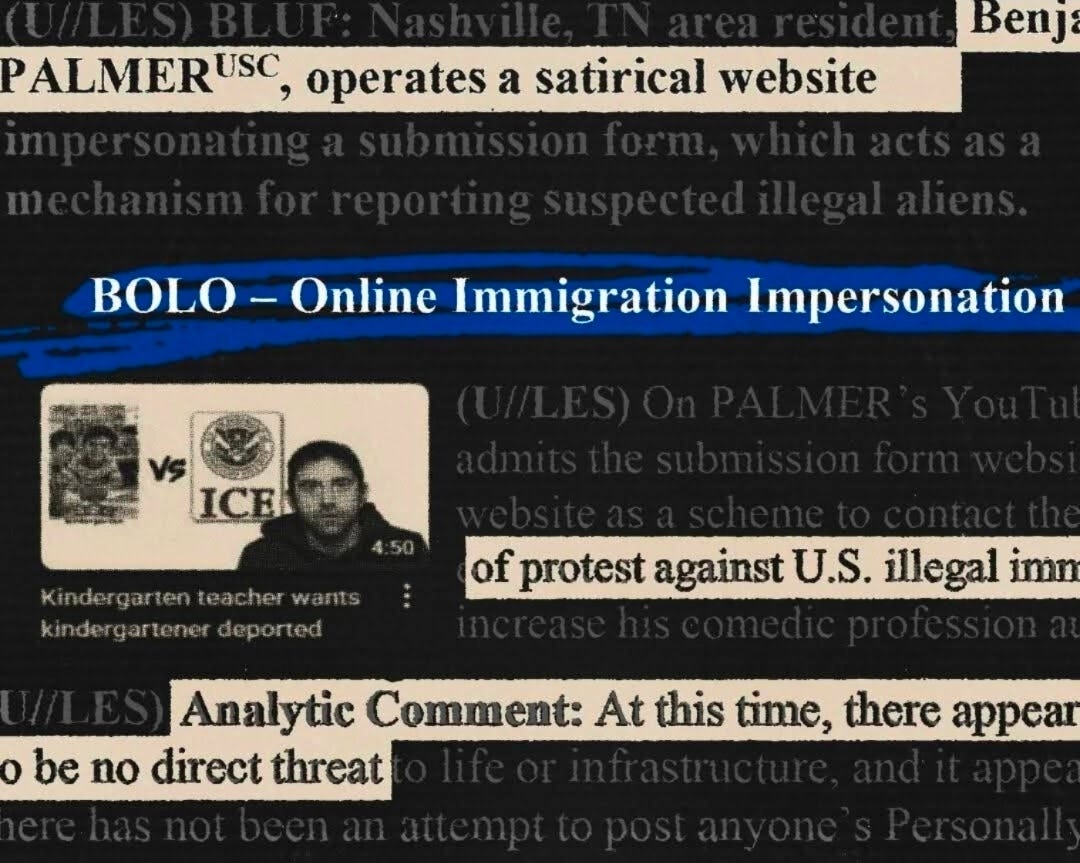
The headline on the alert reportedly described the issue as “online immigration impersonation.” It noted that Palmer, a U.S. citizen, operated a satirical website that imitated a submission form for reporting suspected undocumented immigrants. The alert included material from his spoof website and his YouTube channel, where he had hundreds of thousands of subscribers. The government saw the joke, documented the joke, packaged the joke, and circulated the joke as a law-enforcement awareness matter.
That is the part DHS cannot clean up with bureaucratic language. Near the bottom of the alert, DHS acknowledged there appeared to be “no direct threat to life or infrastructure.” That sentence matters because it strips away the excuse. DHS was not warning officers about a dangerous person. It was flagging a comedian whose parody made the public look at immigration enforcement without the official costume on.
DHS later told Injustice Watch that there was no investigation into Palmer and that the document was only an internal memo for awareness. That explanation does not erase the problem. Government “awareness” still carries power when a private citizen’s name moves through law-enforcement systems. A federal agency does not have to arrest someone for the message to land. The message is already there: mock ICE hard enough, expose the culture around it clearly enough, and the state may start watching.
Palmer’s work embarrassed ICE because it showed something the agency’s defenders would rather keep buried. People were willing to use what they believed was an official government channel to report immigrants, neighbors, workers, families, and strangers. The parody did not invent that impulse. It held up a mirror. Instead of facing what the mirror showed, DHS treated the mirror as the problem.
That is why this belongs on Americans Against ICE.
ICE abuse is not limited to raids, detention cells, deportation flights, medical neglect, or family separation. Those are the visible harms.
Around them is a culture of surveillance, suspicion, reporting, and public permission. Palmer’s parody walked directly into that culture and showed how easily people could be pulled into immigration enforcement as a social weapon. The response from DHS showed how fragile that system becomes when it is mocked.
A retired ICE field office director told Injustice Watch that BOLOs are usually associated with more serious public-safety threats and often carry warnings such as armed-and-dangerous language. That context makes the Palmer alert even more revealing. DHS knew there was no direct threat. Yet the alert still existed. Illinois State Police still shared it. Law-enforcement channels still carried it. The machinery still moved.
This is how state power pressures speech without always needing a courtroom. It does not have to announce censorship. It can call it awareness. It does not have to admit retaliation. It can call it safety. It does not have to say the comedian is dangerous. It can write “no direct threat” and circulate him anyway.
The danger was never Ben Palmer’s parody website. The danger was that the parody made immigration cruelty look ridiculous, and ridicule is dangerous to systems that depend on fear. ICE needs people to treat its violence as serious, necessary, official, and untouchable. Palmer’s site punctured that image. It showed the public how absurd and ugly the reporting culture can be when ordinary prejudice thinks it has found a government form.
That is why DHS putting Ben Palmer’s name in a BOLO matters. It shows how immigration enforcement reaches beyond immigrants and into the speech of people who criticize it, mock it, document it, and expose it. It shows how a federal agency can admit there is no direct threat while still placing a private citizen inside a law-enforcement alert. It shows how quickly satire can become suspicious when the target is ICE.
Palmer called the alert a kind of badge of honor, but no one should have to treat federal monitoring as part of the cost of comedy. A government that can survive war, scandal, corruption, and public outrage should be able to survive a parody website. If it cannot, that tells the public something important. The system is not just cruel. It is fragile.
And when a fragile system has badges, databases, alerts, and law-enforcement networks behind it, ridicule becomes more than a joke. It becomes a test. DHS failed that test. ICE got mocked, and the government moved like mockery was the threat.
The threat was not the comedian.
The threat was the truth his joke exposed.
RESIST | FIGHT WITH US
ICE abuse does not stop at detention doors. It reaches into families, communities, public speech, surveillance, intimidation, and the culture that tells people cruelty is civic duty.
Americans Against ICE keeps the record public.