

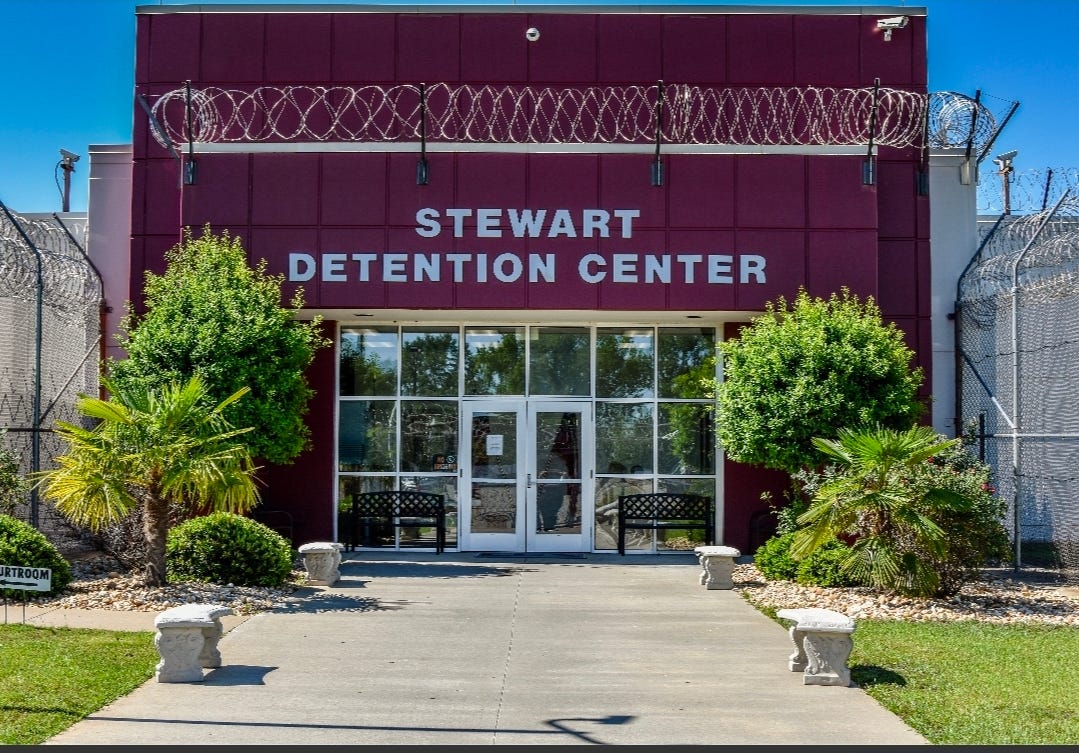
Denny Adán González was 33 years old when he died inside Stewart Detention Center, a privately run immigration detention facility in Lumpkin, Georgia. ICE says his death is being investigated as a suspected suicide, though the official cause remains under investigation.
His death is not an isolated incident. González is the 18th person to die in ICE custody in 2026 and the 30th person to die in ICE custody since October. He is also the fourth person reported to have died by suicide inside Stewart, a facility that has faced years of accusations involving medical misconduct, dangerous conditions, and the misuse of solitary confinement.
That is the record behind the government’s language. ICE and CoreCivic describe their facilities as safe, secure, humane, and respectful. But people keep dying inside them. The statements remain polished while the death count rises.
According to a congressional notification reviewed by the Guardian, González died Tuesday night inside Stewart. CoreCivic, the private prison company that operates the facility for ICE, said staff called a medical emergency after finding an unresponsive person inside his living area around 10:26 p.m. Emergency medical services arrived and attempted to save his life, but González was pronounced dead before he could be transported from the facility.
ICE later confirmed the death in a press release. The agency said the suspected cause was suicide, while noting that the official cause remains under investigation. The notification said González was pronounced dead at 11:11 p.m.
Those details matter because they are the official version. They also raise the same questions that follow so many deaths in custody: What happened before staff found him? Was he placed in solitary confinement? Was there an altercation with a guard? Did anyone identify signs of crisis? Was he receiving adequate care? Were detention staff trained and prepared to intervene? What records exist, and will the public ever see them?
Investigative reporter and attorney Andrew Free reported that González had been sent to solitary confinement following an altercation with a guard, citing sources close to the Stewart facility. Neither ICE nor CoreCivic responded to questions about that report or about whether solitary confinement was used in this case.
That silence sits inside a much larger history. Stewart has repeatedly faced accusations from attorneys, lawmakers, and federal government investigators involving medical neglect and inappropriate use of solitary confinement. The facility can detain nearly 2,000 people. It is one of the largest immigration detention centers in the country, and it has long been criticized as one of the most dangerous.
González is the fourth person reported to have died by suicide inside Stewart. In 2017, a young Panamanian immigrant died inside a solitary confinement cell. In 2018, a Mexican man also died by suicide inside a solitary unit. Last summer, another 45-year-old man from Mexico died by suicide at Stewart. Now González’s death has been added to that record.
A facility with repeated deaths by suicide does not get to present each new death as though it happened in a vacuum. A pattern this severe demands public accountability. It demands scrutiny of staffing, medical care, mental health treatment, isolation practices, emergency response, contractor oversight, ICE supervision, and the basic question of why people continue to be held in a place with this history.
Stewart is not just a building. It is part of the private immigration detention system that allows ICE to detain people through contracts with companies like CoreCivic. That structure matters because detention becomes a business arrangement. The government supplies the detainees. Private companies operate the facilities. Public money flows through the contract. Human beings disappear behind walls.
When someone dies inside that system, responsibility cannot be scattered until no one is accountable. ICE cannot point to the contractor and walk away. CoreCivic cannot hide behind government authority while collecting payment to run the facility. Congress cannot treat death notifications as paperwork. The public cannot be asked to accept another statement about “safe, secure, and humane environments” while families are left with a body and unanswered questions.
CoreCivic has said it is committed to providing safe, humane, and respectful care to everyone entrusted to it. ICE has said it is committed to ensuring that people in custody reside in safe, secure, and humane environments. But those words now sit beside 18 deaths in ICE custody in 2026, 30 deaths since October, and four reported suicides at Stewart.
At some point, the official language stops clarifying the record and starts obscuring it.
The Trump administration has dramatically expanded immigration detention as arrest operations surge across the country. More people are being detained, more facilities are being filled, and more private contractors are positioned to profit from the expansion. With that growth has come more reports of horrific conditions, mistreatment, neglect, and death.
The human cost is not incidental. It is built into a detention system that treats people as bodies to be held, transferred, processed, and removed. When the system expands faster than oversight, care, staffing, and accountability, people become more vulnerable inside it. When the facilities are private, the public also has to confront the profit motive sitting behind confinement.
Stewart has been central to those concerns for years. Advocates have repeatedly called for the facility to be shut down. After González’s death, Azadeh Shahshahani, legal and advocacy director of Project South, renewed that demand, calling Stewart a “deadly prison” and urging Congress to take decisive action.
That demand is not rhetorical. It is grounded in the facility’s record. If a detention center has repeated suicides, a long history of complaints, allegations involving medical misconduct, and questions about solitary confinement, then the issue is not merely whether one death was handled properly. The issue is whether the facility itself should continue to operate.
The government often responds to detention deaths by promising investigations. But investigations without consequences become part of the machinery. A person dies, the agency issues a statement, the contractor expresses condolences, the official cause is reviewed, and the system keeps moving. Another person is detained. Another bed is filled. Another contract remains active.
That is how death becomes normalized.
González’s death must not be treated as one more entry in a custody-death report. He was a person. He was 33 years old. He died inside a facility controlled by a private prison company on behalf of the federal government. His death came inside a system already producing record numbers of deaths under ICE custody.
The question is not only what happened to him. The question is why the federal government continues to rely on facilities where these outcomes keep happening.
ICE detention is often described through bureaucratic language: custody, processing, housing, facility operations, compliance, transport, medical emergency, notification. Those words flatten what is actually taking place. People are locked inside detention centers. They are separated from families, lawyers, communities, and familiar support systems. They may face isolation, fear, medical neglect, language barriers, and uncertainty over whether they will be deported.
Inside that environment, mental health crises are not unexpected. They are foreseeable. That is why solitary confinement is so dangerous. That is why medical care matters. That is why oversight matters. That is why private detention facilities with repeated deaths should not be allowed to continue operating under the same public reassurances.
The government cannot keep calling these spaces safe while people continue to die inside them.
González’s death also exposes the cruelty of detention expansion under Trump’s anti-immigration agenda. The administration is not merely enforcing immigration law in some neutral administrative sense. It is building a larger detention and deportation apparatus, filling facilities, increasing arrests, and relying on private contractors to keep the machinery running.
That machinery produces consequences. It produces fear. It produces isolation. It produces deaths that officials later describe in careful language.
But careful language does not change the record.
Denny Adán González died inside Stewart Detention Center. ICE says the suspected cause is suicide. Stewart has already seen multiple reported suicides. The facility has long faced accusations involving medical misconduct and solitary confinement. CoreCivic continues to operate it for ICE. Immigration detention has ballooned under the Trump administration. The death count in ICE custody keeps rising.
That is the story.
It is not enough for ICE to confirm a death. It is not enough for CoreCivic to describe a medical emergency. It is not enough for officials to say the matter remains under investigation. The public needs answers, records, oversight, and consequences. Congress should be demanding every document tied to this death, every record related to solitary confinement, every medical and mental health contact, every incident report, every camera record, and every communication between ICE and CoreCivic.
And if Stewart cannot keep people alive, it should not keep operating.
A detention center where people repeatedly die by suicide should not be treated as a normal part of immigration enforcement. A private prison company should not keep collecting public money while families receive death notifications. ICE should not be allowed to expand detention while hiding behind statements about humane care that collapse against the facts.
González’s death belongs in the public record because detention systems rely on disappearance. People are taken out of public view. They are held far from support. Their suffering becomes paperwork. Their deaths become press releases. Their names risk being swallowed by the machinery that confined them.
That cannot happen here.
Denny Adán González was 33 years old. He died in ICE custody at Stewart Detention Center. His death is part of a pattern the government cannot be allowed to explain away.
The question now is not whether Stewart has a problem.
The question is why it is still open.
Americans Against ICE exists to document what the government and its contractors try to bury behind detention walls, legal language, and press releases.
When people die in ICE custody, their names cannot be allowed to disappear into statistics. When private detention companies keep getting paid while deaths mount, the record has to stay public. This work follows the facilities, the contractors, the custody deaths, the families, and the official language used to keep the machinery running.
Upgrade to a paid subscription to support independent documentation, investigation, and accountability journalism focused on ICE, detention, deportation infrastructure, and the people harmed by it.