

Mamuka Artmeladze had no criminal record.
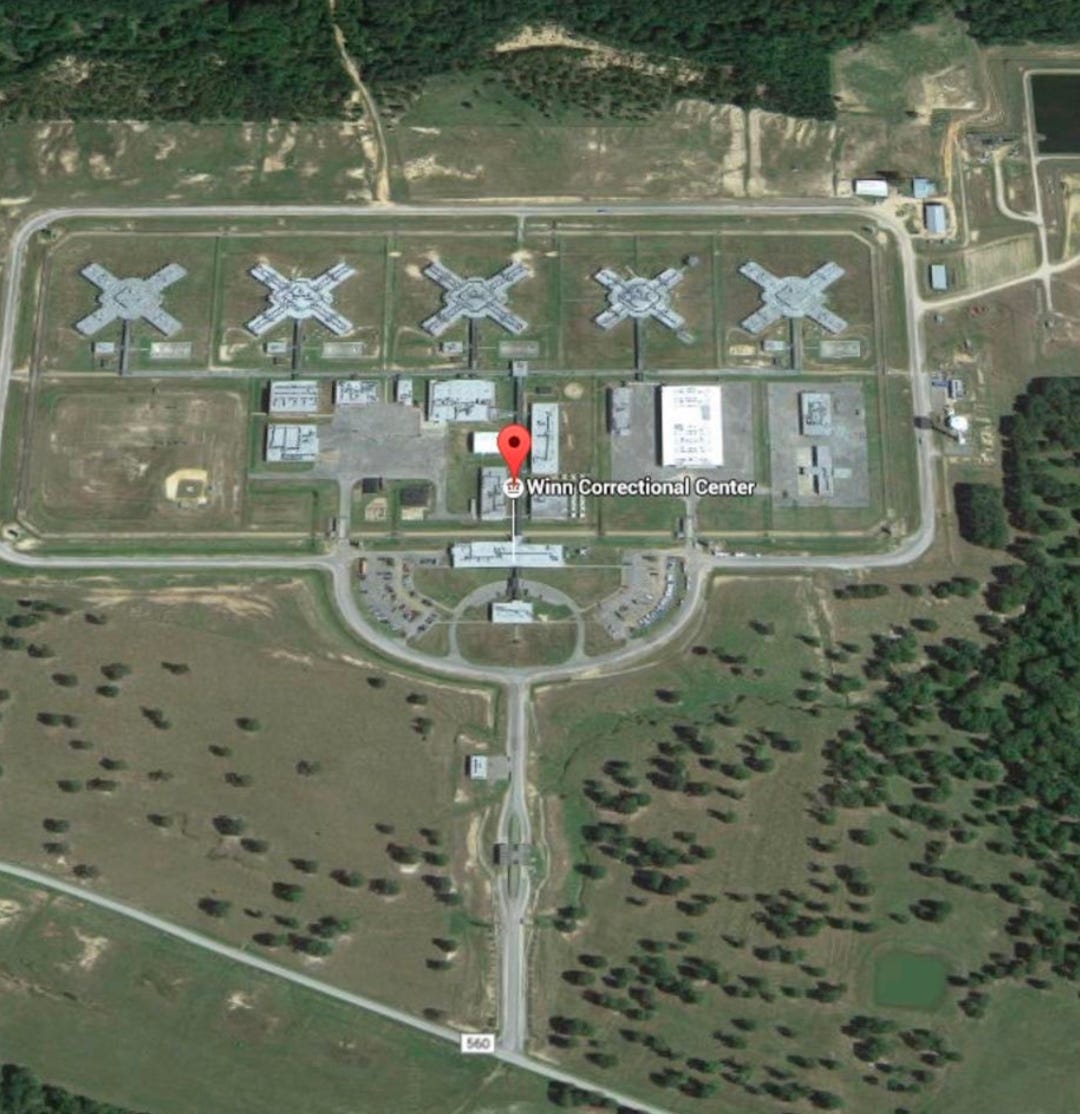
He was 43 years old, a Georgian national, and had been held for nearly four months inside Winn Correctional Center in Winnfield, Louisiana, when staff found him unresponsive on June 4, 2026. ICE said facility staff attempted resuscitation before Artmeladze was taken by ambulance to a local hospital, where he was pronounced dead less than an hour later.
The cause of death remains pending an autopsy.
That is the basic death notice. The public record around it is much larger.
Two days before Artmeladze died, the Department of Homeland Security’s Office of Inspector General released a report on Winn Correctional Center. Federal inspectors had found that the facility did not fully comply with reviewed detention standards involving environmental health and safety, food service, use of force, medical care, classification, voluntary work programs, legal access and materials, staff-detainee communication, and outdoor recreation.
The government’s own watchdog had already documented serious failures at the facility. Then a man with no criminal record was dead inside it.
Artmeladze was not serving a criminal sentence. According to ICE, Border Patrol encountered him in September 2022 and allowed him to remain in the United States under ICE supervision. In February 2026, ICE arrested him in Alabama after determining that he no longer had lawful status. He was then held at Winn, a facility managed by the Winn Parish Sheriff’s Office and private contractor LaSalle Corrections.
He remained there for nearly four months.
On June 4, staff found him unresponsive. ICE’s announcement said lifesaving measures were attempted and that he was transported to Winn Parish Medical Center. He was pronounced dead after arriving at the hospital. ICE said it notified the appropriate officials and that the agency’s Office of Professional Responsibility would review the death, as required under detention-death procedures.
Those procedures now sit beside another fact: Artmeladze died at a facility federal inspectors had already flagged.
The OIG report was based on an unannounced inspection conducted from March 4 to March 6, 2025. At the time of the inspection, ICE housed 1,576 male detainees at Winn, the facility’s contractual maximum. Inspectors reviewed conditions across multiple parts of the detention operation and found problems that reached far beyond paperwork.
The use-of-force findings were especially serious. Inspectors reviewed five use-of-force incidents and found that staff used prohibited techniques or failed to follow required standards in three of them. In one incident, an officer applied a chokehold to a detainee, even though the report states that the technique is specifically prohibited under ICE detention standards. In another incident, an officer stabbed a detainee’s thumb with a pen after the detainee refused to remove his hand from a door. A third case involved staff placing mechanical restraints on a detainee without the required medical review being documented on camera.
These are not minor administrative gaps.
They are failures involving force, restraint, documentation, and the treatment of people held in federal immigration custody.
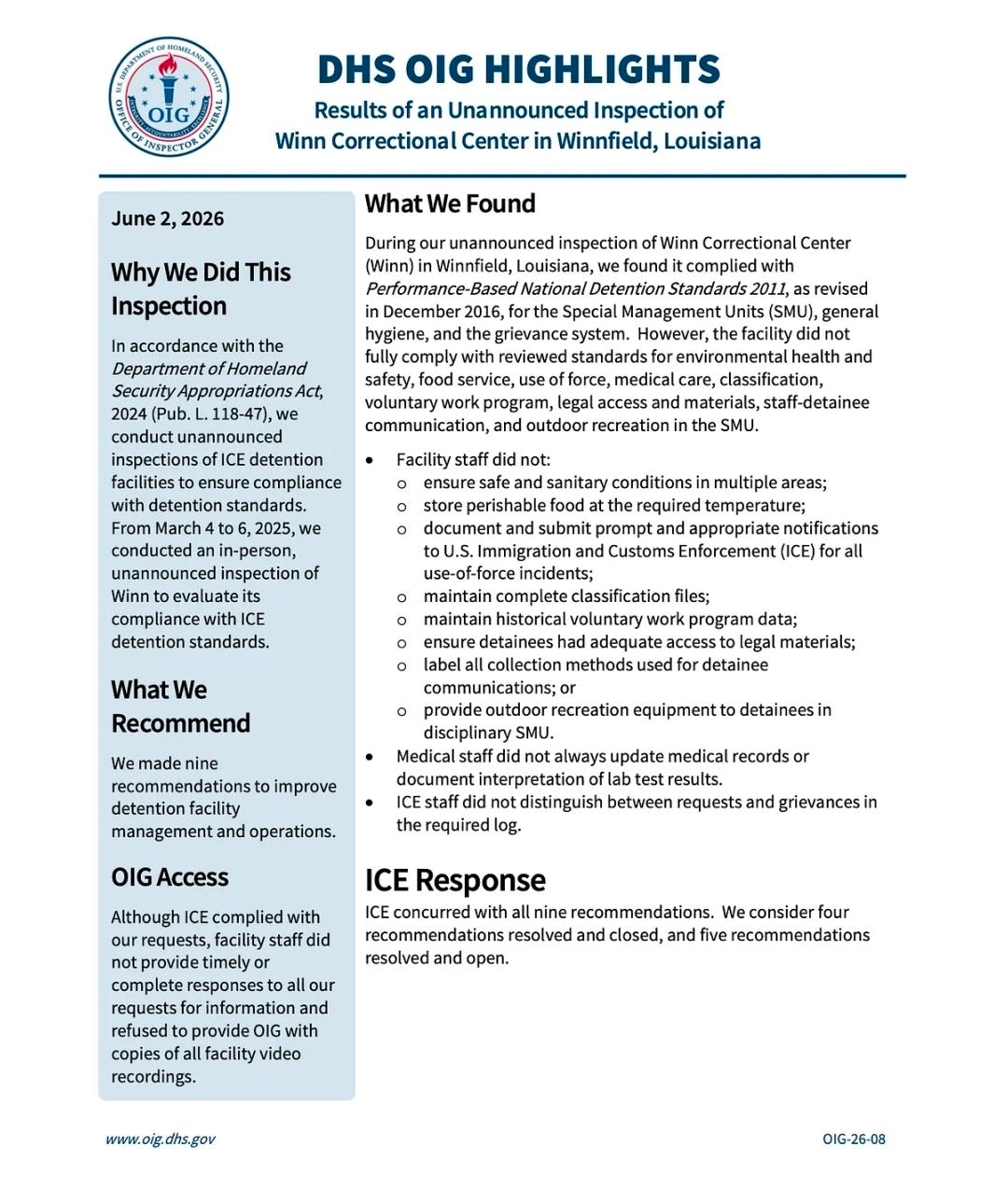
The physical conditions described by inspectors also mattered. The report cited water leaking through kitchen vents, holes and exposed insulation in the ceiling of the intake building, and food stored in freezers above required temperatures. Medical staff also failed to keep updated treatment documents and laboratory testing records, a failure the report warned could negatively affect detainee health care and safety.
That medical-record finding carries particular weight after a death in custody.
When a person dies inside detention, the public is forced to ask what the facility knew, what medical staff documented, what care was provided, what warning signs were missed, and whether the records are complete enough to answer those questions. A detention system with deficient medical documentation makes accountability harder at the precise moment accountability is most necessary.
Winn had already seen another death this year.
On April 11, 2026, Alejandro Cabrera Clemente, a 49-year-old Mexican national, was found unresponsive during a routine security check at the same facility. Staff attempted resuscitation, and he was transported to Winn Parish Medical Center, where he later died. Less than two months later, Artmeladze was taken to the same hospital and pronounced dead.
That makes Artmeladze’s death more than an isolated incident at Winn. It is the second reported death at the facility in less than two months, at a jail already flagged by federal inspectors for use-of-force violations, medical record problems, food safety issues, sanitation failures, and other deficiencies.
Winn is part of the private detention infrastructure that sits beneath ICE’s public-facing custody system. The facility is managed by the Winn Parish Sheriff’s Office and LaSalle Corrections, a Louisiana-based private prison company, under contract with ICE. That structure matters because accountability is spread across government agencies, local detention authorities, and private operators while the person in custody remains trapped inside the system.
ICE holds the detainees. Local and private detention operators run the facility. Federal inspectors document failures. Public officials approve contracts and funding. Families are left with death notifications.
Each death becomes part of the record of a detention system that continues to operate while its failures are documented.
Representative Pramila Jayapal, Ranking Member of the House Subcommittee on Immigration Integrity, Security and Enforcement, responded to the OIG report by saying it reflected what detained immigrants across the country had already described: detention centers violating required standards and putting people’s health and safety at serious risk. She called for DHS to withdraw funding from facilities that consistently fail to meet minimum standards and renewed support for legislation to end private, for-profit immigration detention.
That response belongs in the record because Winn is not simply a building with bad conditions. It is part of a detention network funded through federal immigration policy and sustained by contracts with private operators.
A DHS spokesperson said the inspector general report demonstrated the facility’s compliance with detention standards, even though the report documented prohibited force, medical record failures, and other deficiencies. ICE did not immediately provide further public explanation of Artmeladze’s death beyond its initial announcement.
The contradiction sits in the record.
Federal inspectors documented prohibited force, medical documentation failures, food safety concerns, environmental problems, and other deficiencies. DHS still defended the facility’s compliance. Two days after the report was released, Artmeladze was dead.
The death also comes amid a broader rise in deaths in ICE custody. Austin Kocher’s tracking has identified Artmeladze as the 19th person to die in ICE custody in 2026. Other reporting has framed the toll differently, identifying him as the 50th ICE detention death since Trump returned to office in January 2025. Those figures measure different timeframes, but both point to the same public concern: people are dying in immigration custody at a pace that demands scrutiny.
Artmeladze’s case should not disappear into a count.
He was a man with no criminal record. He had been allowed to remain in the United States under ICE supervision after a 2022 Border Patrol encounter. He was later arrested after ICE determined he no longer had lawful status. He spent nearly four months at Winn Correctional Center. He was found unresponsive. He was taken to a hospital. He died.
Those facts matter because immigration detention often turns civil status into a carceral reality. A person can have no criminal record and still be locked inside a correctional center. A person can be held under immigration authority and still be subjected to force, medical failures, unsafe conditions, and the same institutional neglect that defines the broader detention system.
The language of immigration custody can make that harm sound procedural. “No longer had lawful status.” “Held under ICE supervision.” “Transported to a local hospital.” “Cause of death pending autopsy.”
But inside the facility, those phrases become confinement, surveillance, medical dependence, isolation, and risk. For Artmeladze, they ended in death.
The OIG report did not cause his death. The autopsy remains pending, and the full medical facts have not yet been released. But the timing matters because the report documented the conditions of the system holding him. It showed a facility with known failures. It showed a detention center operating at contractual capacity. It showed prohibited force incidents, medical documentation problems, food and environmental concerns, and breakdowns across core detention standards.
That is the accountability question now.
What happens when federal inspectors document serious failures at an ICE jail, DHS defends the facility, the contractor remains in place, and another person dies?
For Americans Against ICE, that question belongs in the public record.
Mamuka Artmeladze was not a criminal defendant or a man serving a prison sentence. He had no criminal record, and he died after months in immigration detention at a facility federal inspectors had already warned about.
The federal government’s own watchdog had documented failures at Winn Correctional Center.
Two days later, Mamuka Artmeladze was dead inside that same detention system.
This article is part of Americans Against ICE’s public record on ICE custody deaths, private detention contractors, and the facilities where people die while held by the federal government.
Mamuka Artmeladze had no criminal record. He died inside a detention system federal inspectors had already flagged for force violations, medical record failures, sanitation problems, and unsafe conditions.
Americans Against ICE documents the deaths, contracts, inspections, lawsuits, and official failures that immigration agencies and private detention operators leave behind.
Upgrade to a paid subscription to support the work that keeps these records public.