

Bodycam Footage Challenges ICE Narrative in Killing of 23-Year-Old U.S. Citizen Ruben Ray Martinez
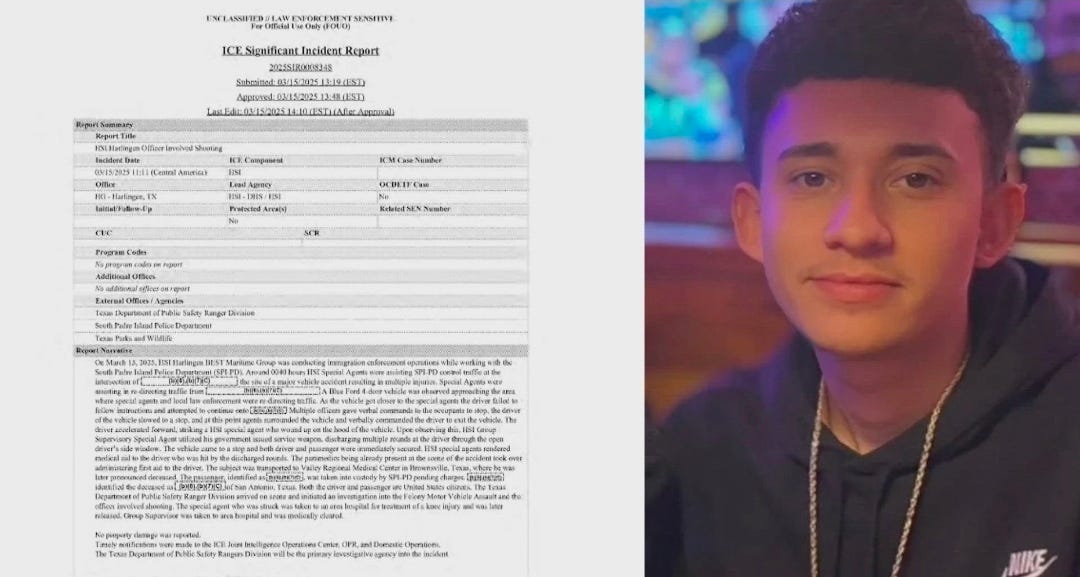
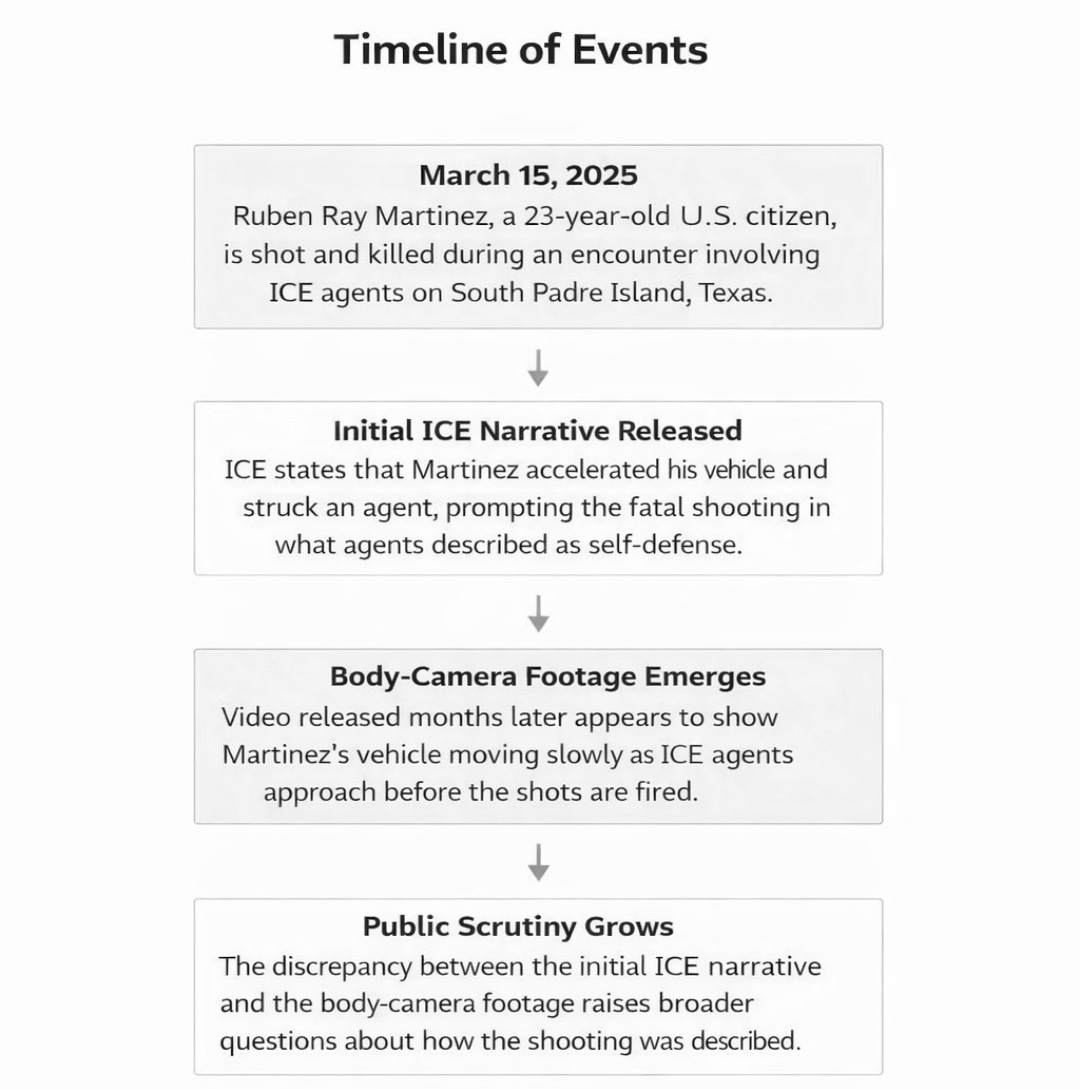
On March 15, 2025, Ruben Ray Martinez, a 23-year-old U.S. citizen, was shot and killed on South Padre Island, Texas. Martinez had traveled to the coast with friends to celebrate his birthday weekend when an encounter involving local police and Immigration and Customs Enforcement agents escalated into a fatal shooting.
According to reports released after the incident, officers surrounded Martinez’s vehicle during what ICE later described as an enforcement situation connected to a traffic stop. Within moments of the confrontation intensifying, an ICE agent fired multiple rounds through the driver’s side window of Martinez’s car. Martinez was transported to a hospital but later died from his injuries.
In the immediate aftermath of the shooting, information about what had happened was limited. Early accounts described an officer-involved shooting but did not immediately clarify that a federal immigration agent had fired the fatal shots. The role of ICE only became widely known months later after investigative reporting and records requests revealed that federal immigration agents had been involved in the encounter.
Once that involvement became public, ICE released its explanation of the shooting. The agency said Martinez accelerated his vehicle and struck an ICE agent, forcing another agent to fire in self-defense. The description of a vehicle being used as a weapon quickly became the central justification for the shooting, establishing the official narrative that agents had responded to an immediate threat. For months that explanation shaped how the case was publicly understood.
The Evidence That Reopened the Case
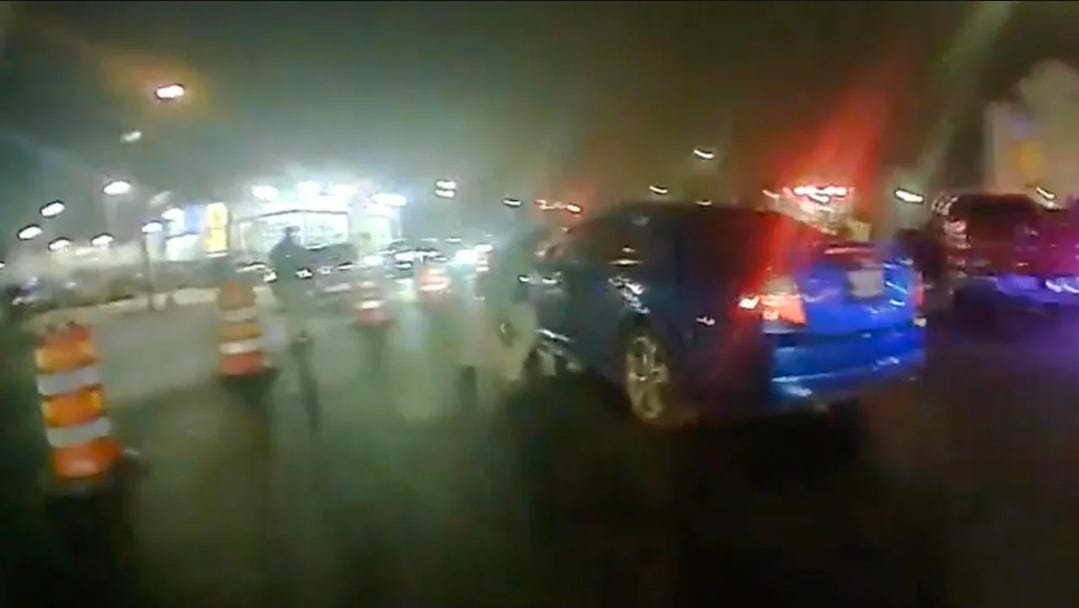
🎥 When body-camera footage from the scene was eventually released, it provided the first independent visual record of the moments leading up to the shooting. The video immediately drew attention because what it appears to show differs from the version of events initially described by ICE.
Rather than depicting a vehicle accelerating toward officers, the footage appears to show Martinez’s car moving slowly while agents approach from several directions. At several points in the recording, brake lights illuminate as the vehicle creeps forward while agents surround it and shout commands.
Seconds later gunfire erupts as an ICE agent fires multiple rounds through the driver’s side window of the vehicle. The footage does not clearly show the moment ICE officials claimed Martinez struck an agent with his car, an absence that has become one of the most disputed aspects of the case. If the vehicle was moving slowly rather than accelerating toward officers, the central claim that agents faced an immediate lethal threat becomes far more difficult to evaluate. That uncertainty is why the video has become a focal point of renewed scrutiny surrounding the shooting.
Joshua Orta, who was a passenger in the vehicle that night, later told investigators the car had been “crawling,” not accelerating toward officers. He described a chaotic scene in which agents surrounded the vehicle and issued commands simultaneously, creating confusion about how Martinez was expected to respond.
Autopsy results later showed Martinez had alcohol and marijuana in his system. Investigators said intoxication may have contributed to the confusion during the encounter. However, the presence of intoxicants does not resolve the central question raised by the video: whether Martinez’s actions posed the immediate danger described in ICE’s original narrative.
The Pattern Raising Broader Questions About ICE
The death of Ruben Ray Martinez has drawn national attention not only because of the body-camera footage but because the sequence of events surrounding the shooting resembles patterns that have surfaced in other controversial encounters involving ICE agents. In several incidents over the past decade, fatal confrontations involving vehicles have been followed by official explanations describing agents responding to an immediate threat.
Civil-rights attorneys and investigative journalists have repeatedly examined these cases after video footage, witness testimony, or public-records disclosures raised questions about how the events were initially described. When additional evidence emerges, the early narrative can sometimes prove incomplete or inconsistent with the available footage.
The Martinez case now joins that broader scrutiny because the body-camera video appears to complicate the explanation ICE first provided.
The case has also raised broader questions because Martinez was a U.S. citizen killed during an encounter involving federal immigration agents. Immigration enforcement operations frequently involve coordination between ICE and local law enforcement agencies, which can create volatile situations when multiple authorities converge during a rapidly unfolding incident.
Another factor fueling concern is the delay in publicly acknowledging ICE’s role in the shooting. The agency did not initially disclose its involvement, and details about the federal agents present only became widely known months later through investigative reporting.
For Martinez’s family, that delay has compounded the trauma surrounding the case. His mother has repeatedly called for the release of all body-camera recordings and investigative files connected to the shooting, reflecting a broader demand for transparency whenever ICE agents use deadly force.
Why the First Narrative Matters
In incidents involving deadly force, the first explanation released by authorities often becomes the foundation of the public narrative. Early reports influence how the media covers the event and how the public understands what occurred before independent evidence becomes available. Once that narrative takes hold, revising it can take months or even years.
The Martinez case illustrates how powerful those early explanations can be. The claim that Martinez struck an ICE agent with his vehicle framed the shooting as a defensive act and shaped how the incident was initially interpreted.
But the body-camera footage now circulating publicly suggests the situation may have been more complicated than the first account indicated.
Video evidence has become one of the most important tools for evaluating shootings involving armed government agents. Unlike written reports, which rely heavily on the perspective of the officers involved, video provides a visual record that investigators and the public can analyze independently. When footage aligns with official accounts, it reinforces confidence in those reports. When it diverges from them, it raises difficult questions about how the original narrative was constructed.
For months the official narrative defined how the public understood the death of Ruben Ray Martinez. Now that body-camera footage has entered the public record, attention has shifted from what ICE initially said happened to what the evidence itself appears to show. For Martinez’s family, the video represents a renewed search for answers about the final moments of his life, while for the broader public the case raises deeper questions about transparency and accountability when ICE agents use deadly force.
Independent reporting on immigration enforcement rarely receives sustained institutional funding. Work like this continues because readers choose to support it.
If you want to help sustain ongoing accountability reporting into immigration enforcement and deaths in custody, consider becoming a paid subscriber.
Honestly, isn’t it time for drastic measures? We do have the 2nd amendment if we had the balls to take up arms against a tyrannical government.
Impeachment would take too long with endless, useless, time consuming congressional hearings. We see how effective those are. Additionally Congress failed to remove this impeached president twice already. Is that a good investment of our work and time?
Congress checked out 14 months ago. Purposely ineffective. We can’t count on them to remove a paper clip! Or a 30+ convicted violent felon. Who ever heard of a guy with 30 violent felonies not getting sentenced? No jail time? No orange jumpsuit and handcuffs in a court room?
I know I’m preaching to the choir. I’m sure we agree that the trumpf regime is on a murder spree and a spending binge. They removed every guardrail we had. No District Attorney Prosecutor to bring criminal charges. No judges to order sentences and no law enforcement to carry it out.
I haven’t studied the 25th amendment of what it takes to find a president mentally incompetent. In real life this would be a cake walk with the rap sheet these DC insiders are compiling.
There is no question that donald j trumpf is a danger to himself and others. How many walks on the roof of buildings does security have to take? How many threats and attempts to kill and imprison? How many orders have there been to shoot, and even hang anyone who disagrees with the regime?
I’m sure it’s a full time job for several people, security guards and psychiatrists to handle trumpfs misplaced rage. I’m sure he cannot be left alone for fear he will hurt himself and others. He’s doing that anyway.
So… How do we do a rise against an out of control government? Does the 2nd amendment seem drastic yet? Or is it appropriate? We need a defensive militia.
We need real strategists. The Navy Seals and 101st Army Airborne. The guys who went and got Madero and his wife would be helpful. Where are they?
Drastic times call formdrastic measures.
Anyone got a better idea? I’d love to hear it.