

Expansion is no longer theoretical.
It is physical.
The Department of Homeland Security (DHS) is acquiring large-scale industrial warehouse properties across the country and converting them into immigration detention facilities.
These are not purpose-built civic structures.
They are logistics buildings.
Former Big Lots.
Former Pep Boys.
Regional distribution hubs.
Industrial fulfillment centers.
Now reclassified as human holding facilities.
Capacity Is the Story
One facility in Social Circle, Georgia — approximately 45 miles from Atlanta — is reported to hold up to 8,500 detainees.
For comparison:
Camp East Montana in Fort Bliss, Texas — currently the nation’s largest existing detention site — holds fewer people than that single proposed Georgia site.
This is not incremental growth.
It is capacity multiplication.
Warehouses are designed for:
• Throughput
• Centralization
• Volume efficiency
• Rapid intake and transfer
Those are logistics principles.
Not humanitarian ones.
📊 Detention Capacity Growth (2018–2025)
U.S. Immigration Detention Capacity Increase (2018–2025)
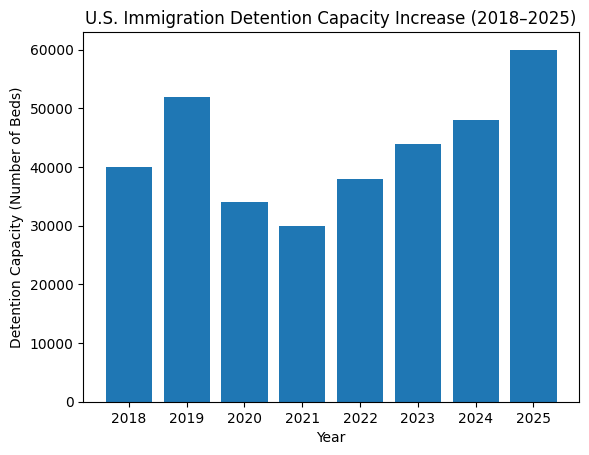
Bars illustrating steady annual growth followed by accelerated expansion aligned with warehouse acquisition timeline.
The Infrastructure Shift
Traditional detention centers were geographically dispersed and built within existing correctional frameworks.
Warehouse conversions represent a structural shift:
• Industrial-scale square footage
• Lower conversion cost
• Faster operational timeline
• Urban-edge logistics positioning
• High-capacity intake design
This is not just policy.
It is physical buildout.
It is fixed capital.
And fixed capital signals long-term intent.
The Geographic Spread
This is not a regional anomaly.
It is national in scope.
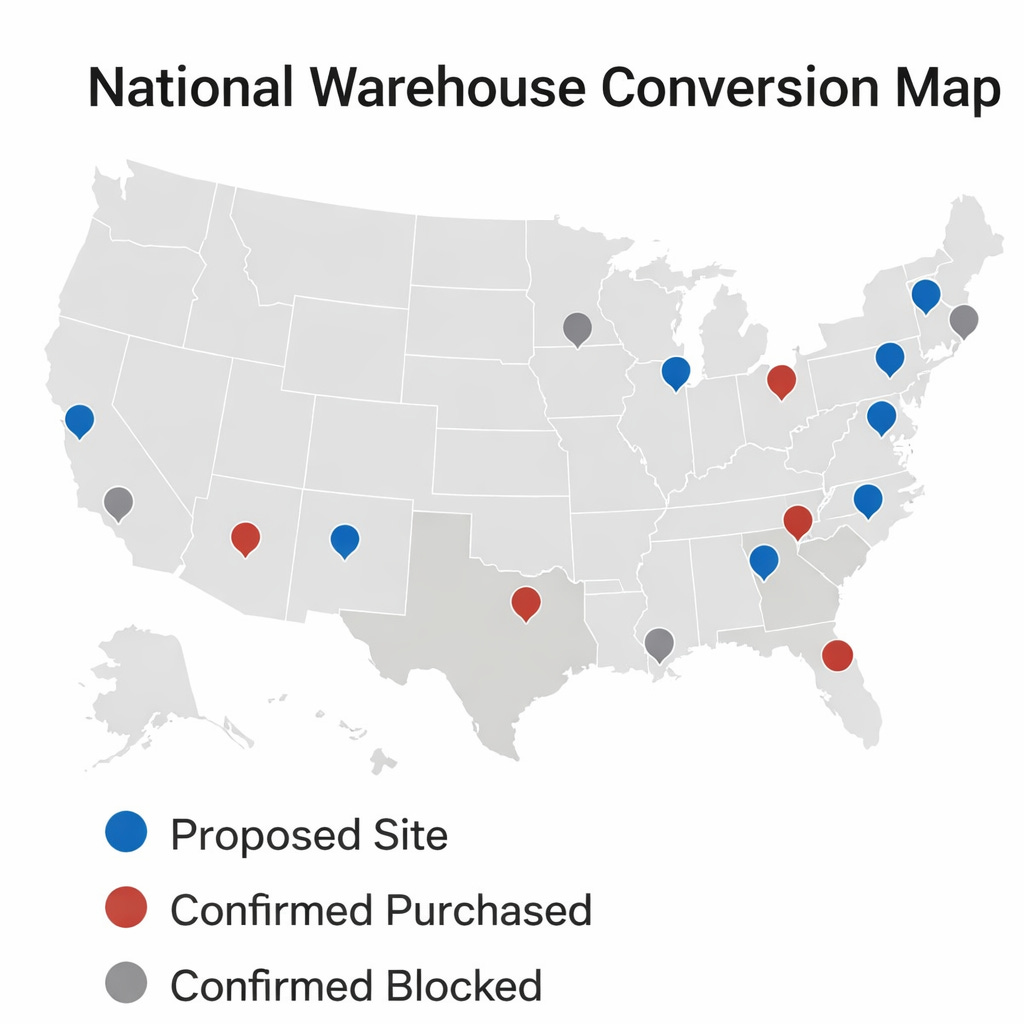
More than twenty large-scale warehouse acquisitions — proposed, confirmed, or completed — are distributed across multiple states.
From Arizona to Georgia. From Texas to New York. From California to the Midwest.
This is coordinated infrastructure expansion across jurisdictions.
Not a single pilot program. Not an isolated conversion. Not an emergency overflow solution.
A distributed buildout.
🗺 National Warehouse Conversion Map
Industrial Properties, Not Civic Facilities
Many of these sites were previously:
• Retail big-box stores
• Commercial logistics hubs
• Industrial distribution warehouses
• E-commerce fulfillment centers
They were designed for goods.
Not for people.
Industrial square footage allows:
• Massive bed counts
• Rapid internal reconfiguration
• Scalable intake processing
• High-volume transfer capacity
When detention shifts into industrial logistics space, capacity is no longer constrained by traditional facility limits.
It becomes modular.
State-Level Snapshot: Arizona
Address: 13290 W Sweetwater Ave, Surprise, AZ
Square Footage: 418,000
Estimated Capacity: 1,500
Status: Purchased for $70 million
Previously owned by RG Surprise, LLC — tied to the New York-based Rockefeller Group.


State-Level Snapshot: Georgia
Social Circle, GA
Estimated Capacity: Up to 8,500 detainees
Operational target timeline: Reported within months
This single facility would more than double the population of the nation’s largest current detention site.


Infrastructure Pattern
Across states, the pattern repeats:
• Industrial zoning
• High square footage
• Logistics accessibility (interstates, rail, freight corridors)
• Rapid acquisition timeline
• High projected capacity
This is not reactive detention expansion.
It is infrastructure-first expansion.
Capacity built in advance.
Fixed assets positioned for long-term use.
The question is no longer whether detention is expanding.
The question is how permanent this infrastructure is intended to be.
The Financing Layer
Infrastructure at this scale requires capital.
Large-scale warehouse acquisitions are not short-term lease experiments.
They involve purchase agreements, zoning adjustments, municipal coordination, and long-term operational contracts.
That means:
• Upfront acquisition cost
• Conversion cost
• Security retrofitting
• Staffing expansion
• Ongoing federal contract allocation
This is not temporary overflow spending.
It is capital deployment.
Capital Signals Intent
When the federal government purchases industrial real estate outright — rather than leasing short-term emergency space — it changes the risk profile.
Ownership signals:
• Long-term utilization expectation
• Multi-year operational planning
• Budget normalization within agency forecasts
• Institutional permanence
Fixed assets are rarely acquired for short-term policy shifts.
They are acquired for durability.
Conversion Economics
Warehouse conversions offer specific financial advantages:
• Lower per-square-foot cost compared to purpose-built detention facilities
• Faster operational timeline
• Reduced construction overhead
• Existing logistics infrastructure
Industrial buildings are engineered for:
• Large occupancy loads
• Segmented internal configuration
• High-volume movement
• Security retrofitting compatibility
From a procurement standpoint, the model is efficient.
From a civic standpoint, it raises structural questions.
The Municipal Position
Local governments often describe these acquisitions as:
• Commercial property transactions
• Zoning-compliant industrial use
• Federal agency discretion
The framing is procedural.
But the function is transformative.
When warehouse infrastructure is repurposed into detention infrastructure, the land use may remain industrial — but the civic impact does not.
Communities are not being asked whether detention should expand.
They are being informed that the square footage has already been secured.
The Pattern Across States
Across multiple states, the pattern remains consistent:
• Industrial-edge properties
• High square footage
• Rapid acquisition timeline
• Elevated projected capacity
This is not an isolated procurement anomaly.
It is distributed infrastructure scaling.
When capacity is built in advance, it reshapes policy possibilities.
When fixed capital is positioned nationwide, it shifts the baseline.
The question is no longer whether detention can expand.
The question becomes how expansion is normalized once infrastructure exists.
The Policy Implication
Infrastructure does not simply respond to policy.
It shapes it.
When detention capacity is expanded through fixed industrial assets, the baseline changes.
Available space alters enforcement ceilings.
Operational limits expand before legislative debate occurs.
Capacity as Leverage
Detention capacity functions as policy leverage.
When capacity is constrained, enforcement is naturally limited.
When capacity scales, enforcement potential scales with it.
Industrial warehouse conversions introduce:
• Large intake ceilings
• Modular internal expansion capability
• Multi-site geographic distribution
• Redundant capacity across regions
This reduces bottlenecks.
It increases throughput potential.
It stabilizes long-term operational continuity.
Normalization Through Buildout
Once infrastructure exists, it becomes administratively routine.
Budgets adapt.
Staffing expands.
Contracts renew.
The presence of fixed assets shifts discussions from:
“Should this expand?”
to
“How should this be managed?”
Structural Momentum
Fixed capital generates institutional momentum.
Properties purchased outright carry:
• Depreciation schedules
• Maintenance allocations
• Federal staffing commitments
• Contractual vendor relationships
These are not emergency tools.
They are long-horizon investments.
The Strategic Question
If warehouse-scale detention capacity becomes embedded nationwide:
• What becomes the default enforcement level?
• How does distributed capacity alter federal discretion?
• What oversight mechanisms exist for industrial-scale facilities?
• How permanent is infrastructure once normalized?
The structural question is not whether detention is expanding.
It is whether expansion is being built into the physical landscape in advance of public recalibration.
The Civic Reckoning
Infrastructure does not appear neutral once operational.
Once activated, it produces outcomes.
When detention capacity is embedded across multiple states, three shifts occur simultaneously:
• Enforcement flexibility increases
• Geographic reach expands
• Political reversal becomes more complex
Capacity built in advance reduces friction.
It lowers the threshold for use.
The Feedback Loop
When facilities exist:
• Staffing scales to meet space
• Budgets normalize around capacity
• Contracts renew automatically
• Vendor ecosystems solidify
What begins as expansion becomes baseline.
What becomes baseline becomes expected.
The Institutional Lock-In Effect
Fixed industrial assets introduce structural inertia.
• Multi-year budget planning
• Long-term staffing commitments
• Vendor and contractor dependence
• Depreciation schedules spanning decades
These are not temporary frameworks.
They are continuity frameworks.
Reversal becomes administratively difficult.
Pause becomes operational disruption.
Reduction becomes political cost.
Public Visibility vs. Physical Reality
Warehouse conversions often occur outside traditional civic corridors.
Industrial zones.
Edge-of-city logistics parks.
Commercial districts repurposed quietly.
The land use classification remains industrial.
But the function shifts entirely.
Communities may not see daily activity.
Yet the capacity remains embedded.
The Structural Question
If detention capacity is now scalable, distributed, and capitalized:
• What limits remain?
• What oversight adapts?
• What metrics define necessity?
When physical capacity exceeds immediate demand, the system adjusts to fill it.
Infrastructure does not wait for policy.
Policy adjusts to infrastructure.
The Closing Frame
This is not about one facility.
It is not about one state.
It is about a national shift from reactive detention to infrastructure-driven detention.
When square footage is secured in advance, expansion becomes easier than contraction.
And once capacity is normalized, the debate no longer begins at zero.
It begins inside the structure that has already been built.
The Counterweight
Infrastructure scales quietly.
Oversight must scale deliberately.
If detention capacity is being industrialized, then scrutiny must be institutionalized.
If square footage is being secured in advance, then monitoring must exist in parallel.
Industrial infrastructure is funded by capital.
Oversight must be funded too.
The Role of Americans Against ICE
Americans Against ICE exists to track:
• Acquisition patterns
• Contract disclosures
• Capacity expansion timelines
• Vendor ecosystems
• Budget allocations
• Federal-local coordination
• Policy shifts tied to physical infrastructure
This is not protest coverage.
It is infrastructure monitoring.
Structural documentation.
What has been physically built becomes administratively normalized.
And what becomes normalized becomes default.
If capacity is embedded across multiple states, accountability cannot remain episodic.
It must be continuous.
Subscribe to Sustain Oversight
Paid subscription funds:
• Continuous investigative tracking
• Public records analysis
• Multi-state monitoring
• Long-horizon documentation
If infrastructure expansion is permanent, oversight must be permanent.
Subscribe to support ongoing detention infrastructure monitoring.
What’s true here is that infrastructure shapes policy long before policy admits it.
When you start storing human beings in buildings designed for merchandise, something in the soul of a nation is being itemized.
Infrastructure may be efficient, but you’d better ask what kind of future you are engineering when cages become part of the skyline.
Thank you for the detail. The map of proposed ICE concentration camps is useful. None in LA. Wow!