

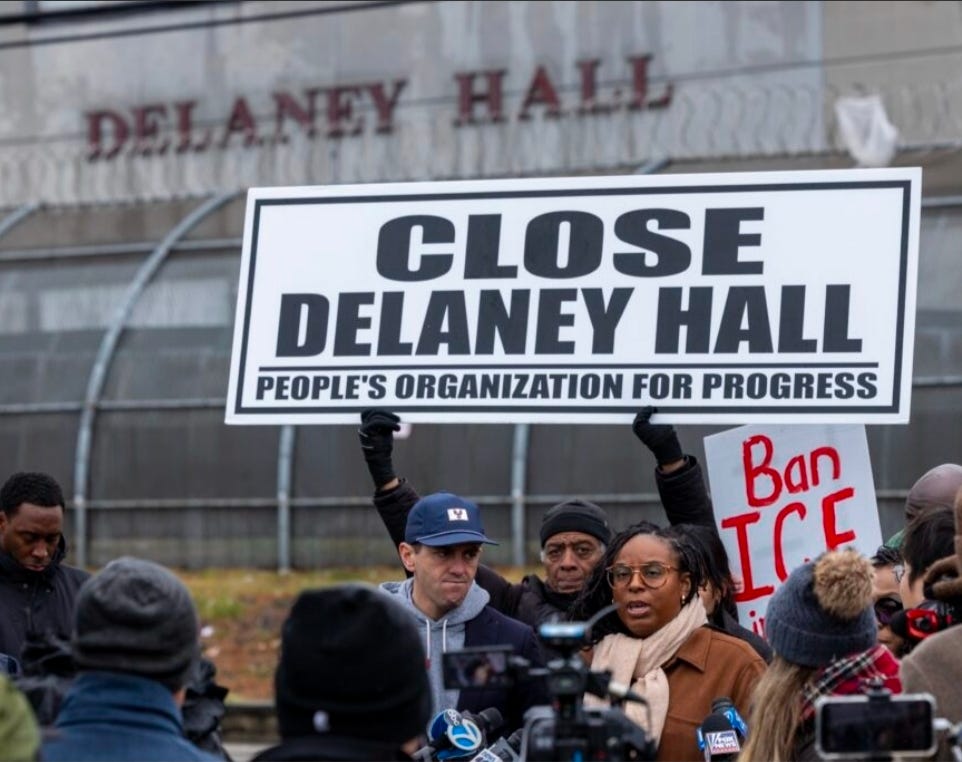
Delaney Hall is not only holding people in ICE custody. According to detained workers, organizers, and reporting on the facility, the people locked inside are also part of the labor system that keeps the Newark detention center running.
For nearly two weeks, detained people at Delaney Hall have been on strike. What began as a simultaneous hunger and labor strike has become largely a labor struggle, according to organizers with Cosecha New Jersey. The workers are the detainees themselves: custodians, kitchen workers, laundry workers, barbershop workers, janitors, and people assigned to the daily labor that allows the facility to function.
In a May 31 letter titled “We Demand Freedom,” detained people wrote that they had voluntarily stopped working and assisting with facility operations. The letter, signed by 46 detained people and published June 3, said the strike was near-unanimous and ongoing.
Their demands include a chance to speak with New Jersey Gov. Mikie Sherrill, reviews of their cases, and ultimately, freedom.
The strike is exposing a central contradiction inside ICE detention: GEO Group, the private prison contractor that operates Delaney Hall, describes its work program as voluntary, but the facility’s own rules reportedly treat labor refusal and organizing as punishable conduct.
A recent GEO Group detainee handbook reviewed by Mother Jones describes a “voluntary work program” inside the facility. But the same handbook reportedly lists “encouraging others to participate in a work stoppage or to refuse to work” as a “high offense” that can be punished by disciplinary transfer, isolation, or criminal proceedings.
That is the heart of the story.
Work is called voluntary, but collective refusal can be treated as a serious violation.
The wages are also central. According to the handbook, kitchen workers are paid $4 per day, the highest rate listed. Laundry workers and barbershop workers are paid $3 per day. Special work details are paid $2 per day. All other job assignments are paid $1 per day.
The handbook says workers are ordinarily not permitted to work more than eight hours per day or 40 hours per week.
Those numbers become even more stark when compared with commissary costs. The same document reportedly lists a pair of shoes at $24.28, a blanket at $8, and replacement ID cards at $5. At $1 per day, a replacement ID card can cost a full week’s pay. A pair of shoes can represent several weeks of labor.
That is why the strike matters beyond one facility.
The labor system inside Delaney Hall is not just a side detail. It is part of how the detention center operates. Detained people say they are being asked to clean, cook, maintain, wash, cut hair, and help run the facility while being paid amounts that would be illegal for workers outside detention.
Organizers say the strike has already revealed how dependent the facility is on detained labor.
“They don’t have cleaning staff, they don’t have kitchen staff,” Cat Adorno, an organizer with Cosecha, said. “Those jobs, the detainees are the ones that do that.”
Adorno said organizers are hearing that the facility has become dirty and that conditions have deteriorated since detained workers stopped performing facility labor. She also said guards have become more aggressive and have threatened transfers or additional charges if detainees do not resume work.
The detained strikers made similar claims in their June 3 letter. They wrote that they had been subjected to reprisals, discrimination, mockery, mistreatment, and threats since the strike began.
“They are trying to force us to work in all areas of the facility,” the detained workers wrote, naming cleaning, kitchen, maintenance, laundry, and floor polishing. They said GEO Group staffers threatened to deport them, transfer them to punishment units, and move them from one detention center to another if they refused to work.
“They tell us we have no rights here,” the letter said.
That sentence is not just a complaint. It is a warning about the power imbalance inside immigration detention.
People detained by ICE are already confined, separated from families, facing deportation proceedings, and dependent on the facility for food, medical care, communication, and basic needs. When those same people are also assigned to work that keeps the facility running, refusal carries risks that ordinary labor actions outside detention do not carry.
A strike in detention is not the same as a strike outside detention.
The workers cannot simply go home. They cannot walk off the job and leave the facility. They remain under custody, under surveillance, and subject to disciplinary rules controlled by the same system they are protesting.
That is why labor inside detention has become a long-running legal and moral battleground.
The federal minimum wage does not generally apply to people detained by ICE under several court rulings, and the dollar-a-day wage structure has roots going back decades. But legal challenges over detained labor and unjust pay continue across the country, with more than a dozen lawsuits moving through courts over involuntary work and extremely low wages inside detention systems.
Immigration lawyer and journalist Andrew Free, who researches ICE detention conditions, said the profit margins of facilities like Delaney Hall depend on using people inside to do the labor needed to maintain the facility.
“The way you keep the place clean is you use the people who are inside to clean it,” Free said.
That is the hidden structure the strike has brought into view.
Delaney Hall is often discussed as an ICE facility, a protest site, or a private detention contract. This strike adds another layer: detained people say the facility depends on their labor while limiting their ability to organize, refuse work, or protest conditions without retaliation.
The facility’s operator, GEO Group, did not answer questions about the strike or about whether Delaney Hall could sustain cleaning and kitchen operations without detained workers. In a statement, a GEO Group spokesperson said support services are monitored by ICE, including by on-site agency personnel, to ensure compliance with ICE detention standards and contract requirements.
That is GEO Group’s frame: the work program and support services operate under ICE oversight and detention standards.
The detained workers and organizers are describing something different. They are describing a facility where people in custody say they are pressured to work, paid extremely low wages, threatened when they refuse, and punished for collective action.
Those two accounts now sit side by side in the public record.
The strike also connects to the larger fight outside Delaney Hall. Since the facility reopened as a major ICE detention site, protests have continued outside its gates. Detainees and advocates have raised concerns about conditions inside, while demonstrators outside have faced arrests, force, and escalating confrontations with law enforcement and security.
But the labor strike changes the lens.
It shows that the conflict is not only outside the walls. It is also happening inside the daily operations of the facility, where detained people are refusing to continue the work that helps keep Delaney Hall functioning.
The public often sees detention through fences, buses, court dates, raids, and deportation flights. Less visible is the labor inside: the cleaning, cooking, laundry, maintenance, and other work that makes confinement possible.
This strike forces that labor into view.
It asks a basic question: if a detention facility depends on people in custody working for as little as $1 per day, and punishes them for encouraging others to stop working, what is the public really looking at?
A voluntary program?
Or a detention system built on captive labor?
That question matters because private detention is not only about beds and contracts. It is also about cost. The less a company pays for labor, the cheaper it becomes to operate the facility. When detained people do the work, the detention system can reduce labor costs while maintaining the daily functions required to keep the building open.
The workers at Delaney Hall appear to understand that.
By refusing to work, they are not only making demands about their own cases and their own freedom. They are exposing the labor structure beneath the facility itself.
They are showing that the people held inside are not passive subjects of detention. They are also the workers whose labor helps sustain the institution.
That is why this belongs in the public record.
Delaney Hall is not only a jail where people are detained by ICE. It is a facility where detained workers say they are paid as little as $1 per day to help keep the place running, then threatened when they collectively refuse.
The strike reveals what the detention system often hides: confinement is not only enforced by walls, guards, and contracts. It is also maintained through labor extracted from the people trapped inside.
This report is part of the public record on ICE detention, detained labor, private prison contractors, retaliation claims, and the systems that keep facilities like Delaney Hall running.
Americans Against ICE documents the conditions inside immigration detention and the labor, contracts, and corporate structures that make those facilities possible.
Upgrade to a paid subscription to support the investigations that keep these records public.
The government refers to these places as “detention centers”… yet the groups that run them refer to them as “private prisons”. The law says that convicted criminals belong in prison… yet 97% of the people in these places have no criminal record, and none of the people currently detained have been before a Judge— which means that none of them have been “convicted”. As per our Constitution, they have the right of Due Process. None have actually been arrested, as they have not been read their Miranda Rights. So, they’ve committed no crime. Most of these people have Visas, active asylum cases, and even Green Cards. So they are here legally. Being fed expired, moldy food with maggots would be illegal in any U.S. prison. Being forced into slave labor is also illegal. These concentration camps need to be shut down!!!