

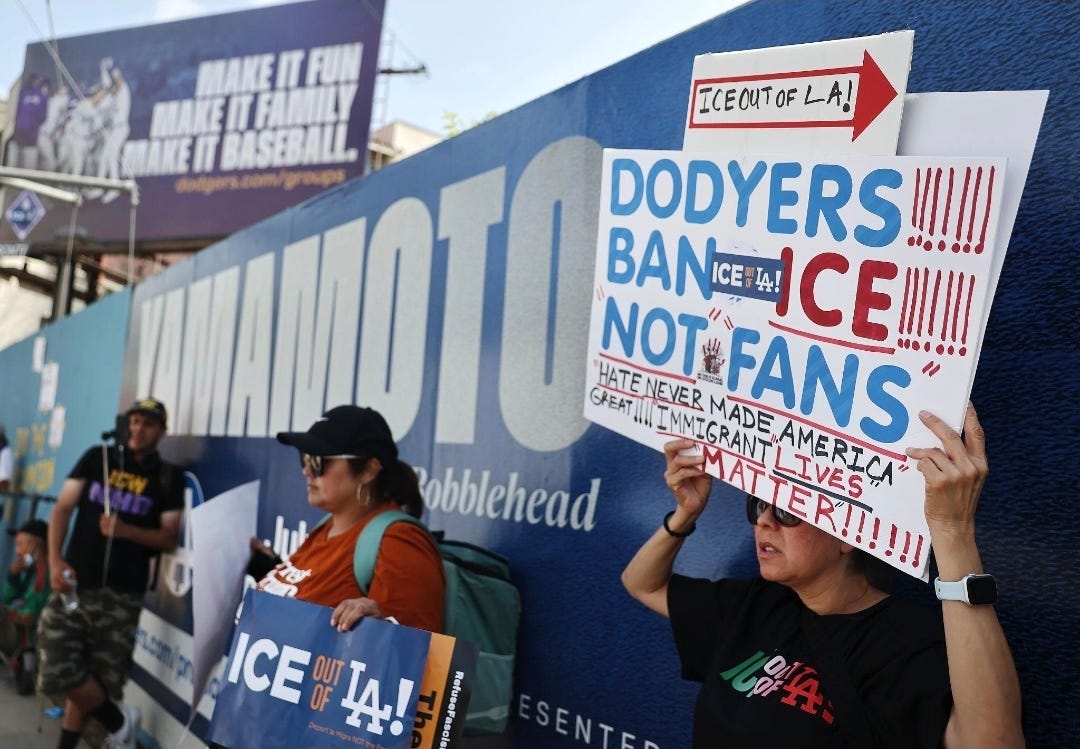
Immigrant families in Los Angeles needed emergency help because federal raids had already damaged their homes, work, safety, and stability.
That is where this story begins: with families forced to absorb the immediate consequences of immigration enforcement while community leaders pressed one of the city’s most powerful cultural institutions to respond.
After pressure from religious, labor, and community leaders, the Dodgers committed $1 million toward direct financial assistance for immigrant families impacted by the raids. The total later reached $1.1 million through the California Community Foundation and Labor Community Services.
That aid mattered. The California Community Foundation used the Dodgers’ donation to help distribute $1,000 in direct relief to 1,000 households, while Labor Community Services used a separate $100,000 donation to provide food assistance to more than 4,000 families.
For families facing raids, fear, lost income, and sudden instability, direct cash and food support are not symbolic. They are survival support.
But survival support is not the same as accountability.
The Dodgers acted because immigrant communities and their allies demanded action from one of Los Angeles’ most powerful cultural institutions. The team is not just a sports franchise in the region. It is part of the civic identity of a city built by immigrant families, Latino communities, workers, and neighborhoods that have supported the Dodgers for generations.
That is why the team’s response mattered. It also explains why advocates continued pressing after the donation.
The deeper question is what powerful institutions owe immigrant communities when the harm is not only immediate, but structural. Raids create urgent need, but the system behind those raids includes detention centers, deportation contractors, surveillance technology, and corporate profit.
According to reporting reviewed by The Times, Guggenheim Partners, the investment firm led by Dodgers owner Mark Walter, previously held more than one million shares of GEO Group, the private prison corporation tied to ICE detention and deportation operations. By the end of March, Guggenheim no longer owned shares in GEO Group, according to SEC filings reviewed by The Times.
The reason for that divestment has not been established. The record can show the divestment without turning it into absolution.
GEO Group remains central because immigrant families are not only harmed at the moment of arrest. They are harmed by the detention network that follows. CHIRLA’s federal lawsuit over the Adelanto ICE Processing Center alleged dangerous conditions, illness, mold, insufficient food, unsafe drinking water, inadequate medical care, and failures to accommodate disabled detainees at a GEO-operated facility.
Those allegations connect the Los Angeles raids to a broader detention system where public enforcement can become private revenue.
The Palantir question adds another layer. Walter also faced criticism over TWG Global’s partnership with Palantir, whose technology has been condemned by civil liberties advocates for its role in ICE’s deportation infrastructure. When families are being raided, detained, tracked, and deported, the companies building the tools and facilities behind that system belong in the public accountability record.
The Dodgers’ donation helped families absorb immediate harm. That should be stated clearly. But no powerful institution should be allowed to turn relief into an endpoint while immigrant communities are still asking who profits from detention, who builds deportation tools, who stays silent during raids, and who has enough influence to do more.
Immigrant families deserved the aid, and they also deserve answers about the detention, surveillance, and deportation systems that keep profiting after raids end.
Immigration raids do not end when the headlines move on.
They leave families rebuilding after lost wages, detention fears, food insecurity, legal costs, and the trauma of watching federal power enter daily life. Emergency aid can help people survive the first wave of harm, but documentation keeps the deeper system from disappearing behind charity, sports branding, and corporate silence.
Americans Against ICE documents the raids, the detention network, the private prison money, and the public institutions that sit close to deportation power.
Support the work ↓