

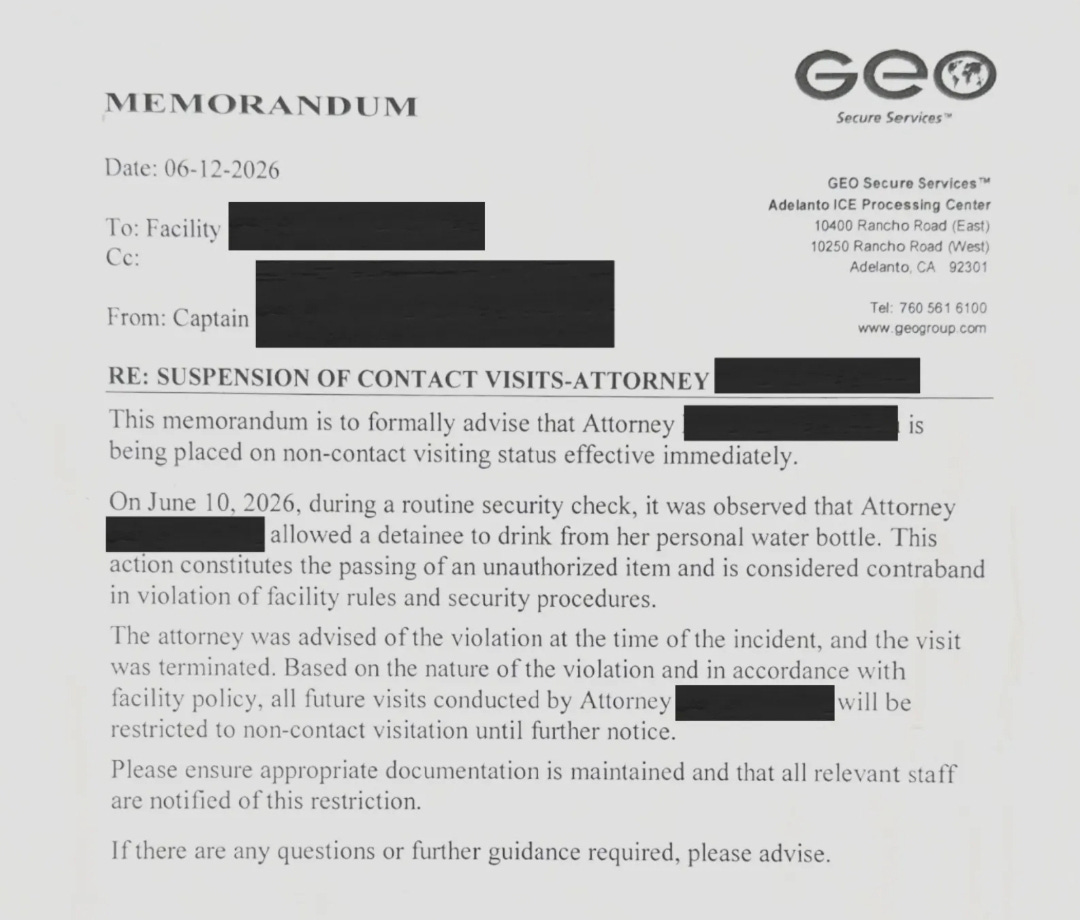
A detained person inside Adelanto ICE Processing Center was given water by an attorney. GEO’s response, according to its own memo, was to restrict the attorney’s contact visits.
The June 12 memorandum from GEO Secure Services says the attorney was placed on non-contact visiting status after allowing a detained person to drink from her personal water bottle during a visit at the Adelanto ICE Processing Center. The memo describes the water as an unauthorized item, calls the act contraband, says the visit was terminated, and states that the attorney’s future visits would be restricted to non-contact visitation until further notice.
That memo is the verified trigger. GEO treated a drink of water as a rule violation and restricted attorney contact afterward.
Eyes On ICE, which circulated the memo, alleged the detained person had gone roughly thirty hours without water and described the restriction as retaliation against legal counsel. Americans Against ICE has not independently verified the thirty-hour claim. But the memo itself confirms that GEO restricted the attorney after she allowed a detained person to drink from her water bottle.
That distinction matters because the public record is already larger than one document. Adelanto has been under scrutiny over allegations involving retaliation, inadequate access to food and water, medical care, and legal communication. Members of Congress have demanded an investigation into reports of retaliation against detainees at Adelanto, while legal advocates have challenged conditions inside the facility through federal litigation.
The question is not whether GEO can write a facility rule around a water bottle. The question is why a detained person needed water badly enough that an attorney gave it, and why the facility’s response was to restrict the attorney’s contact visits.
For people held in immigration detention, access to legal counsel is one of the few protections available inside a system built to isolate. Restricting an attorney’s contact visits does not only affect the lawyer. It can affect detained people trying to speak privately, prepare legal claims, document conditions, and challenge government confinement.
That is why advocates are calling this retaliation. They are not only pointing to one terminated visit. They are pointing to a pattern in which basic human needs, legal access, and complaints about conditions become points of punishment and control.
Adelanto is operated by GEO Group, a private prison corporation paid to run immigration detention under federal contract. When a private detention operator treats water as contraband and limits attorney contact after an act of basic care, the issue is not administrative language. It is power.
Immigration detention is civil confinement. It is not supposed to be punishment. But the record around Adelanto continues to show allegations of deprivation, retaliation, medical neglect, and barriers to legal access.
The memo may be about one attorney and one detained person. The warning is much broader.
Inside private ICE detention, even a drink of water can become a reason to punish the people trying to help.
Conditions inside immigration detention often stay hidden until someone risks exposing them.
Americans Against ICE documents detention abuse, legal-access restrictions, custody deaths, family separation, and the private prison systems that profit from immigration enforcement.
Support the work ↓