

Men detained at the North Lake Processing Center in Baldwin, Michigan, began a hunger strike this week, saying they are being denied adequate food and medical care while judges keep blocking their release.
According to No Detention Centers in Michigan, a majority of men inside the facility have refused food in protest of what they describe as dangerous conditions and cruel procedural delays that keep people trapped inside. In a translated statement, one detained immigrant called for competent doctors, better medical care, edible food, and an end to arbitrary detention. The statement said many people inside meet the requirements for release, yet remain jailed while bond is denied and basic rights are delayed or withheld.
That protest is not emerging in a vacuum. It is unfolding inside the largest ICE facility in the Midwest, at a moment when immigrant detention has expanded sharply under the Trump administration and private prison profits have surged alongside it. GEO Group, the private prison company that owns North Lake and contracts with ICE, reportedly saw a 695 percent increase in profit in 2025, earning $254.4 million in profit compared with $32 million in 2024. At the same time, detainees, advocates, and families have described a facility where people are denied medical care, forced to endure degrading treatment, and left in legal limbo.
That is the structure at the center of this story: detention expanding, corporate revenue rising, and the people inside saying they are being treated as disposable.
The hunger strike is one of the clearest signs yet that people inside North Lake believe the official channels available to them are either failing or being used to wear them down. In the translated statement circulated by advocates, one detained immigrant said, “We are being held prisoner arbitrarily.” The statement described a population of detainees who are not only deprived of proper care, but also blocked from release by a system that keeps extending confinement while pretending due process is functioning.
North Lake has already been under scrutiny. Lawmakers have called for an investigation into reports of medical negligence at the facility after 56-year-old Nenko Ganchev died in ICE custody. Ganchev, a Bulgarian national, had been arrested by ICE at an immigration appointment in Chicago before being transferred to Baldwin. Months later, he was dead. His family has accused the facility of denying him life-saving medical treatment.
That death now sits alongside new reports from detained immigrants who say the conditions remain dangerous enough to justify a collective refusal of food.
Former detainee Fernando Ramirez, who was held at North Lake for five months, said his medication was withheld. He also said detainees who could not speak English were often ignored or not taken seriously. That allegation matters because it points to something larger than understaffing or bureaucratic delay. It suggests a system in which vulnerability itself becomes a target — where language barriers, immigration status, isolation, and confinement combine to make abuse easier to commit and harder to challenge.
The nonprofit monitoring the facility says hundreds of people held there have been found to be unlawfully detained. If that is true, then the hunger strike is not only a protest over conditions. It is also a protest against confinement itself — against being kept inside a private detention center while the legal justification for continued detention breaks down or disappears.
Status Coup has also published portions of a court petition and handwritten testimony from one woman whose account widens the scope of what North Lake represents. According to that reporting, the petition was obtained with names redacted to protect detainee identities. The highlighted excerpts describe physical abuse, starvation, blocked legal access, humiliation, fear, and a transfer into North Lake after nearly three weeks at a local ICE field office.
Her words should not be treated as background texture. They are evidence of what detention feels like from inside.
One excerpt states, “For 20 days, I was starving; they only fed me snacks.” Another says, “In those weeks they didn’t let me take a shower.” Another line is even more chilling: “One day an agent said you have a right to call a lawyer but we’re not going to help you.”
Those are not minor complaints about discomfort. They describe deprivation, isolation, and deliberate power. They describe people being held in conditions where hunger, filth, fear, and legal obstruction become part of daily life.
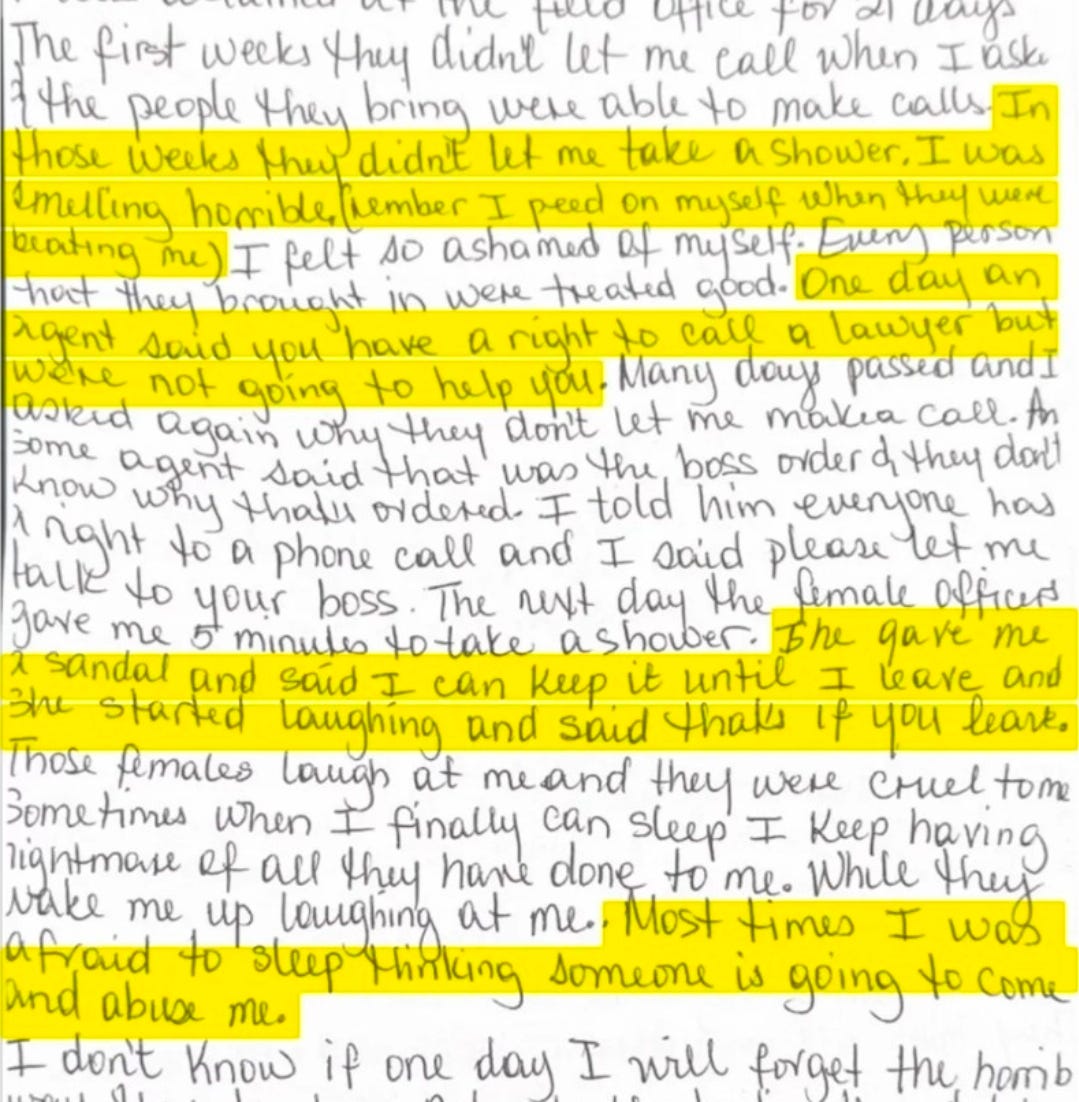
The same handwritten account says the woman believed she was beaten because of her sexual orientation. She wrote that an “old man” hit her “with such hate” and that she believed officials were angry at her and treated her differently because of who she was. She also said she was beaten so severely that she urinated on herself and that officers made her remain there until the bruises on her face, broken nose, and mouth disappeared.
That allegation matters for two reasons. First, because it is an accusation of targeted abuse against a vulnerable detainee inside federal immigration custody. Second, because it shows how detention can function as a zone of impunity, where abuse does not just happen in secret — it is hidden long enough for the visible evidence to fade.

GEO Group reportedly did not answer specific questions about conditions inside the facility and instead provided a general statement. That refusal sits beside the company’s profit surge and beside the accounts of people who say they are being starved, medically neglected, denied release, and trapped in degrading conditions. A company does not need to physically strike a detainee to profit from a structure that keeps abuse in place. It only needs to keep taking the contract, keep filling the beds, and keep refusing meaningful accountability when the people inside begin telling the world what is happening.
That is what makes the profit figure so important. It is not a side note. It is the financial measurement of a detention system expanding fast enough to generate enormous returns while the people inside say they are being denied food, denied care, and denied basic dignity.
Status Coup has previously reported on ICE prisoners at the Dilley Detention Center in Texas being forced to pay nearly $40 for a 10-pack of bottled water while contaminated water remained the alternative. That matters here because it shows North Lake is not the only site where deprivation and profit appear to move together. It is part of a pattern in which migrant confinement becomes a revenue stream and suffering becomes manageable overhead.
When detainees at North Lake say they are being held arbitrarily, when advocates say hundreds have been unlawfully detained, when a man dies after alleged medical neglect, when a former detainee says medication was withheld, and when a handwritten petition describes starvation, beatings, humiliation, blocked legal access, and fear of abuse, the question is no longer whether this is a crisis. The question is how much evidence the public is willing to absorb before calling the system what it is.
A hunger strike is often one of the last tools left to people whose bodies are already under state control. It is what people do when they believe the system holding them will not respond to reason, complaint forms, legal delay, or visible suffering. The men at North Lake are not simply refusing food. They are signaling that the conditions inside have become unbearable enough that risking further bodily harm feels like one of the only ways left to be heard.
That should alarm anyone paying attention, not because the facility has generated bad headlines, but because it reveals what immigration detention has become: a for-profit regime where confinement expands, profits rise, and human beings inside are expected to absorb neglect, fear, and degradation in silence.
The hunger strike at North Lake is not just a protest over one meal line or one unit inside one prison. It is an indictment of the entire machine that made this facility profitable, expandable, and politically defensible while the people inside say they are being starved, ignored, and denied the chance to go home.
Support the reporting, documentation, and accountability work exposing ICE abuse and detention violence.
Americans Against ICE is building the kind of independent journalism this system depends on people not funding.
The size of geo group makes for an enormous amount of complicit staff...