

🎥 Bystander video contradicted ICE’s claim that Gabriel Hurtado-Cariaco choked an ICE agent during his arrest in Bellevue, Nebraska.
Gabriel Hurtado-Cariaco is a Venezuelan asylum seeker who had work authorization and an upcoming immigration court date when ICE arrested him.
He had sought asylum at the border, been paroled into the United States, and told officials he fled Venezuela after deserting the military because he opposed the Maduro regime and feared retaliation. He was living in Bellevue, Nebraska, with his girlfriend and was reportedly on his way to register his car when ICE arrested him.
The arrest became the start of something larger than a physical struggle. ICE and DHS turned Hurtado-Cariaco into a public threat narrative. They called him a “criminal illegal alien” and a “known Tren de Aragua terrorist.” The government accused him of violently attacking an ICE agent, slamming her head into the ground, and trying to choke her to death.
Bystander footage undercut the core of that story. It showed Hurtado-Cariaco resisting arrest and trying to break free. It did not show him choking the ICE agent. Prosecutors later admitted he had not choked the female officer, and a federal judge said the original allegations were “at worst a misrepresentation and at best complete negligence.”
The case is about how ICE’s most extreme claim moved through public language before the evidence undercut it. The government’s narrative did not simply describe an arrest. It escalated a struggle into an attempted-murder story, attached a terrorism label to an asylum seeker, and helped turn Hurtado-Cariaco into a public symbol of threat before the record was forced back toward the evidence.
The arrest happened in Bellevue, Nebraska, in June 2025. Immigration officials had obtained an administrative warrant alleging Hurtado-Cariaco was a member of Tren de Aragua. From there, the case moved quickly from an immigration arrest into a criminal prosecution carrying some of the most extreme accusations the government can attach to a person.
The videos showed a struggle. They showed Hurtado-Cariaco resisting and trying to break free. They showed agents placing him in chokeholds while trying to subdue him. One video began with the female agent placing Hurtado-Cariaco in a chokehold. Another showed the struggle continuing on the ground. What the footage did not show was the central claim used to build the attempted-murder story: Gabriel Hurtado-Cariaco choking the ICE agent.

Hurtado-Cariaco’s plea does not make ICE’s attempted-murder story true. He later pleaded guilty to forcibly resisting arrest causing bodily injury and was sentenced to 14 months in prison, most of which he had already served. But the issue is not whether there was a struggle. The issue is that ICE and federal prosecutors pushed a much larger story: terrorist, gang member, attempted murderer, violent threat.
The government’s most extreme claim came through paperwork. An ICE agent who was not at the scene wrote the affidavit used to support the criminal complaint. That affidavit described Hurtado-Cariaco as placing the female agent in a chokehold and choosing to continue choking her instead of simply fleeing. Video evidence did not support that claim.
Prosecutors later called the choking allegation a “misperception.” That word does not capture the public consequence of the claim. The allegation helped turn an asylum seeker into an attempted-murder defendant. It helped carry a public story that framed him as a terrorist threat. It helped justify the kind of language DHS used against him. The claim did not stay inside an office. It moved through law enforcement paperwork, charges, public statements, and media coverage before the video and the court record broke it open.
Chief U.S. District Judge Robert Rossiter said the allegations were “at worst a misrepresentation and at best complete negligence.” He also said references to Hurtado-Cariaco as a terrorist and attempted murderer, and the claim that he put a chokehold on the agents, were “not borne out by the evidence.” The judge called the law enforcement reports “embellished” and “troubling.”
Those words matter because ICE’s story did not only describe an arrest. It created a public identity around Hurtado-Cariaco before the evidence supported it.
ICE also treated Hurtado-Cariaco’s forearm tattoo as evidence tying him to Tren de Aragua. The tattoo showed two figures walking under an eye and a clock, with the date April 30, 2018, underneath. According to the defense, that date was his son’s birthday.
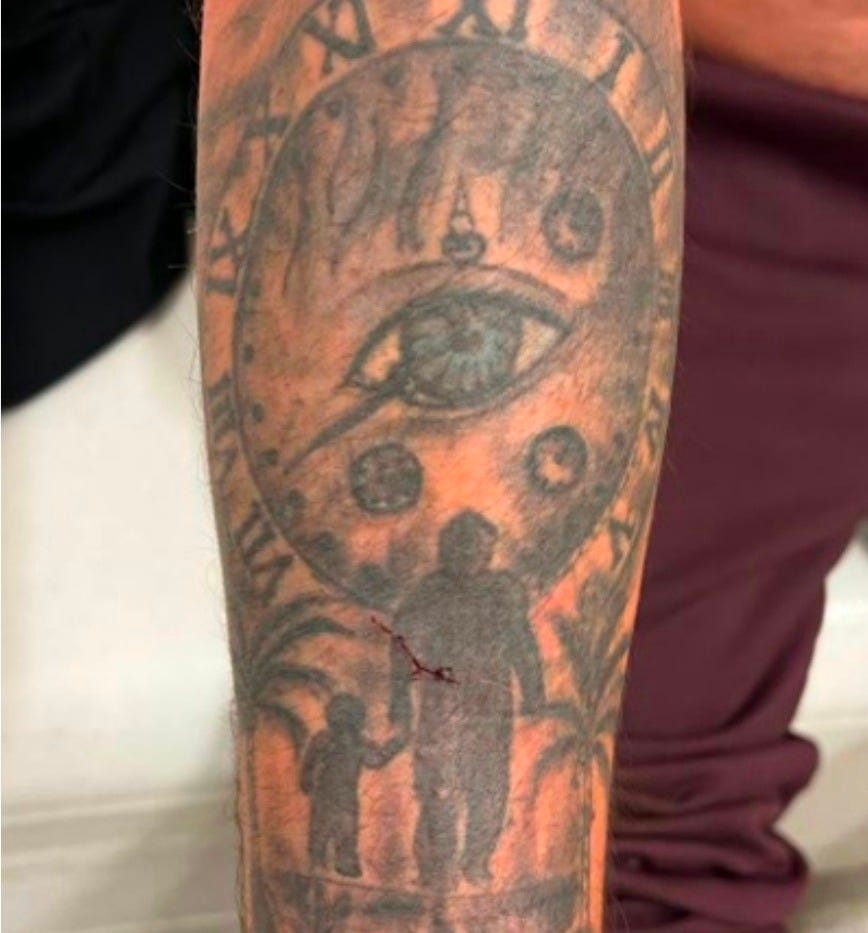
The tattoo allegation shows how quickly personal details can be converted into gang evidence when ICE is building a threat narrative. A date connected to his child could be treated as proof of gang association. Nationality could become suspicion. Fear during an arrest could become violence mythology. A man who said he fled the Venezuelan military after opposing the Maduro regime could be branded a “known Tren de Aragua terrorist” before the evidence was forced into daylight.
The mechanism is clear: an asylum seeker with work authorization and a court date became the target of a gang label, a terrorist label, an attempted-murder claim, public demonization, video contradiction, and finally judicial rebuke.
When ICE calls someone a terrorist, the label does work. It changes how the public sees the person. It changes how the arrest is understood. It makes force easier to defend. It makes detention easier to justify. It makes extreme charges sound plausible before the evidence is tested. It turns a human being into a threat category.
Anti-immigrant language is part of that machinery. Phrases like “criminal illegal alien” are not neutral descriptions. They are tools used to strip context, erase asylum claims, erase work authorization, erase court dates, erase trauma, and make the person easier to punish in public before the case is fully tested.
Hurtado-Cariaco told the court that masked officers triggered traumatic memories from Venezuela and Mexico. He said he had been tortured by police in Venezuela and robbed by cartel members dressed as police in Mexico. When officers with covered faces arrested him, he said he was afraid and ran because those memories came back.
His plea does not erase the context ICE’s narrative tried to bury.
Gabriel Hurtado-Cariaco is not the terrorist story ICE tried to build around him. He is a Venezuelan asylum seeker whose immigration case remains pending, with work authorization and a life in Bellevue. He was reportedly on his way to register his car when ICE arrested him. The government’s labels tried to bury that context under one word: terrorist.
ICE built that story by converting personal details and arrest resistance into threat evidence: a tattoo into gang evidence, a struggle into attempted murder, and a man with work authorization and a pending immigration case into a “known terrorist” in government language. Video evidence broke that story open because the record did not support ICE’s most extreme claims.
ICE arrests people and writes stories about them. Those stories can turn asylum seekers, tattoos, fear, and resistance into terrorism before the evidence catches up.
Americans Against ICE documents the machinery behind detention, deportation, raids, criminalization, and public demonization.
Support this work so ICE’s stories are not allowed to become the public record without being challenged.