

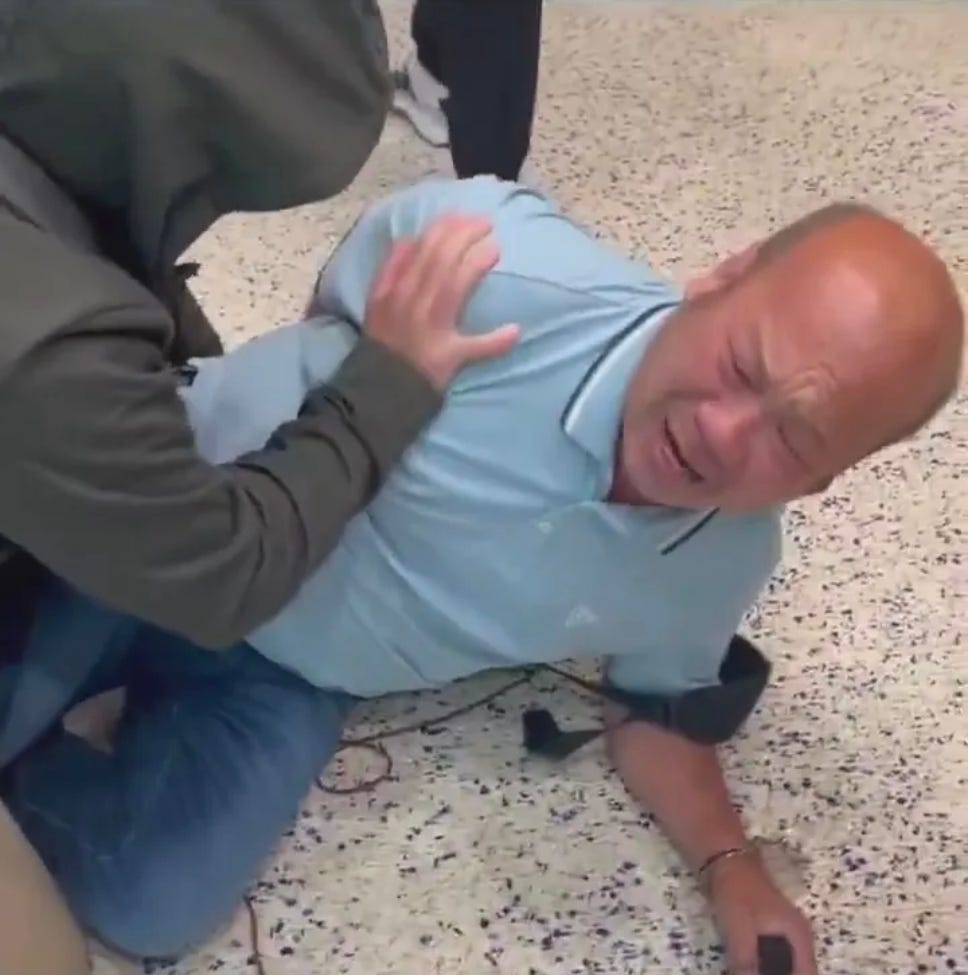
An older Asian man was walking through the Las Vegas airport when plainclothes men identified by an eyewitness as federal immigration officers moved to take him into custody. Video recorded during the incident shows the man on the floor, visibly distressed, while one man in a hoodie controls his upper body and uniformed officers manage the space around them. The scene is not orderly, calm, or administrative. It shows several agents exerting concentrated physical power over an older man whose movement, safety, and access to help had been taken out of his hands.
The government may describe scenes like this through the language of enforcement, custody, and compliance, but official vocabulary does not change what happened to the man’s body. He was forced down in a heavily controlled public space and surrounded by people carrying far more power than he did. Officers determined where he could move, who could approach him, and which questions would be answered. His distress unfolded in front of travelers who were expected to accept the officers’ authority before they understood who the men were, why they had approached him, or what justified the force being used.
Black women nearby refused to accept that arrangement. They moved toward the man, raised their voices, challenged the officers, and remained present while officials tried to control the crowd. Their intervention did not depend on possessing the man’s immigration file or resolving every legal question in the terminal. They recognized the visible imbalance between one vulnerable older man and multiple officers attempting to remove him, and they refused to let that imbalance disappear into the assumption that government action must be legitimate simply because government agents were carrying it out.
Their resistance changed the conditions around the attempted seizure. The officers were no longer dealing with one isolated person while the surrounding public continued toward its gates. They were acting in front of witnesses who would not leave, lower their voices, or allow the man’s fear to be converted into background noise. The eyewitness later reported that the man boarded the flight with the other passengers. The available record does not identify every decision that produced that outcome, but it does show that the effort to take him did not continue without sustained public opposition.
That opposition matters because isolation is one of immigration enforcement’s most important tools. An agent does not need to remove someone from a crowd before making that person functionally alone. Officers can surround the target, control the available information, order witnesses backward, and rely on the social authority of uniforms to discourage questions. The person being taken may not know which agency is involved, whether they are free to leave, what authority is being claimed, how to reach an attorney, or whether anyone nearby is willing to risk helping them. When everyone else assumes that the encounter is private government business, a crowded airport becomes an ideal place to make a person disappear.
Airports intensify that power. They are designed around surveillance, restricted movement, armed authority, checkpoints, and immediate consequences for disobedience. Travelers are conditioned to comply quickly because a dispute can cost them a flight, trigger police involvement, or place them under suspicion. Plainclothes officers can exploit that environment by moving through the terminal without the public immediately understanding who they are or what they are doing. Once the older man was on the floor, the airport’s culture of obedience became part of the force being used against him.
The Las Vegas incident also belongs to the larger enforcement system Donald Trump deliberately expanded. His administration demanded far higher daily arrest numbers from ICE and treated volume as evidence of success. Once the White House made bodies in custody the central measure, agents needed people they could locate and seize quickly enough to keep the numbers moving. That pressure did not produce a narrow campaign focused only on people convicted of serious crimes. It expanded enforcement into workplaces, neighborhoods, courthouses, transit systems, airports, and other spaces where vulnerable people could be found with less preparation and fewer protections.
The detention population reflects that shift. By April 2026, more than 70% of the people held by ICE had no criminal conviction. The administration continued invoking violent criminals to justify the crackdown even as the system filled detention facilities with people who did not match the threat Trump described. Arrest quotas created an incentive to move toward the visible and reachable rather than the dangerous. Workers, parents, older people, travelers, and immigrants already listed within government systems became easier arrest inventory because they could be located, surrounded, and processed faster than the public enemies used to sell the policy.
Americans Against ICE identifies this incident as part of the broader enforcement pattern created by Trump’s arrest quotas: when ICE is pressured to produce thousands of arrests, older people, workers, travelers, and others who are visible and physically easier to overpower become convenient targets.
The older man’s humanity was never conditional on his record or legal status. The video shows what officers did to him in public, while the broader enforcement record explains why scenes like this are becoming more common. A government demanding thousands of arrests every day creates pressure to treat vulnerability as an operational advantage. People who are older, physically overmatched, linguistically isolated, alone, or accustomed to complying with authority are easier to control. The system does not have to announce that it is hunting easier prey when its incentives repeatedly drive officers toward the people least equipped to resist.
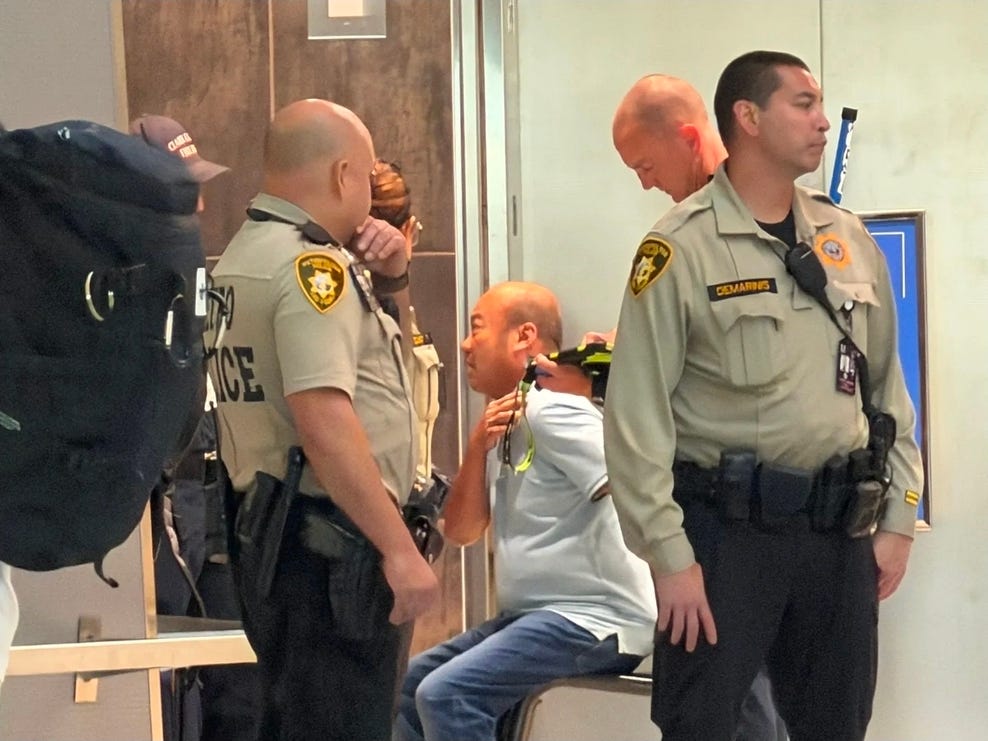
Trump’s rhetoric prepares the public to accept that result. His administration repeatedly describes immigration enforcement as a defense against criminals, invaders, and threats, encouraging Americans to assume that anyone restrained by ICE must have earned the treatment. The accusation arrives before the facts. A person’s body on the floor is offered as evidence that the person was dangerous, while the officers’ decision to use force is treated as proof that force was necessary. This circular logic protects the agency from scrutiny and turns the government’s own violence into justification for more government power.
The women who confronted the officers rejected that logic. They did not allow the man’s restraint to define him as a threat. They saw an older person in distress and responded to the immediate human reality rather than the political story Trump’s administration wants the public to impose on every immigration arrest. Their action was not naïve. It reflected an understanding that government officers can possess authority and still abuse it, that a person can be placed in custody without receiving justice, and that silence from witnesses helps official cruelty become routine.
Black women have repeatedly been expected to provide this kind of protection while receiving little institutional protection themselves. Their role in Las Vegas should not be romanticized into another story about Black women naturally carrying everyone else’s moral burden. They should not have been the only people willing to confront concentrated state power, and no society should rely on Black women to place themselves between armed officers and vulnerable strangers whenever public institutions fail. Their courage deserves recognition because they chose to act, not because the country is entitled to expect that labor from them.
The older man remains the person who absorbed the immediate harm. He was placed on the floor, physically controlled, exposed before strangers, and left dependent on witnesses he did not know. The women’s intervention matters because it responded to his vulnerability rather than using him as a symbol of their bravery. They recognized him as a person before they knew his name, nationality, or immigration history. That recognition was enough to reject the idea that officers should be allowed to remove him without questions.
Their response also reflects a broader change in how communities are reacting to ICE. More people have watched agents arrive in masks and hoodies, use unmarked vehicles, enter workplaces, wait outside courthouses, and take parents or workers without providing the surrounding public with meaningful explanations. The administration’s language no longer hides the physical reality as effectively as it once did. Neighbors are warning one another, witnesses are filming, families are demanding badge numbers and locations, and communities are gathering around people targeted by agents because they understand that the difference between an enforcement action and a disappearance can be the presence of witnesses who refuse to leave.
This resistance does not require the public to adjudicate immigration law in real time. It requires people to recognize that state power must remain answerable when it touches a human body. Witnesses can demand identification, ask whether the person is free to leave, record the conduct of officers, locate family or counsel, request interpretation, and preserve evidence that agencies might otherwise control. Those actions may not stop every detention, but they remove the privacy that allows coercion to be described later through sanitized agency language.
The Las Vegas airport scene demands answers that have not been publicly provided. The government should identify the officers and agency involved, explain why they targeted the older man, state what authority they claimed, disclose why physical restraint was used, and account for the decision to place him on the floor. It should also explain whether he was injured, whether interpretation or medical assistance was offered, and what changed before he ultimately boarded the flight. These are not technical distractions from the incident. They concern the government’s treatment of a vulnerable man whose body was controlled in a public terminal.
What the available evidence already establishes is serious enough. An older man was physically dominated and publicly humiliated while several officers controlled the space around him. The people carrying out the operation expected the airport’s culture of obedience to help them isolate him from meaningful public support. Black women broke that isolation by moving toward the man and refusing to let the officers define the scene without challenge.
Trump’s expanded immigration machinery depends on making vulnerable people easy to take and teaching everyone else to accept the seizure as normal. At the Las Vegas airport, Black women interrupted that machinery by refusing to let officers isolate a vulnerable man without witnesses, questions, or public resistance.
Americans Against ICE documents the raids, public seizures, detention abuse, custody deaths, family separation, and community resistance that Trump’s immigration machinery depends on the public forgetting. This work keeps the people targeted by ICE visible, connects individual acts of cruelty to the system producing them, and preserves the record when government agencies refuse to explain what their officers have done.
Subscribe to Americans Against ICE and help keep every seizure, every act of cruelty, and every refusal to look away in the public record.
SOURCE:
Eyewitness account and video: Dr. Julian Vasquez Heilig, Cloaking Inequity.
As usual. Would he have done the same for her is the question.
Kudos to the women who stood up and acted up.