

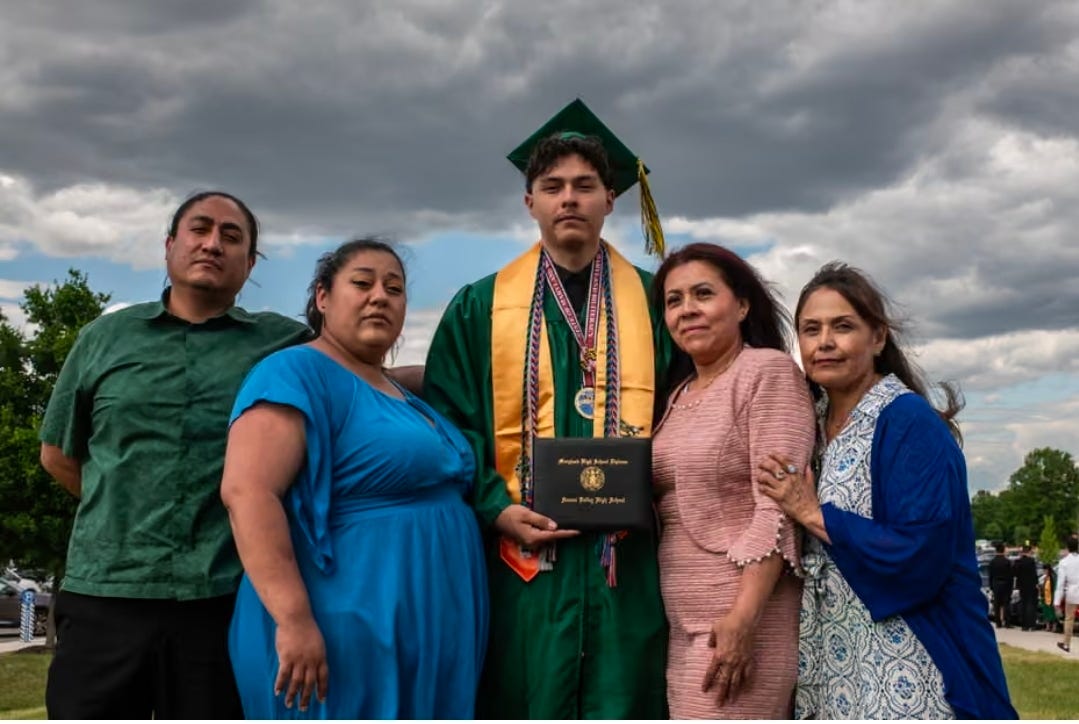
Mark was getting ready for his high school graduation when he thought about what his father would have done if he had been there.
His slacks were a little tight. His tie needed attention. His father, Marco, probably would have insisted on fixing both before Mark walked across the stage. He would have wanted his son to look his best.
But Marco was not there.
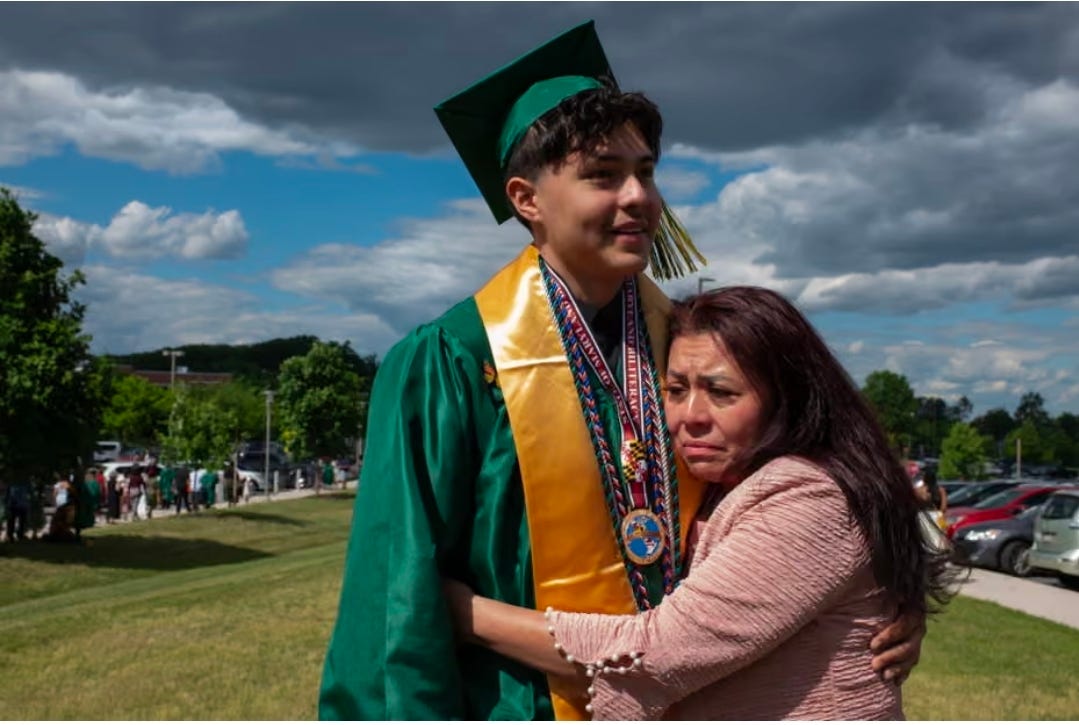
He was nearly 2,000 miles away after Immigration and Customs Enforcement arrested him in Maryland before Christmas and deported him months later. When Mark walked up to receive his diploma, the moment carried relief, pride, and absence at the same time. His mother, Rosie, told him afterward: “Congratulations — we finally made it through.”
They had made it through graduation. They had not made it through whole.
Marco had lived in the United States for nearly 40 years. He had built a contracting business in Maryland. He had a 17-year-old son and a 35-year-old daughter who are both U.S. citizens. His biggest dream was to see Mark graduate from high school.
Instead, he watched by livestream from far away.
Marco said he was happy and proud, but also sad that he could not be present. That is what ICE deportation did to this family. It did not only remove a man from the country. It removed a father from a milestone he had spent years waiting to see.
Mark had once loved school. He took advanced placement classes, had close friends, and moved through senior year with the ordinary pressures of a teenager preparing for the next stage of life. After his father was arrested and deported, that stability began to break apart.
For much of the semester, Mark said he did not want to go to school. Even after he came to terms with what had happened to his father, he still did not want to be there. The arrest did not stay confined to an immigration case. It followed him into classrooms, assignments, grades, sleep, and concentration.
He began skipping classes. He dropped an advanced placement class because he could not keep up. His math grade fell to an “E.” He was failing.
That is part of the harm that does not fit neatly into a deportation order. A teenager did not only lose daily contact with his father. He lost the ability to move through school the way he had before. The pressure of separation reached into his education and changed the final semester of his childhood.
The family’s finances changed too.
Marco’s contracting work had helped cover rent, utilities, and groceries. Rosie’s job at Burger King helped pay for extras, including clothes and dinners out. After Marco was removed, Mark and Rosie began eating through their savings while trying to figure out how to keep the household stable.
Mark started taking shifts at Walmart to help pay the bills. Local mutual aid support helped the family cover basics. Rosie tried to stay strong for her son, but Mark could hear her crying in her room.
“Separation in that way breaks our hearts,” Rosie said. “We are suffering in every aspect.”
Marco had been shopping at Home Depot with a friend when ICE officers stopped them. He had been trying to avoid Home Depot because he knew immigration agents were conducting raids there, but he needed supplies for a contracting job and could not find the part anywhere else.
He was first held at a federal building in Baltimore, then transferred to a detention center in Mississippi. Rosie described the experience as a nightmare. The family tried to gather paperwork, documents, and evidence to fight his deportation. His lawyer believed he might qualify for residency through a humanitarian relief program for Central Americans who came to the United States before 1990.
It did not stop the removal.
An immigration judge ordered Marco deported even though his family says documentation was presented showing he had been in the United States for 37 years. He was sent to El Salvador, a country he had left as a child before later relocating to Mexico.
In detention, Marco struggled to eat the poor-quality food and heard other detainees crying and screaming through the night. After three months, he had lost 30 pounds.
Mark found a painful irony in that. His father had always wanted to lose some weight, he said, but not like that.
This is why ICE detention cannot be separated from the family story. The detention center was not an abstract holding space. It was where a father’s body changed while his family tried to keep a household together without him. It was where a man who wanted to see his son graduate waited while his son was falling into depression hundreds of miles away.
The broader pattern is larger than one family. A Guardian investigation found that during the first seven months of the Trump administration, officials arrested the parents of at least 27,000 children, including 12,000 U.S. citizen children. During that period, DHS deported about twice as many parents each month compared with 2024.
Those numbers matter because Mark’s graduation was not an isolated tragedy. It was part of a system that reaches into homes where children are U.S. citizens and parents are pulled away by immigration enforcement.
Family separation does not end when the parent is deported. It continues in the bills left behind, the empty chair at graduation, the child working shifts to help with rent, the mother crying in another room, and the father watching a ceremony through a screen.
Marco tried to keep parenting from a distance. Before he was deported, he wrote Mark a letter. It began with love and memory, telling him how wonderful it was when they saw him for the first time after he was born. He told Mark to take care of his mother and girlfriend, to exercise, to keep learning, and to find a stable path forward.
He also gave him practical advice about electrical work. Mark laughed when reading that part back. His father, he said, just wanted him to be OK.
Mark wanted that too.
He asked his math teacher for extra work so he could bring his grade back up. He kept working. He reconnected with his half-sister after years without contact and learned she was expecting a baby, making him an uncle. She promised that if anything happened to Rosie, she would be there for him.
That was one good thing, Mark said.
Marco, meanwhile, struggled with grief and post-traumatic stress after deportation. He began working odd jobs quickly because he did not want to burden Rosie and Mark. He wanted to support them financially from afar, but could not make enough.
Rosie said he felt helpless.
Eventually, Marco made his way to Mexico, where he could be closer to family. He is still exploring legal options to return to the United States or to find a way to be closer to Rosie and Mark. For now, he said he wants to do whatever he can to support his son.
He also sees how much Mark has changed. Before the arrest, Marco said, Mark was still a child. Since then, he has grown.
That growth came at a cost.
Mark made it to graduation, but he had to do it after watching his family split apart. He had to finish school while worrying ICE might take his mother too. He had to work, study, and recover from a semester that should have been about prom, finals, friends, and senior-year memories.
Instead, ICE deportation became the central fact of his final semester.
Mark is expected to start community college soon and wants to become a civil or mechanical engineer. He is also trying to save enough money to visit his father in Mexico. If he can make the trip, he plans to pack his cap and gown.
He wants to take graduation pictures with Marco.
He wants to recreate the moment his father was forced to miss.
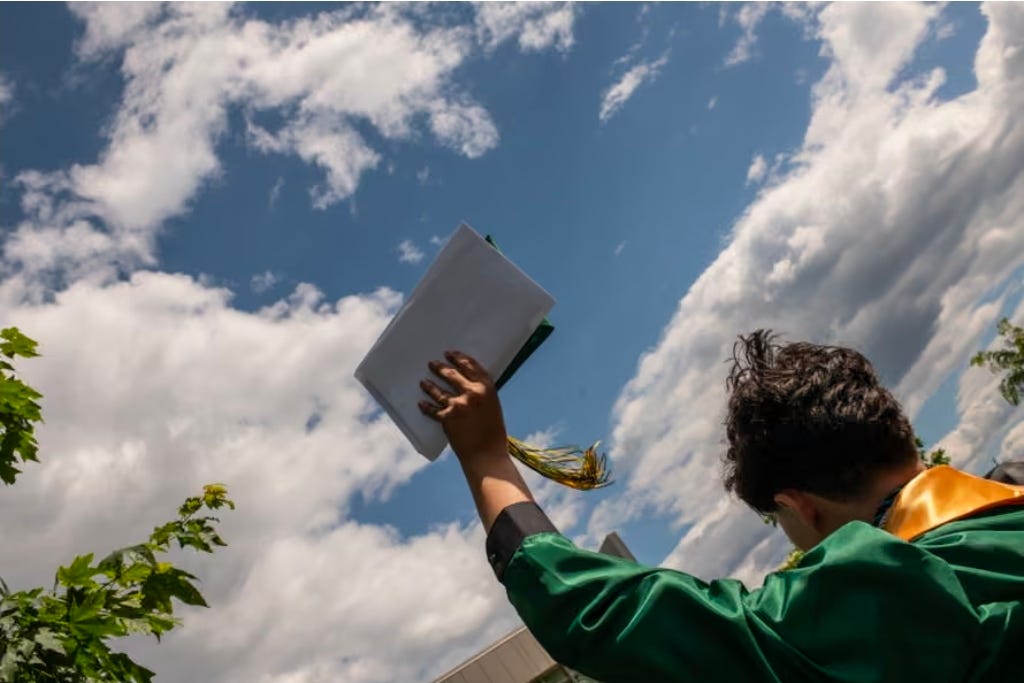
That is the image this story leaves behind: a U.S. citizen teenager carrying his cap and gown across a border so his deported father can stand beside him in the memory ICE took from them.
This report is part of the public record on ICE deportation, family separation, U.S. citizen children, detention trauma, school disruption, and the families left trying to survive after a parent is taken away.
Upgrade to a paid subscription to support Americans Against ICE and the work that keeps these records public and tells families’ stories affected by ICE.
A graduation lasts a few hours. The loss that follows a deportation can last for years. Families do not measure separation in miles. They measure it in missed milestones, empty seats, and moments that can never be repeated.