

Twelve days after his youngest daughter was born prematurely, Juan Chavez Velasco was on his way to deliver milk to her hospital room — still in his own neighborhood in Weslaco, Texas — when immigration agents pulled in front of his car.
His wife, Stephanie Villarreal, 32, was on the phone with him and heard the agents yelling at him to get out of the vehicle. She said she felt panic hit instantly, because the situation was already fragile: their newborn was in intensive care, and their family was running on exhaustion, fear, and routine.
Juan told the agents he had children. He told them he had a wife. He told them he had DACA. He remembers their response.
“They said, ‘That doesn’t matter,’” Chavez Velasco recalled.
He was taken into custody and transported to a detention center in Laredo, leaving behind a U.S.-citizen wife and three U.S.-citizen children, the youngest of whom was in an isolation chamber in the neonatal intensive care unit. What followed was not only separation, but a new kind of cruelty: the kind that takes advantage of time-sensitive medical need, and then calls that pressure “process.”
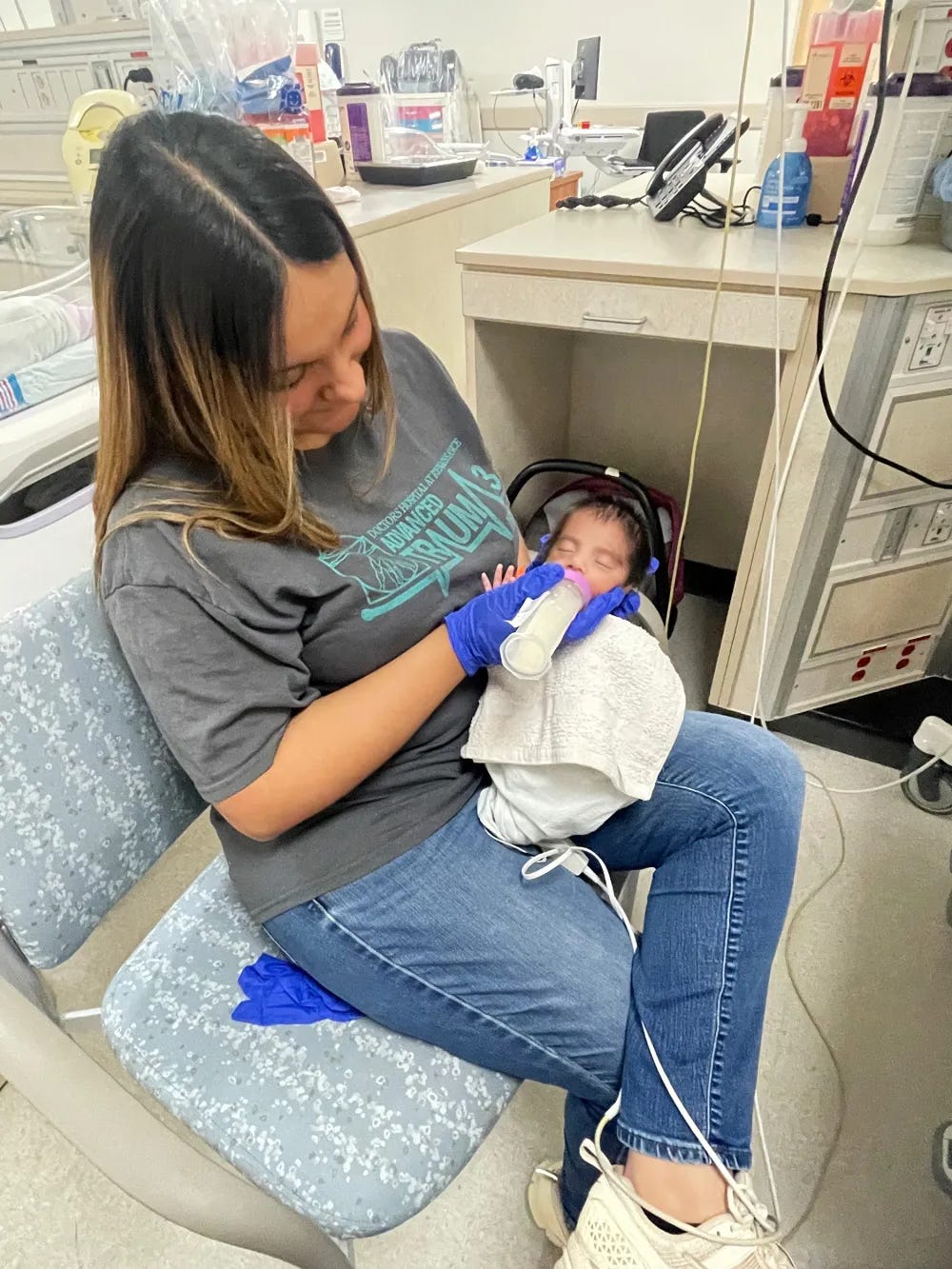
Chavez Velasco told MS NOW he never got to hold his daughter before he was taken away. In a system that claims it targets danger, this is what “enforcement” looks like in practice: a newborn in the NICU, and a father behind glass.
The story is specific. The pattern is not.
The detention of Chavez Velasco — a recipient of the Deferred Action for Childhood Arrivals program, which has allowed hundreds of thousands of undocumented immigrants who arrived as children to obtain work permits and protection from deportation — reflects a broader pattern that immigration attorneys and advocates say has accelerated under the Trump administration: the targeting of Dreamers who once believed the program shielded them.
A separate pattern has also emerged at the same time. Recipients applying for renewals, which must be submitted every two years, are facing lengthy delays that leave some with expired status and no work authorization. Attorneys and advocates have described the delays as destabilizing by design, because they create an opening for detention, job loss, and coercion even without a new allegation.
This is how “legal” pressure becomes lived punishment. You do not have to be convicted of anything to be targeted; you only have to be made vulnerable at the wrong moment. When the government controls the timeline, it also controls the leverage.
DHS offered labels, not accountability.
In response to questions about Chavez Velasco’s case, a DHS spokesperson described him as “an illegal alien” and said he was “issued a final order of removal in 2005.” The spokesperson did not respond to questions about his separation from his children or about the specific circumstances of a NICU newborn. Instead, the spokesperson repeated a line that has become common in public-facing agency messaging: a claim that “DACA does NOT confer any form of legal status,” and that recipients “are not automatically protected from deportations.”
Then came the line that reveals the point of the whole posture: “Being in detention is a choice,” the spokesperson said, encouraging DACA recipients to self-deport and receive “$2,600 and a free flight.”
That is not a public safety statement. That is coercion dressed up as options. It is a demand for silence, wrapped in a threat, delivered as customer service.
A life built in the United States — and a childhood status he didn’t choose.
Chavez Velasco’s parents brought him to the United States from Colombia in 1999 when he was 8 years old. They came on a tourist visa, overstayed and applied for asylum — a request that was denied in 2004. After a failed appeal the following year, the family was issued a final order of removal that Immigration and Customs Enforcement never enforced.
In 2016, his parents were able to reopen their case and ultimately adjusted their status to legal residents through their U.S.-citizen daughter. The gap is important, because it shows how arbitrary and punitive immigration “paths” can be even inside the same family. For Juan, the same route was not available on the same timeline.
Under immigration law, the wait time for a sibling of a U.S. citizen to adjust status can stretch 15 to 20 years, compared with 12 to 18 months for a parent. Bureaucracy becomes a wall, and then that wall becomes an excuse for enforcement.
In 2012, Chavez Velasco enrolled in DACA. He went on to earn two bachelor’s degrees — in biology and clinical laboratory science — and built a career as a medical laboratory scientist. He worked on the front lines of an emergency room during the Covid-19 pandemic, the kind of work the country relies on and applauds until the moment the government decides his presence is suddenly disposable.
“He has no criminal history. Never has had any type of criminal history,” Villarreal said. “He did everything right.”
The newborn is five weeks old. The clock is not slowing down.
Their youngest daughter, Elianna, was born Feb. 6. She is five weeks old. The morning after Chavez Velasco first spoke to MS NOW, he called again to say she needed to undergo a blood transfusion — a potential sign, he said, that her bone marrow was not producing enough red blood cells.
While his daughter was still in intensive care, Chavez Velasco’s DACA status expired on March 10. He was already in custody when it expired, after the renewal application he submitted last November went unanswered by the government.
That timing matters because it illustrates the trap. A renewal delay becomes an expiration. An expiration becomes a vulnerability. A vulnerability becomes detention. And detention becomes the leverage the government uses to pressure people to give up their lives in the United States.
This is why “paperwork” cannot be treated as neutral. When the paperwork determines whether you can work, stay, or feed your newborn in a hospital room, it stops being administrative and becomes existential.
“We’re straddling a tightrope.”
Jodi Goodwin, Chavez Velasco’s attorney, said the best outcome would be for U.S. Citizenship and Immigration Services to renew his DACA status and for ICE to release him on that basis. But she described the situation in the terms any family living under enforcement recognizes immediately: time is the weapon.
“We’re straddling a tightrope, because we need time and we don’t have that kind of time if they’re going to put him on a plane,” Goodwin said. “I don’t have a lot of faith in what we’re doing here, because I don’t have any faith in ICE whatsoever.”
The fear here is not abstract. It is a fear of a phone call that arrives too late, a plane ticket booked without warning, a bureaucratic decision that turns into permanent separation before a child can even leave the hospital.
Chavez Velasco said he had always told his wife there was nothing to fear. “I feel betrayed,” he said. “I feel very sad and heartbroken.” He added that he had thought the Trump administration would be more compassionate toward people like him who contribute, work, and have lived in the United States most of their lives.
The hardest part of that betrayal is how familiar it is. Families are repeatedly told that compliance will protect them, that stability will protect them, that a program will protect them. Then the government shifts the ground, and calls the collapse “law.”
A family does not become less real because the state says so.
DHS has argued publicly that DACA recipients are “not automatically protected,” as if the moral problem here is the family’s misunderstanding. But the family is not confused about what DACA is. They are living what DACA has always been: conditional permission, vulnerable to politics, administered through timelines that can be tightened without warning.
When an agency tells the public “Being in detention is a choice,” it is not describing reality. It is attempting to rewrite reality so the harm looks voluntary. It is the same move used in countless detention cases: blame the person for being trapped inside the system that trapped them.
Villarreal said her biggest fear is “how much” her husband is “gonna miss out” on their children’s lives. That fear is not a prediction anymore. It is already happening.
This week, Villarreal brought their son Damien to see Juan for the first time since his detention. They hadn’t told him the full truth about where his father was, because parents do what parents always do: they try to protect their children from terror they didn’t cause. But sitting on the other side of a glass barrier, Damien began to cry.
“Daddy, why are you behind that glass?” he asked.
There are sentences that expose the entire system. That is one of them. A child naming the punishment, without the language adults use to disguise it.
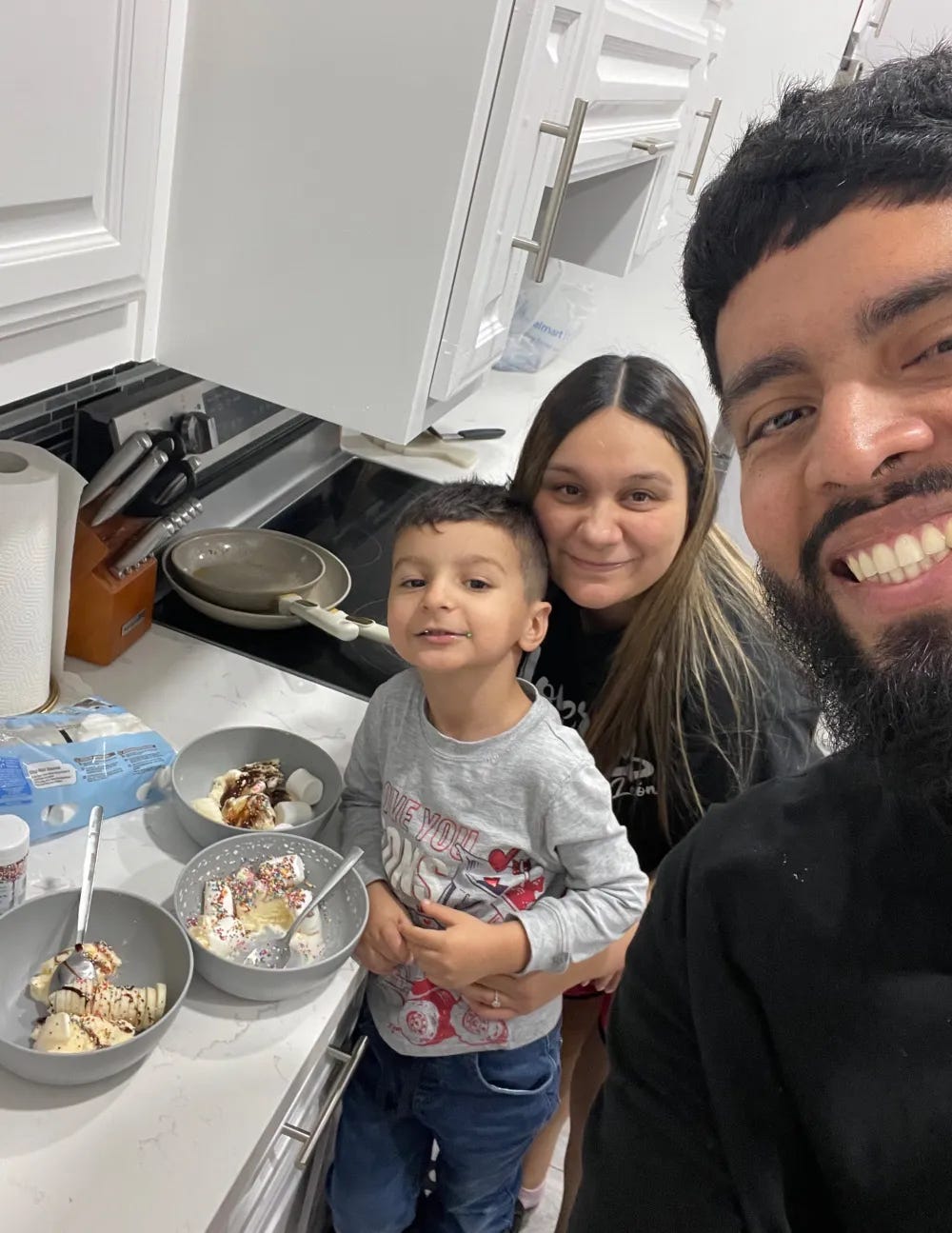
“Process” becomes punishment when the system relies on harm to function.
You can hear it in how this story is narrated by the state. In the agency framing, this is a case file: a person with a removal order, a program that does not confer legal status, an option to self-deport. In the family’s reality, it is a newborn in an isolation chamber, a father who never got to hold her, a mother trying to keep a household stable while a government spokesperson calls her husband “illegal” and suggests he should leave for money.
The gap between those two descriptions is the point. The language is engineered to make the harm sound orderly. “Orderly” is how institutions defend themselves while they break families apart.
This is not a failure of empathy. It is policy operating as designed: create insecurity, apply pressure, present “compliance” as the only path to relief, and then call the coercion a choice.
When a father with no criminal history can be detained while trying to deliver milk to his newborn in the NICU, it is not a glitch. It is a message. It tells every family watching that nothing is stable — not work history, not community ties, not a newborn’s medical crisis, not even the careful effort to renew status on time.
What accountability looks like here
Accountability is not only about a single release decision, though that matters urgently. Accountability also means refusing the language games that make this system feel normal. It means rejecting the idea that a newborn’s first weeks can be treated as collateral. It means calling “self-deport” what it is: forced surrender under threat.
It also means keeping the public record clear. Families like this are repeatedly pushed into silence because speaking out can feel dangerous. The system counts on that fear. Visibility is one of the only tools that makes it harder to move people in the dark.
Chavez Velasco and Villarreal shared their story publicly for the first time because they believe he could soon be deported to Colombia. The fear is not only exile; it is irreversibility. Once a parent is gone, the bureaucracy rarely feels obligated to repair what it broke.
The moral question is simple even when the law tries to make it complicated: What kind of country treats a father like a removable problem while his newborn fights to survive in a hospital?
If the answer is “this one,” then the next question is what we are willing to tolerate, and what we are willing to document until tolerance becomes impossible.
Support Americans Against ICE
Problem: Families are being torn apart through detention and deportation pressure, including cases involving Dreamers and parents of U.S.-citizen children.
Consequence: Children lose parents, newborns lose care, and “process” becomes punishment—while agencies deny accountability and demand silence.
Action: Support reporting and organizing that keeps ICE accountability public, documented, and impossible to bury.
They took a father from his newborn and called it policy.
That is what ICE cruelty looks like when the target is a family.