

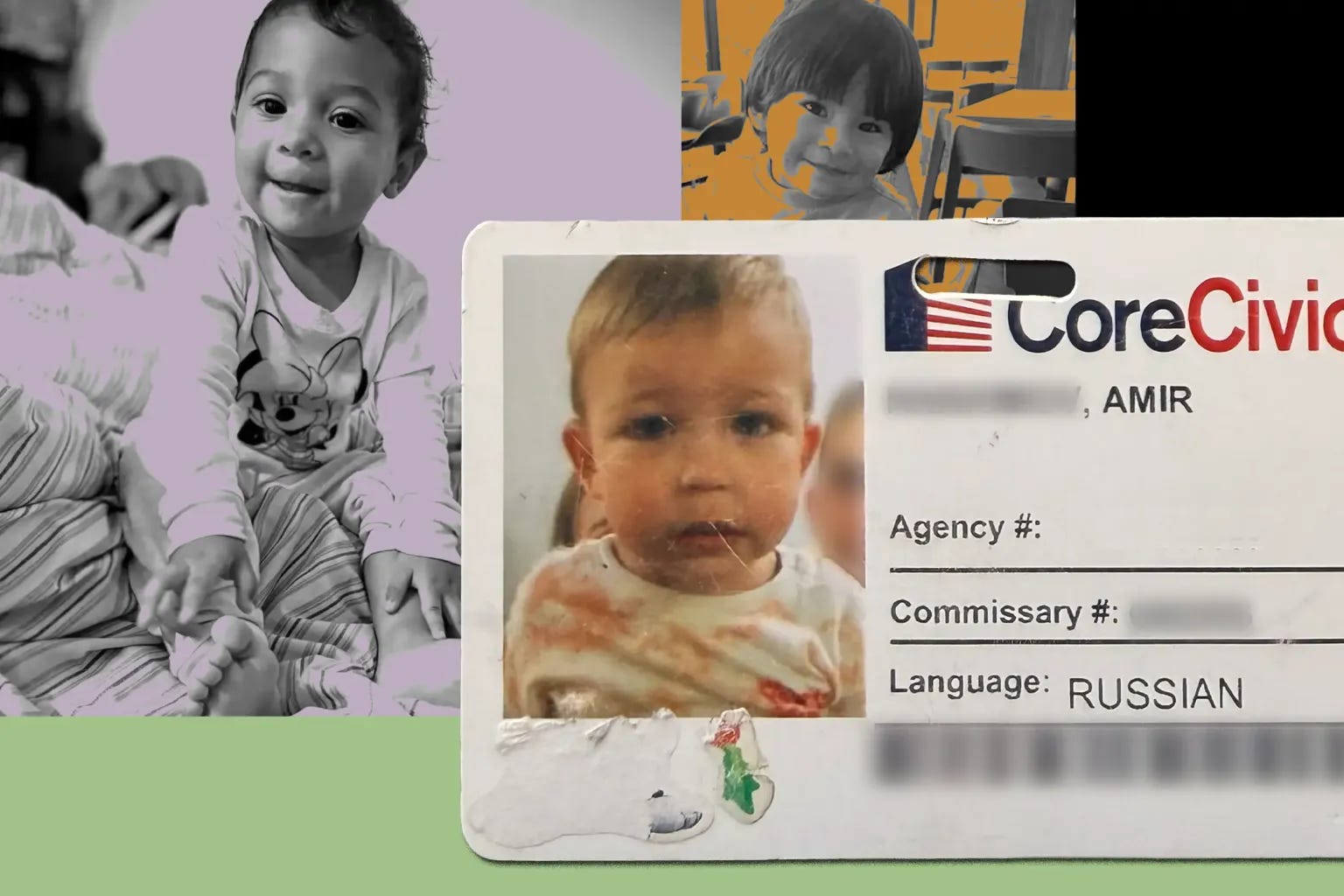
More than 500 babies and toddlers have been held in U.S. Immigration and Customs Enforcement custody since President Donald Trump returned to office, according to a joint analysis by MS NOW and The Marshall Project.
The analysis, based on records obtained by the Deportation Data Project, found that ICE dramatically increased the detention of children age 3 and younger after Trump restarted family detention. Between January 2025 and March 2026, ICE held 25 babies and toddlers in custody on an average day. During the prior 12 months under President Joe Biden, the average was fewer than three.
That is not only a data point. It is a policy reversal measured in infants, toddlers, parents, and days spent inside federal immigration custody.
The first years of life are among the most developmentally fragile years a child will ever experience. Babies and toddlers are learning language, forming attachments, developing memory, building emotional regulation, and depending on parents for safety, routine, food, and comfort.
Immigration detention interrupts all of that.
Marsha Griffin, a pediatrics professor and co-founder of the American Academy of Pediatrics’ Council on Immigrant Child and Family Health, told MS NOW and The Marshall Project that infancy and toddlerhood may be the most harmful period of life to place a child in detention.
“Our immigration system is breaking children,” she said.
The numbers show how quickly the system changed.
Biden ended family detention in 2021, and the Dilley facility in Texas, once used to hold families, eventually closed. Trump restarted the practice after returning to office and moved to reopen Dilley, reviving a detention model that pediatricians, immigrant-rights advocates, and attorneys have long warned can harm children.
Dilley Immigration Processing Center is now the primary ICE facility used to detain families with children. It is operated by CoreCivic, a private prison and detention company. The facility has become central to the renewed family detention system.
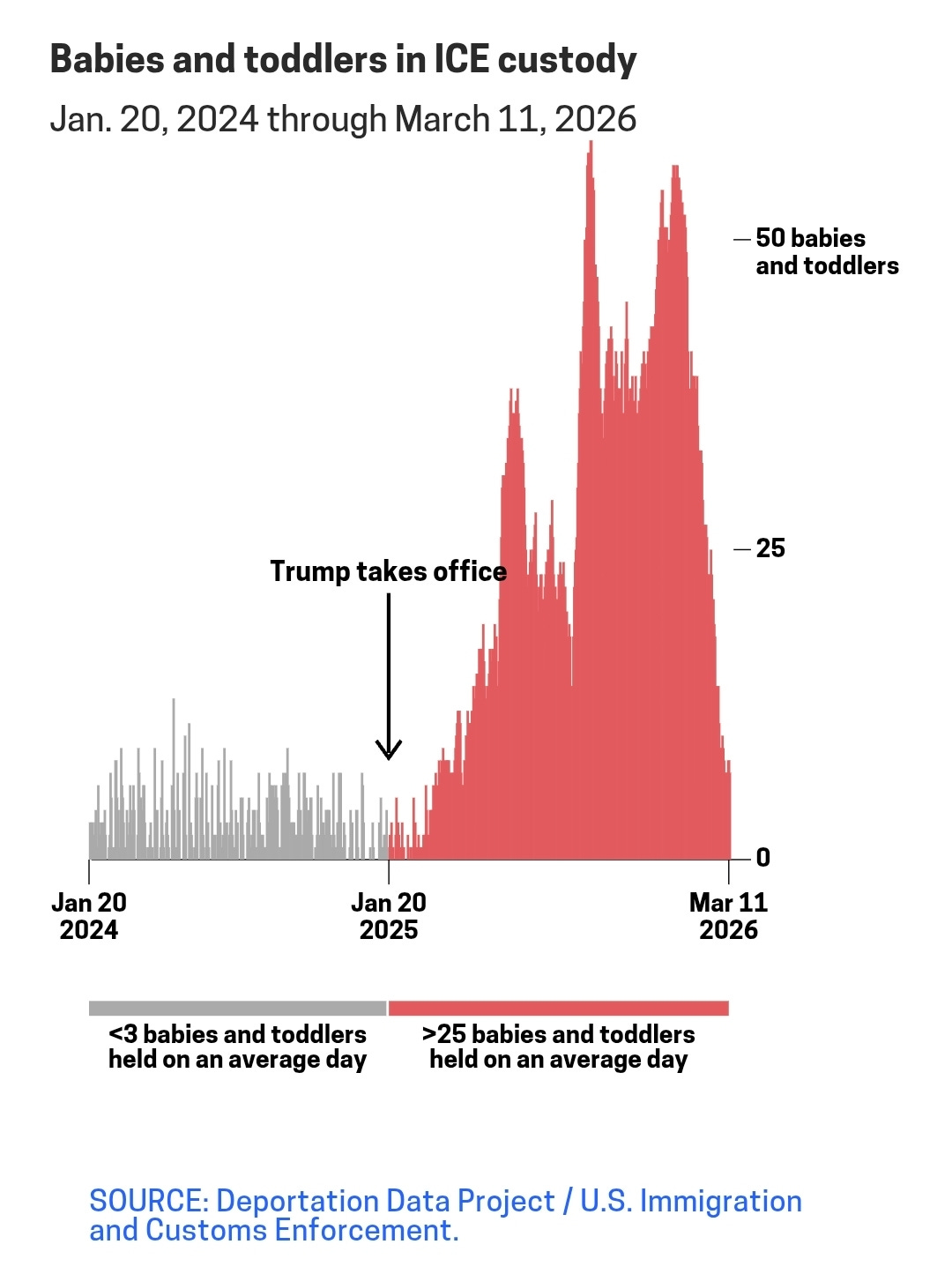
The analysis also found that many very young children were held for prolonged periods. Between Trump’s second inauguration and March 2026, ICE held at least 175 babies and toddlers longer than the 20-day limit associated with the Flores settlement framework governing children in immigration detention.
During the final year of the Biden administration, the analysis found that no children age 3 or younger were held beyond that 20-day limit.
ICE said in a May court filing required under the Flores settlement that it works to assess cases and discharge minors from custody as promptly as possible. The agency did not respond to MS NOW and The Marshall Project’s question about the increase in detained babies and toddlers. In a statement, ICE said families with children receive appropriate food, water, and medical care.
CoreCivic said its facilities were safe for infants and toddlers.
Parents described something very different.
In March, Joani, her husband, and their 2-year-old son, Kaleth, appeared for a required immigration check-in appointment in California. According to the family’s lawyer, they had never missed a required appointment after immigrating and seeking asylum in 2024.
ICE took them into custody anyway.
Kaleth’s father was handcuffed and taken to an adult detention facility in California. Joani and Kaleth were sent to Dilley in Texas.
The family was split apart inside the immigration system.
At Dilley, Joani said her son repeatedly tried to reach a wall-mounted phone, pushing a tiny table toward it so he could climb high enough to use it. She moved the table away each time so he would not fall. Even if he had reached the phone, contacting his father in another detention facility would not have been possible.
Then Kaleth stopped eating.
Joani said he went 12 days without food. When she tried to force him to eat, he vomited. He eventually stopped having bowel movements. She watched his face grow gaunt and his eyes sink.
Facility doctors attributed his refusal to eat to depression, according to Joani.
For a toddler, trauma does not always arrive as words. It can appear in the body. It can appear in appetite, digestion, sleep, silence, regression, fear, and the sudden loss of ordinary childhood behavior.
Lori Goodman, the CEO of LEAP, a nonprofit that works with families with young children in California and has supported Kaleth’s family, told MS NOW and The Marshall Project that his distress manifested physically because children his age have fewer verbal tools to explain what is happening to them.
That is the public record behind the figure of more than 500 babies and toddlers.
This was more than a detention placement or facility assignment.
A toddler was taken from his father, placed inside a private detention system, and became so distressed that his body began shutting down ordinary functions.
Another family’s story shows the same pattern from a different angle.
Alsu and Azat fled Russia with their 1-year-old son, Amir, fearing that their opposition to the war in Ukraine could lead to prison for them and an orphanage for their child. They entered the United States through the southern border without visas and presented themselves to authorities at a legal port of entry.
They expected confinement to last a few weeks.
Instead, they spent months in detention, first in California and then at Dilley.
Azat said they came to the United States to escape prison and find freedom. Instead, the family spent four months in immigration detention.
Amir, once lively, began withdrawing. His parents said he started hitting himself in the face. His speech slowed. Eventually, he stopped saying almost anything except “mom” and “dad.”
His parents said Dilley had few toys for toddlers. Some children played with rocks. They could not find books in Russian, even though they understood that reading and conversation were important for Amir’s development.
Griffin, the pediatrics professor, explained that parents need to talk to children to support language development. But detention can silence both parents and children. Fear, stress, and incarceration can reduce ordinary interaction, disrupt bonding, and change the way a child experiences their parent’s ability to protect them.
That is one of the hidden harms of family detention.
A child does not only experience the facility; they also experience a parent’s loss of control inside it. The adult who normally provides safety is also trapped, monitored, and constrained.
Rahil Briggs, a psychologist with the early-childhood advocacy organization Zero to Three, told MS NOW and The Marshall Project that developmental setbacks in early childhood can create a domino effect. A child focused on safety in a frightening setting may miss foundational learning that later skills depend on.
That is why the age of these children matters.
A 1-year-old or 2-year-old cannot separate detention from the world. The facility becomes the child’s environment. The rules, food, fear, guards, doors, phone access, medical limitations, and parental distress become part of the developmental setting.
For Amir’s family, food became another crisis.
Alsu said employees at Dilley forced her to wean Amir off formula, telling her he was too old. She said the available solid food was not appropriate for a 1-year-old. She described sucking spicy sauce off noodles so she could feed them to her son. She and Azat hid cereal from the dining hall in their clothing so Amir would not go to sleep hungry.
After the parents argued with staff over food, Azat alleged that employees in CoreCivic uniforms woke him in the middle of the night and threatened to send the parents to separate immigration facilities and Amir to foster care if they continued complaining.
CoreCivic has said its facilities are safe for infants and toddlers. ICE has said families receive appropriate food, water, and medical care.
The parents’ accounts raise a different accountability question: what does “appropriate” mean inside a detention system that holds babies and toddlers for weeks or months?
The answer depends on whose standard is being used: a federal contractor’s, an agency managing custody, or a child’s body inside confinement. For parents describing speech regression, food refusal, and fear, “appropriate care” is not an agency phrase. It is a test of whether the system is meeting a child’s basic needs.
That question matters because Dilley is not only a building.
It is part of a detention infrastructure with a federal contract, a private operator, and a public policy choice behind it. The Trump administration did not inherit a fully active family detention system at Dilley. It restarted one.
The Washington Post reported in 2025 that the Trump administration moved to reopen the Dilley, Texas family detention center, operated by CoreCivic, reviving family detention after Biden ended the practice in 2021.
The Houston Chronicle later reported that the Dilley Immigration Processing Center contract pays more than $15.6 million monthly and allows the facility to hold up to 2,400 people, with the contract running through March 2030.
That is the contractor layer of the story.
Every detained child is also part of a funded system. Every family bed exists inside a facility budget. Every day of custody extends the relationship among ICE, the private contractor, the courts, the parents, and the child.
The data from MS NOW and The Marshall Project shows that the renewed system is reaching children during the earliest years of life.
Children age 3 and under are not collateral details in immigration enforcement. They are babies and toddlers. They are learning how to speak, eat, regulate fear, trust adults, and understand safety. They cannot meaningfully participate in immigration proceedings. They cannot understand why a parent was handcuffed, why a phone cannot reach their father, why familiar food is gone, or why they cannot leave.
The federal government can call it family detention. ICE can describe care as appropriate. CoreCivic can defend its facilities as safe.
But the public record now includes a documented set of findings that cannot be dismissed as routine custody.
KEY FINDINGS FROM THE ANALYSIS
More than 500 babies and toddlers were placed in ICE custody after Trump restarted family detention.
ICE held 25 children age 3 or younger on an average day, roughly ten times the prior average.
At least 175 babies and toddlers were held longer than the Flores-related 20-day limit.
Parents described children becoming sick, isolated, withdrawn, and developmentally regressive inside detention.
One 2-year-old stopped eating for 12 days after being separated from his father.
One 1-year-old’s parents said he withdrew, hit himself, lost language, and struggled to get appropriate food.
This is the record AAI exists to document.
Immigration cruelty does not always appear as a raid video, a deportation flight, or a detention death. It can appear in quieter records: a toddler trying to reach a phone he cannot use, a parent hiding cereal in clothing so a child can eat later, or a spreadsheet line showing babies held beyond the court framework meant to limit child detention.
Family detention is often defended as an alternative to separating families.
But holding families together inside immigration custody still places children inside a detention system. It still exposes them to confinement, fear, isolation, disrupted development, limited food options, and the sight of parents losing control over the conditions of daily life.
For babies and toddlers, that is not a temporary inconvenience.
It happens during the years when the brain is building the foundations for the rest of life.
That is the accountability question behind the data.
The Trump administration restarted family detention. ICE expanded custody of babies and toddlers. CoreCivic operates the primary facility used to hold families. Parents described sickness, regression, hunger, and fear. Experts warned that early-childhood detention can cause lasting harm.
A federal immigration system that places babies and toddlers inside private detention during the most fragile years of development cannot be treated as routine enforcement.
That is a public harm, and it belongs in the public record.
This report is part of the public record on ICE detention, family separation, private detention contractors, and the children placed inside immigration custody.
Americans Against ICE documents the systems that turn migrant families, asylum seekers, and children into detention numbers — and the public officials and contractors who keep those systems running.
Upgrade to a paid subscription to support the work that keeps these records public.