

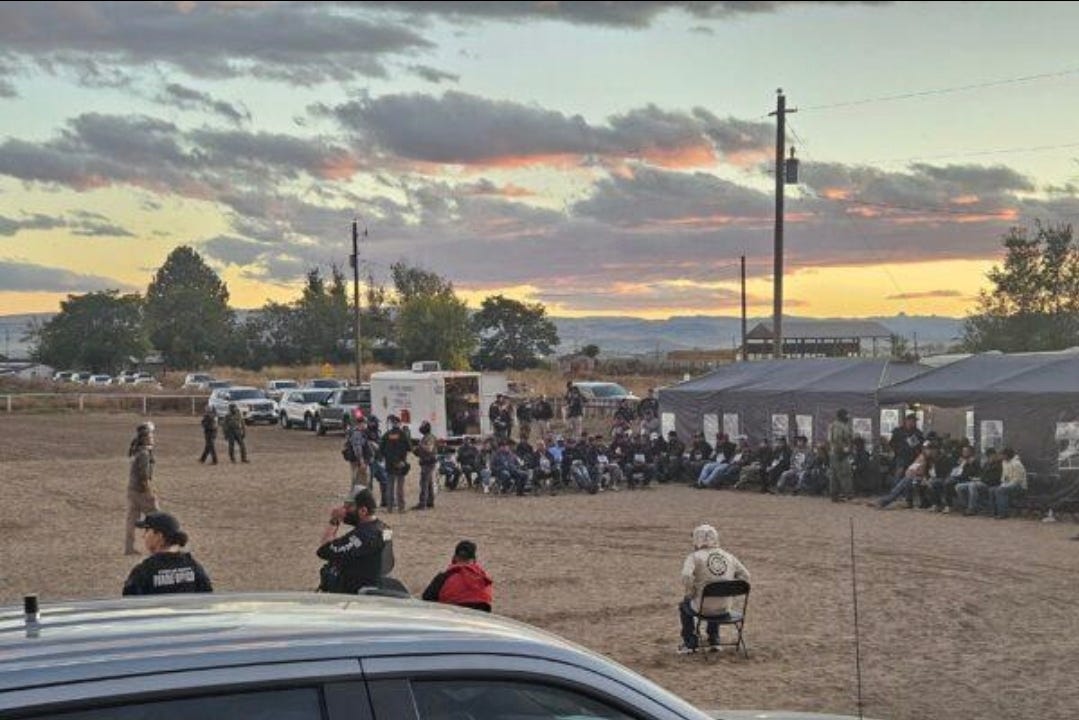
Armed ICE agents stormed a family horse-racing event in Wilder, Idaho, while children watched.
Helicopters and armored vehicles descended on La Catedral Arena as federal, state, and local officers moved through the crowd with guns, flashbang grenades, and rubber bullets. Families who had gathered for a community event suddenly found themselves surrounded by immigration enforcement.
Juana Rodriguez, a U.S. citizen, later described the raid as a nightmare. The Marshall Project reported that agents zip-tied her hands and kept her from feeding her three-year-old child for hours. The government said the operation was aimed at illegal gambling. Instead, more than 100 people were arrested, all on civil immigration charges.
That is where this story has to begin: not with the government’s language about operations, targets, or enforcement priorities, but with the children who watched adults with weapons turn a family outing into a trauma scene.
The question is not complicated. Before the raid was approved, who accounted for the children who would be forced to witness it?
Every immigration raid where children are present carries a mental-health consequence. ICE changes the emotional world around the children who watch it happen. Ordinary places become scenes of force. A family event becomes a site of fear. A child learns that safety can disappear without warning.
The government often treats raids, detentions, deportations, and family separations as legal or administrative events. Families experience them as fear, grief, shock, and chronic stress. Children absorb that fear through what they witness at home, at school, and in public spaces, where a knock, a siren, a uniform, or a rumor can become a warning that their family’s life may change.
That harm is often treated by officials as collateral, even though it is part of the enforcement system children are forced to experience. Immigration policy has to be treated as children’s mental-health policy because children are living with the consequences long after agents leave.
The Idaho raid made that harm visible because children were there to witness it. For immigrant families, the mental-health impact of enforcement does not begin or end at one raid scene. It follows families into homes, schools, workplaces, hospitals, and neighborhoods, shaping sleep, trust, public life, and whether parents feel safe enough to ask for help.
ICE enforcement turns uncertainty into a daily condition for children who do not need to understand immigration law to understand fear. The difference between a criminal charge and a civil immigration arrest means little to a child who knows only that someone they love may not come home. Detention can harm children even when they are not the ones placed behind locked doors.
Recent reporting has shown how direct that harm can become. The Marshall Project reported that ICE detained more than 6,200 children during Trump’s second term, including children whose ages and circumstances place them among the most vulnerable people in the immigration system. A separate Marshall Project investigation with MS NOW found that more than 500 babies and toddlers under age three had been detained by ICE since January 2025.
For children, those numbers can become part of memory, behavior, sleep, appetite, school, and trust. A toddler may experience custody through confinement and confusion. An older child may carry the image of a parent’s arrest or the threat of deportation into daily life long before any separation actually happens.
The public-health consequences become clearer when those fears are placed beside the country’s existing youth mental-health crisis. The Centers for Disease Control and Prevention has identified suicide as one of the leading causes of death for young people, including children and adolescents. Pediatric and psychiatric organizations declared a national emergency in children’s mental health years ago, warning that children were facing rising anxiety, depression, grief, isolation, and crisis.
Immigrant children and children from immigrant families face that crisis while also carrying the added pressure of anti-immigrant rhetoric, family separation, detention threats, economic instability, and bullying tied to immigration status.
When political leaders demean immigrants, mock asylum seekers, describe families as threats, or build policy around mass detention and deportation, children hear it. So do the classmates, neighbors, and adults around them. That language does not stay inside speeches. It moves into classrooms, neighborhoods, playgrounds, and social media, giving cruelty a permission structure.
The death of Jocelynn Rojo Carranza shows what that can mean. Jocelynn was 11 years old when she died by suicide in Texas. CNN reported that her mother said Jocelynn had been bullied by other students who claimed her family was in the country illegally, after rumors and speculation about ICE raids spread at her school.
Her death should not be used as a statistic and then forgotten. It should force a public question about what happens when immigration fear becomes a weapon used against children by other children.
In many homes, that fear is already part of daily life. Children hear classmates threaten deportation, watch parents avoid public agencies out of fear, translate adult panic before they have language for their own, and learn that asking for help can feel dangerous.
Even children with legal status, U.S. citizenship, or mixed-status families can internalize the threat. The state does not have to target a child directly for the child to feel hunted. When enforcement moves through a community, fear spreads beyond the arrest list.
Family separation deepens the harm because enforcement can interrupt even the final moments families should be allowed to share. Arlit Maria Martinez was detained by ICE on her way to work, and two days later, her 15-year-old son died of cancer. She did not get to say goodbye, while her surviving children were left inside a grief that no public-health system can cleanly measure.
A child dying without a detained parent at the bedside is a human consequence of enforcement. Siblings left behind after a parent is taken are not footnotes. They carry the loss, the confusion, the anger, and the terror of knowing that a government decision can interrupt even the most sacred moments of family life.
ICE harm does not stop at the arrest. It moves into the bodies of children who cannot sleep, the schools where they cannot focus, the homes where parents disappear, and the grief that follows families long after the official paperwork is filed.
Parents carry the trauma too. A parent who fears ICE may avoid seeking mental-health care. A parent who survives a raid may blame themselves for not protecting a child from what that child saw. A parent living under deportation threat may constantly calculate which public places are safe, which appointments are necessary, and which risks are too great.
Over time, that fear shapes where families go, what children overhear, whether a parent reports abuse, and whether people feel safe seeking therapy, attending school meetings, appearing in court, or asking for help. When immigration enforcement makes basic survival feel dangerous, mental-health advice becomes hollow because the same system telling families to seek support also makes support feel unsafe.
Community care matters, but it cannot be asked to repair trauma while ICE raids, detention, family separation, and deportation fear keep producing the crisis. Reducing detention, keeping families together, ending armed raids at family events, and refusing to terrorize children in the name of immigration enforcement are public-health interventions.
The government cannot separate ICE policy from children’s mental health. Every public raid, every parent taken from a child, every child placed in detention, and every family forced to live with deportation fear becomes part of the mental-health landscape children are expected to survive.
The Idaho raid should have forced that accounting before the operation was ever approved. Before agents stormed a horse-racing event with children present, officials were willing to accept the risk that families would be surrounded, children would witness armed force, and the terror of that scene would be treated as secondary to the enforcement goal.
By accepting that risk, officials treated the children’s fear as an acceptable cost of the raid.
The story is not only the number of arrests. It is the harm carried by the three-year-old whose mother said she was kept from feeding him, by the children who watched adults zip-tied, and by families who learned that a community gathering could become an immigration raid.
ICE is not only removing people from homes; it is putting fear inside children who are learning that the government can take their family at any moment. That fear is produced by policy, reinforced by rhetoric, carried by children, and serious enough to be treated as a public-health emergency.
Immigration enforcement does not end when agents leave the raid scene.
The harm follows children into classrooms, bedrooms, doctor’s offices, family gatherings, and the quiet moments when they wonder whether someone they love will be taken next. It becomes fear, grief, silence, panic, shame, missed care, and chronic stress no child should be forced to carry.
Americans Against ICE documents these harms because ICE violence does not only exist in detention centers or deportation orders. It lives in the children who watch raids happen, the parents who are taken, the toddlers placed in custody, the families separated at the worst moments of their lives, and the communities told to survive trauma while the government calls it enforcement.
Upgrade to support Americans Against ICE and help keep this documentation going.
It's the cruelty to children i cannot forgive.