

President Donald Trump’s deportation campaign looks different now than it did just a few months ago. The spectacle has quieted. The images of public rampages, masked agents flooding neighborhoods, and courthouse arrests drawing immediate backlash have slowed. The public-facing violence that once dominated the news cycle is no longer moving with the same visibility.
That does not mean the machine has stopped.
It means the strategy has changed.
ICE is no longer relying only on visible raids to project power. The Trump administration is now moving through paperwork, legal-status revocations, parole terminations, agency memos, notices, and court filings. The next deportation pool is not only being built at the front door, in the street, or inside immigration courtrooms. It is being built on paper first.
That shift matters because it changes how the public sees the crackdown. A raid is visible. A memo is not. A masked arrest creates footage. A termination notice arrives quietly. A courthouse ambush can spark immediate outrage. A bureaucratic status change can push hundreds of thousands of people into legal uncertainty before the public understands what happened.
That is the danger now.
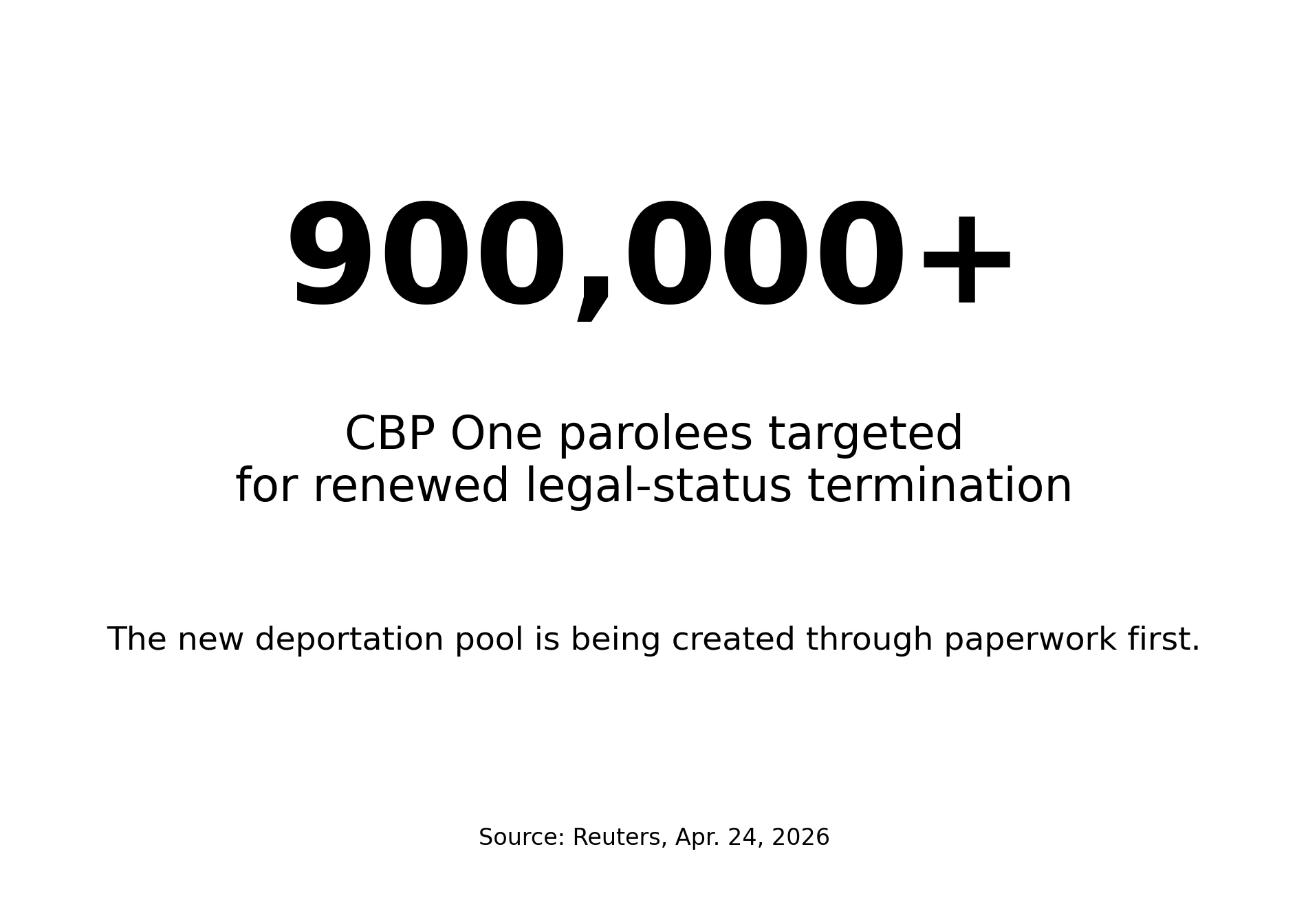
The Trump administration is trying again to terminate legal status for more than 900,000 migrants who entered the United States through the CBP One app and were granted humanitarian parole under the Biden administration. These migrants did not enter through some hidden door. They used a government process. They scheduled appointments with U.S. Customs and Border Protection. They were admitted into the country under parole and allowed to remain while awaiting immigration proceedings.
Now the administration is trying to convert that same group into a mass deportation pool.
That is the shift.
The public was told the crackdown was about “violent criminals.” That was the political cover. But the numbers and legal filings tell a different story. ICE is not simply pursuing people convicted of serious violent crimes. The administration is building capacity to cage people whose legal presence can be revoked, challenged, or erased through administrative force.
The first version of this effort already failed in court. In March, U.S. District Judge Allison Burroughs blocked the administration’s attempt to terminate parole for migrants who entered through CBP One, finding that the government had not properly justified such a sweeping decision. The court required more than a mass notice telling people it was time to leave. It required the government to explain why people admitted under a lawful process should suddenly lose that protection.
Instead of abandoning the effort, the administration came back with a revised version.
Federal officials have now told the court that Customs and Border Protection issued a new memo explaining why parole is supposedly no longer appropriate for this group. The administration is preparing to send new termination notices to people whose parole has not otherwise ended. Immigrant advocacy groups say the government is trying to work around the judge’s earlier order.
That is not retreat.
That is recalibration.
The public-facing crackdown drew too much resistance. So the government moved toward the quieter architecture of removal: revoke status first, create deportability second, hand the resulting population to ICE third. Before agents arrive, the target list is built.
This is the center of the story.
The administration does not need to wait for a dramatic public sweep if it can first transform legally present people into removable targets through paperwork. That is how a quieter deportation campaign expands. It does not always begin with a knock at the door. It begins with a notice, a memo, a status report, a termination decision, and a legal argument that the government has decided someone’s permission to remain no longer counts.
That is why the CBP One fight matters far beyond one courtroom in Boston.
If the administration succeeds, it creates a massive pool of people who were admitted under a government process and then stripped of that protection. ICE does not have to persuade the public that each person is dangerous. It only has to point to the altered paperwork and claim the person is now deportable.
That is bureaucratic disappearance.
Not disappearance in the sense that no one knows where the person went, but disappearance in the civic sense: a person’s legal standing is erased, their presence is reclassified, and their humanity is buried under administrative language. They become a case category. A docket. A notice. A removal target.
The administration understands the power of that process. Public raids provoke public reaction. Paperwork creates distance. It makes the harm harder to see and easier to normalize.
That does not make it less violent.
A deportation campaign built through legal-status revocation still ends in detention, family separation, forced removal, lost jobs, lost housing, broken communities, and people being caged by a system that profits from human confinement. The violence is not softened because it begins in an office instead of on a street.
The data shows why the “violent criminals” narrative is collapsing.
According to TRAC Immigration, 60,311 people were held in ICE detention as of April 4, 2026. Of those, 42,722 had no criminal conviction. That is 70.8% of the detained population.
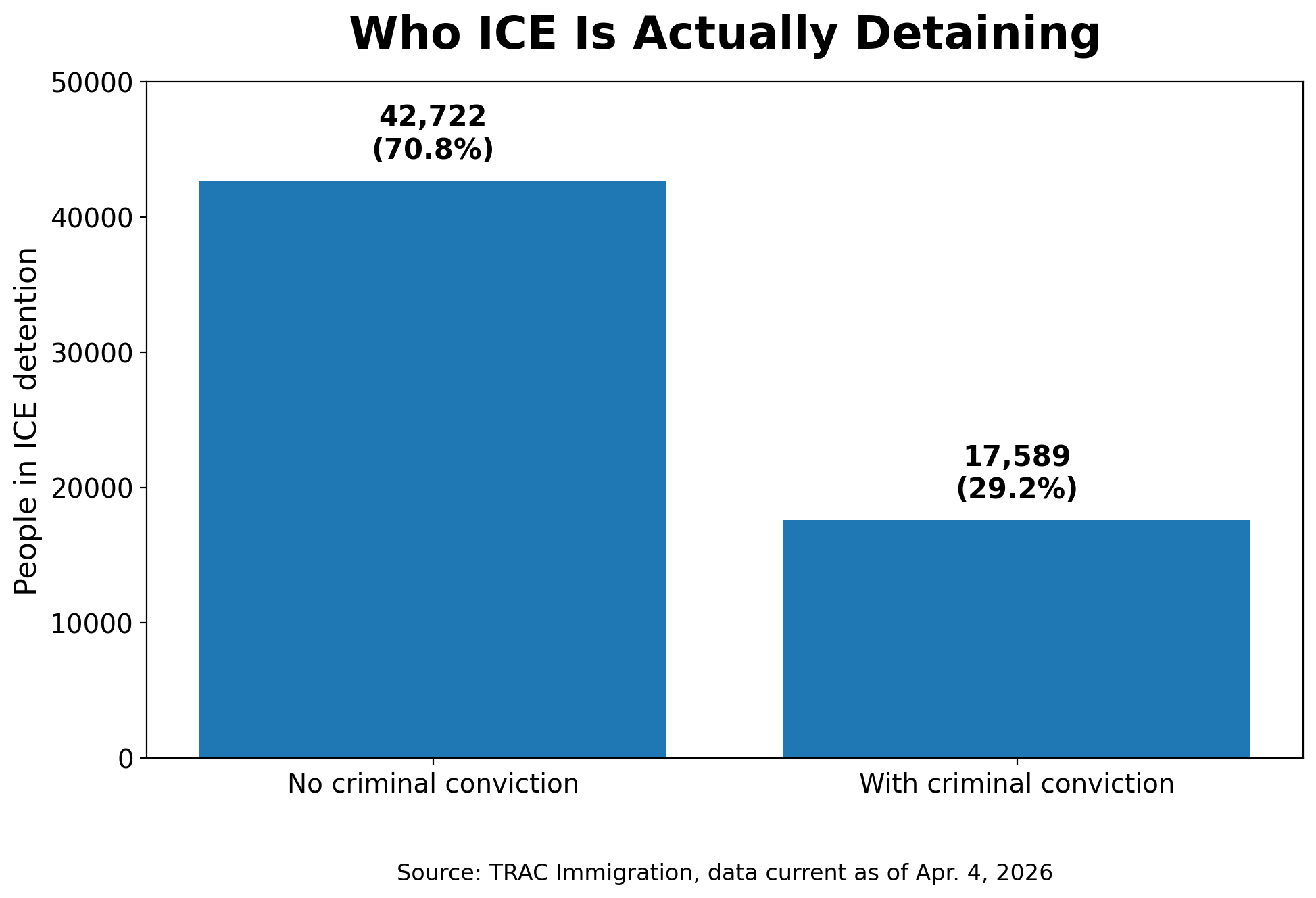
That number cuts through the language used to sell the crackdown. When a detention system is overwhelmingly holding people without criminal convictions, the “violent criminals” frame is not an explanation. It is a shield.
The administration’s rhetoric depends on the public confusing immigration status with criminality. It wants the country to believe that a person becomes dangerous the moment the government changes their paperwork. But legal status is not moral worth. A parole termination notice does not turn a parent, worker, student, asylum seeker, or family member into a threat.
It turns them into a target.
That distinction is the center of this article.
The public was told to imagine ICE chasing violent criminals. But the administration is now positioning itself to pursue people who followed a government process, received government permission, and built lives under the legal status they were given. The cruelty is not accidental. The point is to make even lawful presence feel temporary, fragile, and revocable whenever power decides it needs more bodies for the deportation machine.
That is how fear scales.
When the government can admit people through one process and later revoke their status en masse, the message reaches far beyond the 900,000 people directly targeted. It tells immigrant communities that no paperwork is safe, no appointment is enough, no compliance guarantees protection, and no lawful process is immune from political reversal.
That is not immigration enforcement.
That is state control through instability.
The visible crackdown has also shifted in real time. An Associated Press analysis found that ICE arrests dropped nearly 12% after the Minneapolis killings and the immigration enforcement shake-up that followed. The public posture had become politically volatile. Images of aggressive enforcement, public backlash, and civil liberties concerns were creating pressure.
But a drop in visible arrests does not mean the deportation system is dismantling itself.
It means enforcement is changing shape.
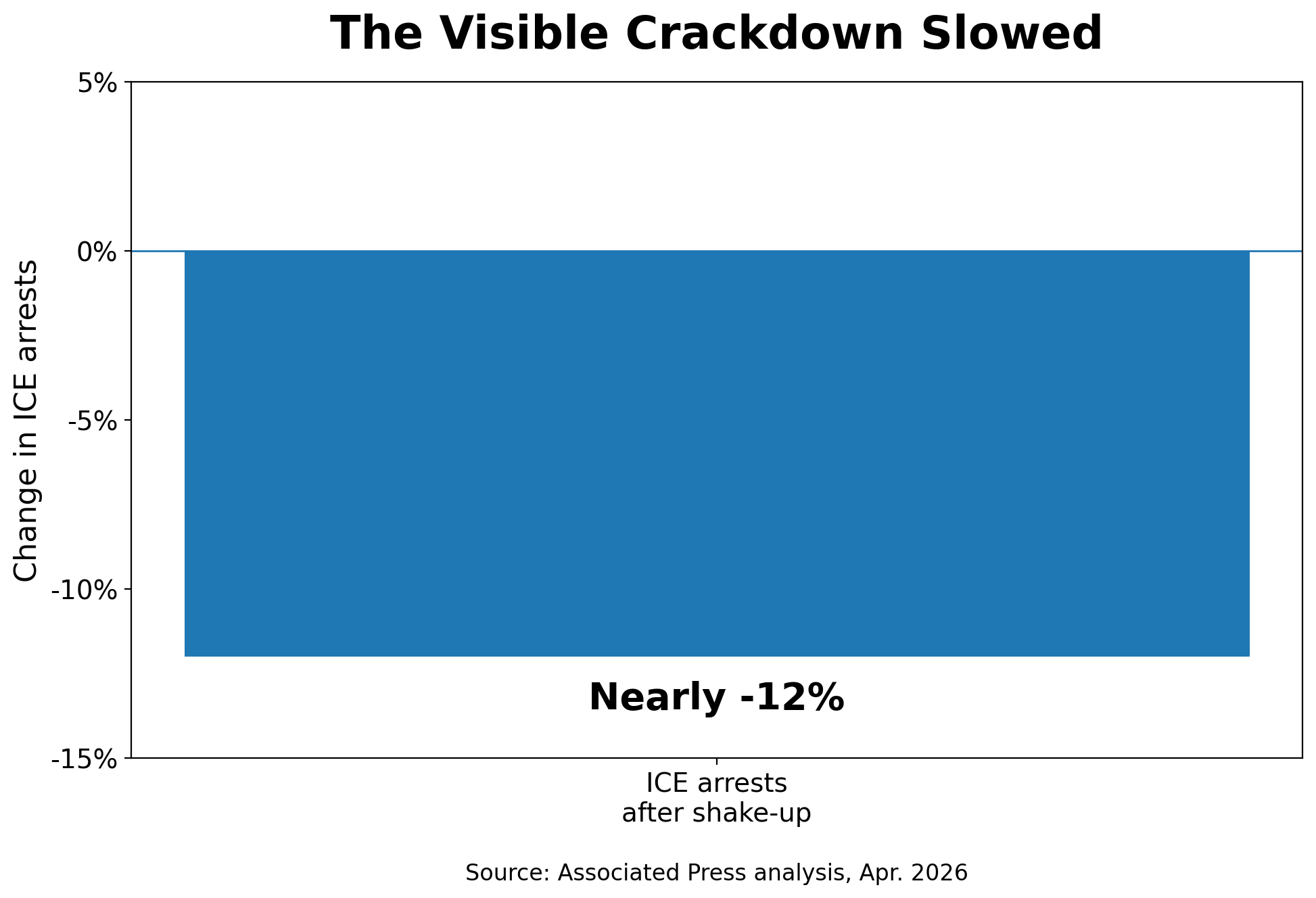
That chart should not be read as relief. It should be read as evidence of the pivot. The administration may have pulled back from some of the public-facing tactics that generated immediate backlash, but the underlying objective remained intact: keep the deportation machine supplied.
That is what the Boston case exposes.
The government does not need every arrest to begin with a public spectacle. It can create vulnerability first. It can revoke status first. It can turn people who were legally present into people ICE can pursue. It can make the paperwork do the first act of violence before detention does the second.
That is the quieter strategy.
The money behind detention is another part of the story.
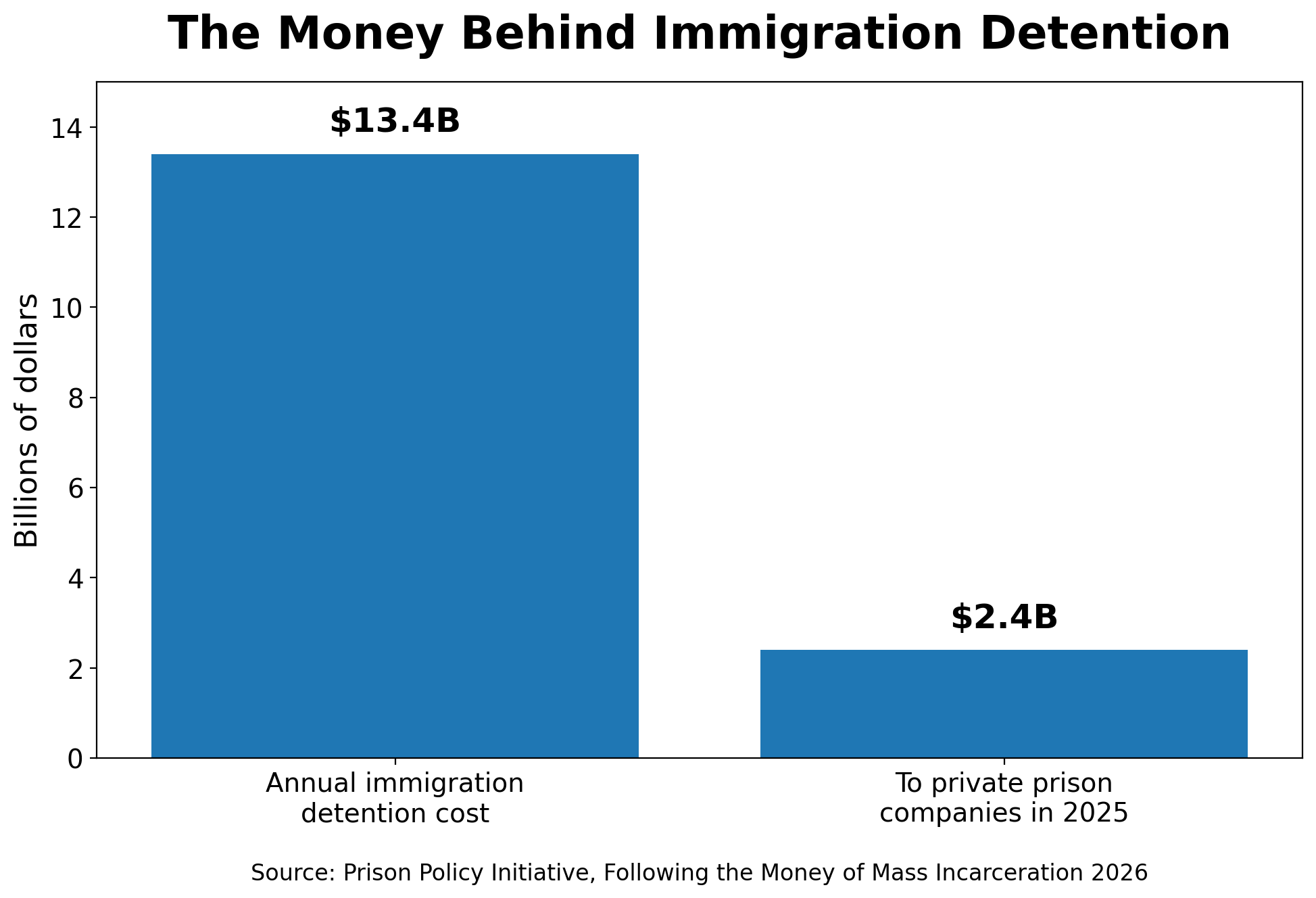
Immigration detention is not just a legal system. It is an industry. Prison Policy Initiative reports that immigration detention costs about $13.4 billion a year, with $2.4 billion in 2025 going to private prison companies operating immigration detention.
This is why the word “caging” matters.
Detention is not an abstraction. It is the physical endpoint of the paperwork. When status is revoked, ICE gets new targets. When ICE gets new targets, detention beds fill. When detention beds fill, contractors get paid. When contractors get paid, the machinery gains another reason to keep expanding.
That is the flow: paperwork to deportability, deportability to detention, detention to profit.
The Boston case shows the mechanics clearly. The court blocked the first sweeping revocation effort because the government failed to justify it. The administration returned with new paperwork. The public still does not have a full accounting of the reasoning behind the new decision, but the direction is clear: DHS wants another path to the same outcome.
Strip the status.
Create the targets.
Feed the machine.
The shift also changes the burden on the public. It is easy to respond to viral footage. It is harder to respond to a status report. It is easy to recognize violence when agents slam someone to the ground. It is harder to recognize violence when it arrives through legal language, agency memos, and technical filings.
That is exactly why it has to be named.
The quiet phase is not the moderate phase. It is not the restrained phase. It is the bureaucratic phase.
A visible raid shows the public what the state is doing. A paperwork campaign hides the violence inside procedure. But the endpoint is the same: people detained, families destabilized, communities threatened, and ICE supplied with another population to cage.
The administration’s retreat from spectacle should not be mistaken for a retreat from cruelty. The strategy is not less dangerous because it is less loud. It may be more dangerous because it is easier for the public to miss.
That is the warning.
ICE does not need constant public raids if the administration can create deportation targets through mass legal-status revocations. It does not need every arrest to begin with a chase if the government can first transform legally present people into “removable” people on paper. It does not need to prove the “violent criminal” narrative if the machinery can keep running on bureaucratic reclassification.
The crackdown did not end.
It moved upstream.
It moved into the paperwork that determines who gets to remain visible as a person and who gets converted into an enforcement category. It moved into the memos that tell courts the government has decided parole is no longer appropriate. It moved into notices that can turn a legally present immigrant into a person ICE can pursue. It moved into the quiet machinery that builds the target list before the raid begins.
That is why the phrase “immigrants with legal status” cannot be softened.
This is not a side issue. It is the new center of the strategy. Trump’s deportation campaign is no longer only about who ICE can grab. It is about who the administration can legally destabilize first.
The real-time shift is visible in the numbers: ICE arrests dropping nearly 12% after public backlash, tens of thousands of people still held in immigration detention, more than 900,000 CBP One parolees facing renewed legal-status termination, and billions of dollars flowing through the detention system.
That is not a retreat.
That is a deportation machine learning how to keep moving with less public noise.
The next phase of resistance has to meet the strategy where it is happening. Not only at the raid. Not only at the detention center. Not only after someone disappears into custody. The fight has to begin at the paperwork stage, where the target list is created and legal presence is converted into vulnerability.
Because once the status is revoked, ICE does not have to invent the target.
The government already did.
This is why Americans Against ICE exists: to track the machinery before it disappears people into paperwork, detention, and silence.
ICE accountability cannot wait until the raid is viral. It has to start where the targeting begins — in the policies, contracts, memos, legal filings, and funding streams that make the cage possible.
Upgrade to a paid subscription to support the work and stay with the documentation:
Sources: Reuters, Associated Press, TRAC Immigration, Prison Policy Initiative.
Stop worrying about preventing Martial Law. ICE IS MARTIAL LAW. We are already being killed, maimed, and hunted by an armed militia backed by the power of the government. Everything you're afraid will happen with Martial Law is already happening.
Coming up: Democrats. Wake up, people!