

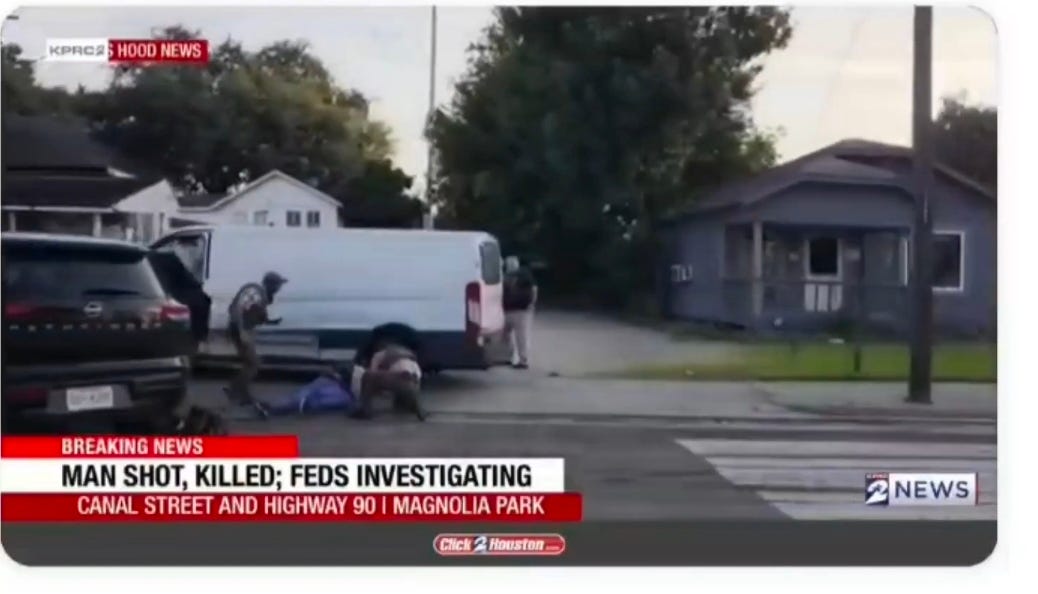
Lorenzo Salgado Araujo is dead after an ICE agent shot him during a traffic stop in Houston.
ICE says agents stopped Salgado Araujo around 6:50 a.m. during what the agency called a targeted enforcement operation. The agency described him as a Mexican national and used its usual dehumanizing language to frame him through immigration status before the public had seen evidence of what happened.
His son, Ronaldo Salgado, told Telemundo Houston that his father had been out that morning looking for workers in the area.
ICE’s version is different. The agency claims Salgado Araujo “weaponized his vehicle” and tried to run over an ICE officer. ICE says the confrontation ended with an agent firing in self-defense. Local law enforcement said Salgado Araujo was shot in the abdomen and taken to a hospital, where he died.
That is the center of this case: ICE killed a man during an immigration traffic stop, then released a familiar justification before the public had access to the evidence.
The phrase “weaponized his vehicle” does a lot of work for the agency. It turns a traffic stop into a claimed battlefield. It turns the dead man into the alleged threat. It gives ICE a ready-made explanation for deadly force before footage, communications, witness accounts, and independent review are available to the public.
The public should not accept that statement as truth because ICE said it first.
ICE has not publicly produced evidence corroborating its account. The FBI is expected to take over the investigation. Civil-rights advocates and elected officials are already demanding transparency, including preservation and review of available footage, communications, and other evidence.
That demand matters because ICE’s own statement is not accountability. It is the agency’s first defense of its own officer after a man was killed.
The Texas Civil Rights Project condemned the use of force and called for full transparency, an independent investigation, and accountability for the shooting. Rochelle Garza, the group’s president, said communities are not battlegrounds. U.S. Representative Sylvia Garcia of Houston also called for a complete and transparent accounting and said Salgado Araujo’s family and constituents deserve to know what happened.
When an immigration agent kills someone, the public should not be asked to accept the agency’s account before the evidence is public. ICE controls the first narrative after its own officer fires the fatal shot. That makes independent evidence essential, not optional.
The family’s account also matters. Salgado Araujo’s son said his father had gone out looking for workers that morning. That detail does not answer every question about the stop, but it pushes against the agency’s attempt to reduce him to a threat label. He was a man with a family before ICE turned him into a justification for force.
The “weaponized vehicle” claim must be treated with care because this language has appeared before.
In other ICE shootings, government descriptions of vehicles as threats have later been challenged or contradicted by video evidence. The killing of Renee Good in Minneapolis and shootings involving Venezuelan men in Oregon were both followed by official accounts that came under scrutiny after visual evidence emerged. In another California traffic-stop case, the federal government claimed a man “weaponized his vehicle,” even though no officers were hit by his car.
That pattern does not prove what happened in Houston. It does show why ICE’s wording cannot be treated as neutral fact.
The agency has an institutional interest in defending its officer, its operation, and its use of force. It also has a political interest in criminalizing the person killed. The public needs footage, radio communications, body-camera material if it exists, vehicle positioning, witness accounts, medical records, and a full independent timeline.
Without that evidence, ICE’s statement remains an agency account, not accountability.
The deeper issue is not only one shooting. It is the power ICE carries into ordinary places. A person can be stopped in the early morning, framed through immigration enforcement, accused after death by the same agency that used force, and turned into a public threat before the public knows what the evidence shows.
Deadly enforcement narratives often begin this way: the stop, the force, the agency statement, and then the language meant to make the shooting sound inevitable — targeted operation, illegal alien, weaponized vehicle, self-defense. By the time an investigation begins, the dead person has already been introduced to the public through ICE’s version of why force was necessary.
Lorenzo Salgado Araujo does not get to answer that version.
Transparency cannot wait. His family deserves more than a government explanation written by the agency involved in his death. Houston deserves more than a press statement. The public deserves to see whether ICE’s claim matches the evidence.
An immigration stop should not become a death sentence hidden behind agency language.
ICE used deadly force in Houston. Lorenzo Salgado Araujo died. The agency says he weaponized his vehicle, but it has not publicly produced evidence for that claim. Until the evidence is released and independently reviewed, ICE’s account should not be treated as the final story.
It should be treated as the first version offered by the agency whose officer killed him.
ICE should not get to kill someone, criminalize the dead, and control the public story before the evidence is released.
Americans Against ICE documents deadly enforcement, custody violence, medical neglect, family separation, and the machinery that turns immigrants into threats after harm is already done.
Support the work.
ICE stories never change….”,They tried to run me down”, “They were reaching for a gun” …..Yeah Yeah….. everyone lies except tRump and ICE.
Whenever deadly force is used by any government agency, transparency isn't optional; it's essential.
The family deserves clear answers. The officers deserve a fair investigation. And the public deserves evidence rather than competing narratives.
No matter who is involved, I think the same principle should apply: release the available evidence, conduct an independent investigation, and let the facts lead the conclusions instead of allowing conclusions to race ahead of the facts.
A loss of human life should never become just another headline or another political talking point. It deserves honesty, accountability, and compassion for everyone affected.
Stay entangled, my friend.
—The Bathrobe Guy