

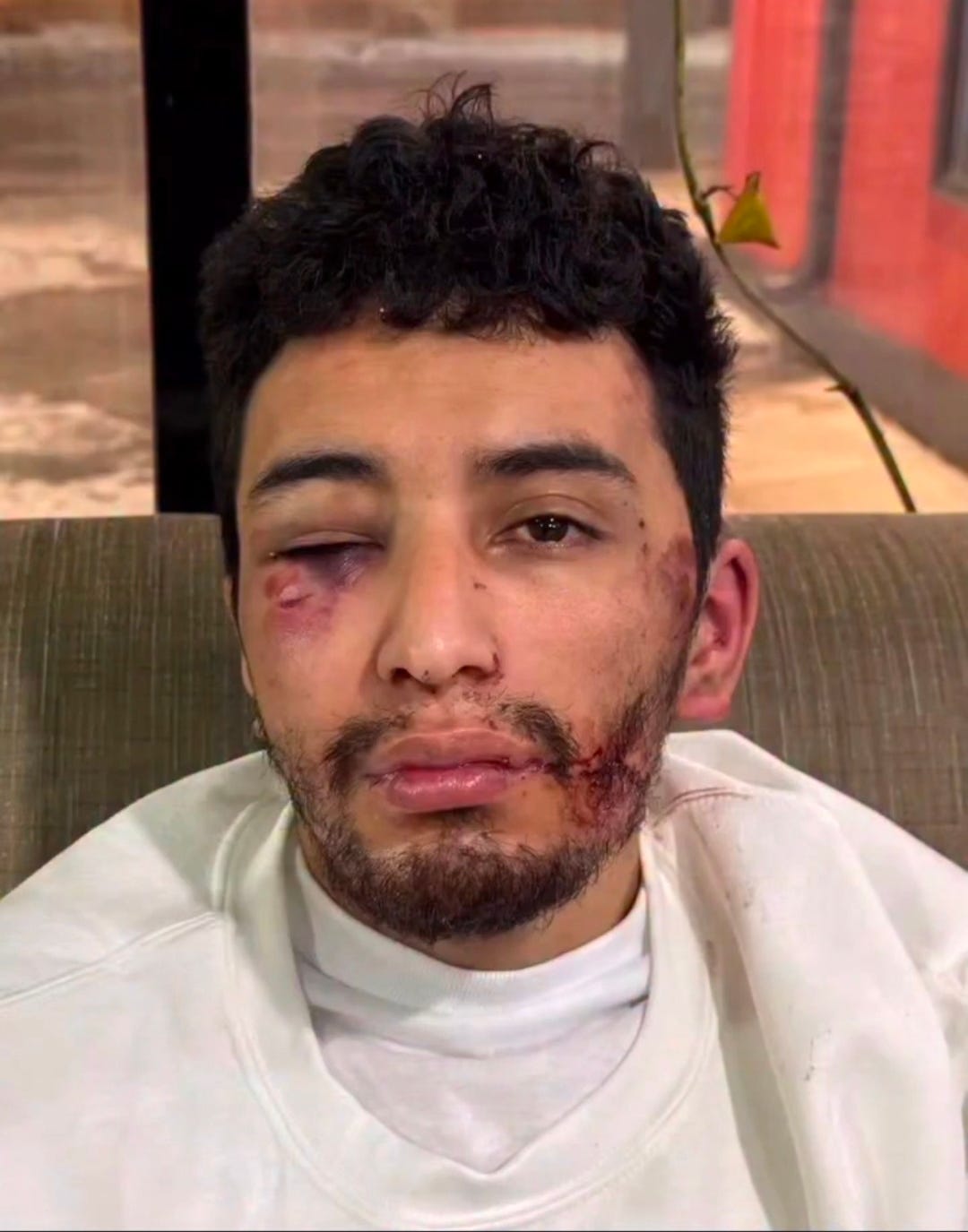
Many of you remember the harrowing images of Juan Carlos — a U.S. citizen and neighbor — after federal agents violently beat and wrongfully detained him during Operation Metro Surge in Minneapolis.
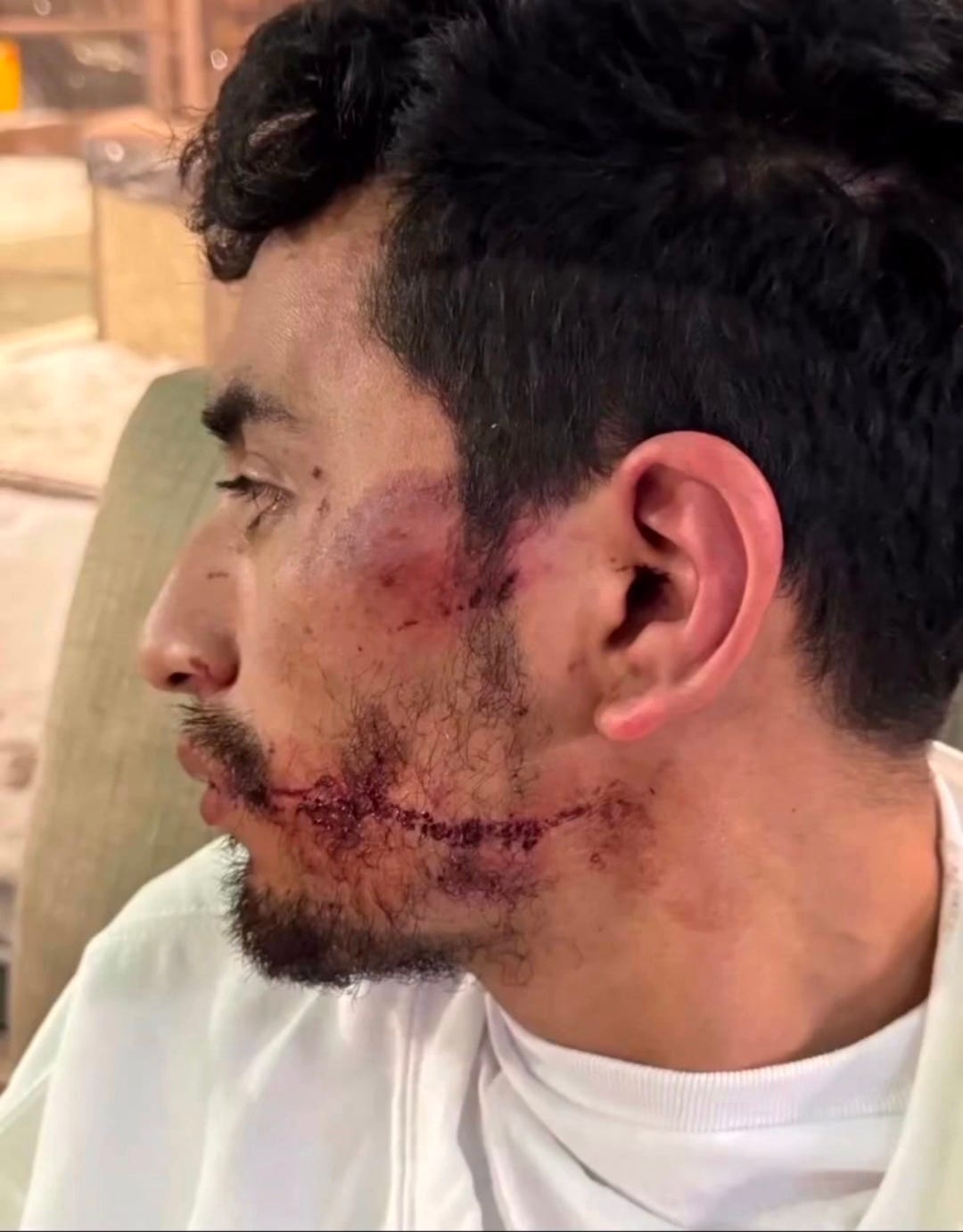
The images were impossible to look away from. His eye was bruised and swollen. His face was cut. His cheek and jawline carried visible wounds. His arm showed abrasions and blood. A federal violation notice reduced the encounter to paperwork, but the photos showed what the paperwork could not hide: ICE and federal agents left a U.S. citizen injured, marked, and forced into a system that then tried to process the violence as if it were routine.
That is the part the public was supposed to forget.
The video circulated. The images moved. People reacted. Then the story began to slip out of the news cycle, not because Juan Carlos was made whole, not because ICE and DHS were held accountable, and not because the federal agents involved were forced into public scrutiny. The media moved on at the exact stage where accountability was supposed to begin.
That is why this update matters.
Juan Carlos’s legal team is preparing a wrongful arrest and civil-rights lawsuit after federal agents beat him, shackled him, detained him, and left him recovering from the physical and emotional harm. His attorneys are seeking a formal apology and damages for what was done to him. That demand is not symbolic. A formal apology matters because ICE and DHS do not get to violently beat a U.S. citizen, label the aftermath enforcement, and move on as if no public record is owed.
Damages matter because harm does not disappear when the camera stops recording. The bruises heal before the trauma does. The paperwork outlives the video. The agencies involved depend on the public losing interest before the record is fully built. A lawsuit matters because ICE and federal agents should not be allowed to hide behind uniforms, paperwork, or agency silence after inflicting violence on someone they had no right to brutalize.
Juan Carlos’s case also sits inside something larger than one arrest.
Operation Metro Surge was not a normal law-enforcement action. Minnesota Attorney General Keith Ellison, Minneapolis, and St. Paul have expanded their lawsuit against DHS and related federal agencies, arguing that Operation Metro Surge violated the law and the Constitution. The amended complaint seeks to have the federal surge declared unconstitutional and unlawful. It also adds new data about the harm DHS inflicted across Minneapolis, St. Paul, workers, families, and local businesses.
That harm was not abstract. According to the Minnesota Attorney General’s Office, experts estimate that Minneapolis and St. Paul residents lost more than $240 million in wages during Operation Metro Surge, while businesses in the two cities lost more than $600 million in revenue. The same update says survey data showed clear racial bias in DHS actions.
This is what ICE and DHS brought into Minnesota: violence against people, fear in neighborhoods, missed work, lost wages, closed doors, avoided medical care, damaged businesses, and a civic wound that did not end when federal agents left the street. ICE did not just target individuals. DHS dragged federal force through whole communities and left workers, families, and neighbors carrying the cost.
The amended lawsuit also says DHS agents entered Minnesota in unprecedented numbers and inflicted severe harm on residents, cities, and businesses. Ellison described the surge as unlawful and said DHS agents took lives and caused severe harm during the operation. His office is asking the court to stop Minnesota from ever having to endure another violent federal operation like this again.
That language matters because it names what happened. It does not hide behind the soft vocabulary of “operations,” “enforcement actions,” or “public safety.” It names the federal presence as violent, destructive, and harmful.
Juan Carlos’s injuries belong inside that record.

There is another accountability update that cannot be separated from this pattern.
Hennepin County has charged ICE agent Gregory Donnell Morgan Jr. with two counts of second-degree assault in a separate February incident connected to the same federal surge environment. According to the Hennepin County Attorney’s Office, Morgan allegedly brandished and pointed his duty weapon at two people while driving alongside them on Highway 62. The county attorney’s office said there was an active nationwide warrant for his arrest.
That case is separate from Juan Carlos’s case, but it matters because it shows the violence was not imaginary, isolated, or harmless. It shows that the federal surge did not merely create “concerns.” It created a field of danger around ICE and federal agents operating with force, fear, and impunity.
Hennepin County Attorney Mary Moriarty described the charges as an important milestone in seeking accountability for harms inflicted on the community during Metro Surge. Her office also made clear that other federal-agent conduct remained under investigation. That is the accountability stage the media keeps failing to follow.
The initial violence gets attention because bruises are visible. Blood is visible. A swollen eye is visible. A video of federal agents forcing someone down is visible. But lawsuits, amended complaints, damages, warrants, civil-rights claims, internal investigations, and charging decisions move slowly. They require sustained attention. They require newsrooms to stay with the victim after the public has already been shocked.
Too often, that is where the media disappears.
Juan Carlos was violently beaten by federal agents, and the public saw what ICE and DHS did to him. But the harder question now is whether the media will keep covering the case when the story is no longer just an image, but a record.
Because this is how state violence survives.
First, the harm becomes visible. Then officials wait. Agencies refuse to answer. The legal process slows down. Reporters move to the next outrage. The public is told, directly or indirectly, that the story is old. And while everyone looks elsewhere, the person who was harmed is left to heal alone while the institutions responsible remain intact.
That is not an accident. It is a pattern.
ICE and DHS benefit when the public only watches the violence and not the aftermath. They benefit when the footage goes viral but the lawsuit does not. They benefit when a man’s bruised face gets shared for one day, but the names, agencies, officers, supervisors, policies, and court filings are allowed to fade into procedural silence.
Juan Carlos’s case cannot be treated that way.
He is not a symbol to be used and abandoned. He is a person. A U.S. citizen. A neighbor. A man who was left visibly injured after federal agents turned a Minneapolis street into another scene of federal violence. His face showed the consequences. His body carried the proof. His case now demands the kind of attention that does not disappear when the images stop circulating.
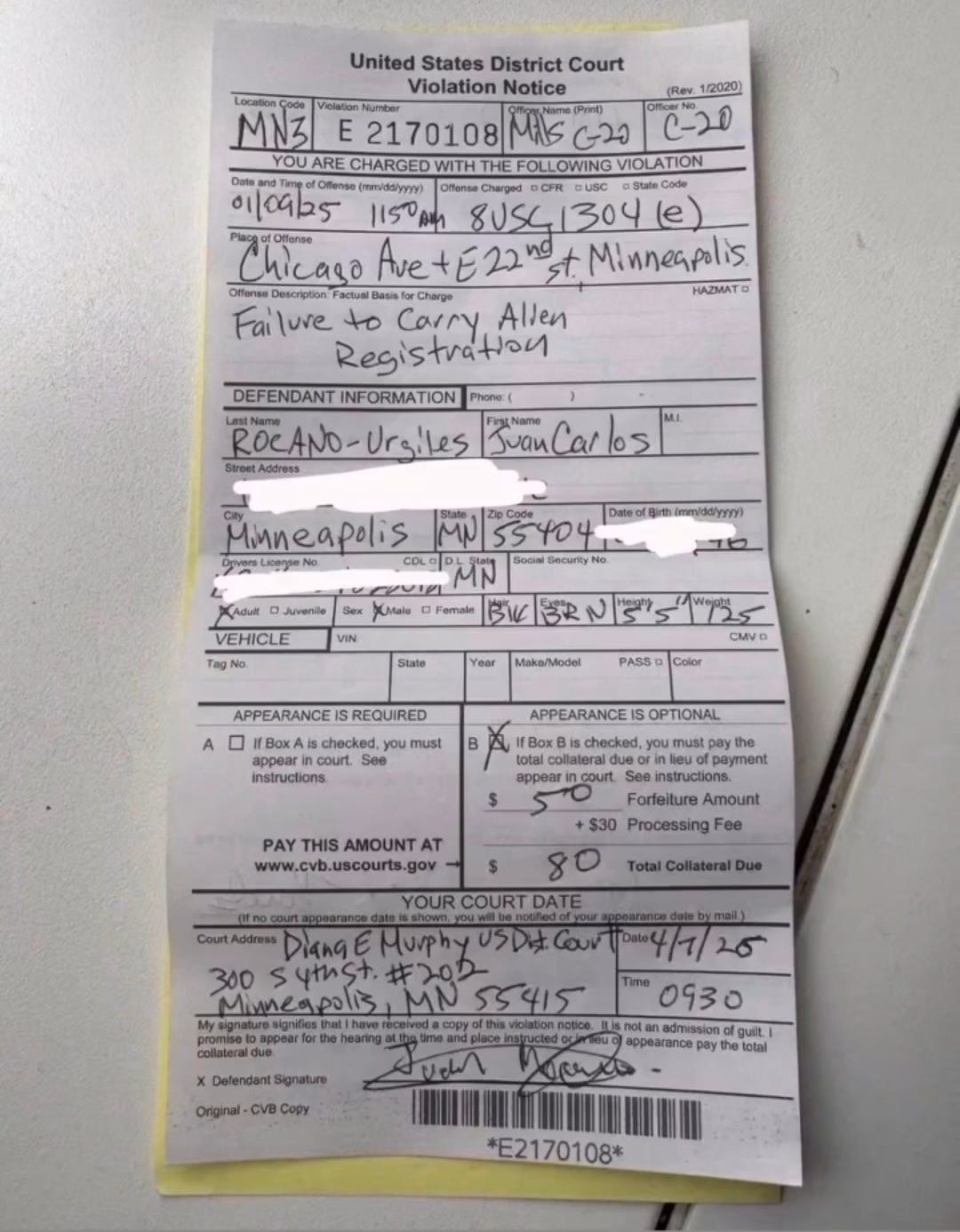
The violation notice is part of the story, too.
It shows how quickly the federal system can try to turn violence into paperwork. A person can be beaten, bruised, cut, shackled, and detained — and then the record can be made to look like a routine charge, a box checked, a court date, a fee, a processed event.
That is how institutions launder harm.
They take the blood out of the language. They take the bruises out of the form. They make the violence look administrative. They reduce a person’s injury to a case number, then depend on the public to stop reading.
But the photos and the paper belong together. One shows what ICE and federal agents did. The other shows how the system tried to process what happened afterward.
That is why this cannot be covered as one man’s isolated experience. Operation Metro Surge damaged people across Minneapolis and St. Paul. It drove residents away from work, medical care, businesses, and public life. The Attorney General’s updated lawsuit says residents who encountered DHS agents were significantly more likely to miss work, avoid medical appointments, and distrust law enforcement afterward.
The lawsuit also says people of color in Minneapolis were more likely than white respondents to be questioned about race, ethnicity, national origin, immigration, or citizenship, and more likely to be distrusted even after showing ID. That is not public safety. That is federal racial targeting dressed up as enforcement.
Juan Carlos’s injuries sit inside that broader pattern: ICE and DHS entering communities, using force, creating fear, damaging lives, then leaving the victims and cities to carry the cost.
The media cannot claim it covered the story if it only covered the moment of harm.
The story is the beating. The story is the wrongful detention. The story is the lawsuit being prepared. The story is the demand for apology and damages. The story is the state lawsuit against DHS. The story is the economic damage. The story is the racial targeting. The story is the ICE agent charged in a separate assault case. The story is the growing public record of what federal agents did in Minnesota.
And the story is the silence that follows when institutions hope everyone moves on.
That silence protects ICE. It protects DHS. It protects federal agents who use force and expect the public to lose focus before accountability arrives. It protects a political system that treats immigrant communities, Black and brown neighborhoods, workers, and bystanders as acceptable damage.
Juan Carlos’s case should be a test for every newsroom that covered the viral images. Covering the bruises was not enough. The accountability record is the story now: the lawsuit, the federal actors, the DHS chain of command, the agents who used force, and the public filings that will show what ICE and federal agencies did in Minneapolis. A newsroom that leaves now is not “moving on.” It is abandoning the victim at the exact stage where power hopes the public stops watching.
That is the question now.
Juan Carlos’s story cannot go quiet because the people who harmed him are depending on quiet. ICE and DHS are depending on delay. The federal government is depending on procedural fog. The media is depending on the public moving on.
But the record is still being built.
Juan Carlos deserves more than a viral moment. He deserves accountability, damages, a formal apology, and a public record that names what ICE and federal agents did to him.
Minneapolis deserves answers for what DHS brought into the city.
Every person harmed by Operation Metro Surge deserves more than silence after the cameras leave.
And the public deserves a press that does not abandon victims at the exact moment accountability begins.
Justice for Juan Carlos means the harm gets named, the record gets built, and every federal actor involved is forced into public accountability.
Support Americans Against ICE.
ICE and DHS rely on silence, delay, and public exhaustion. They count on people seeing the injury once, reacting, and moving on before the lawsuit, the charging decisions, the court filings, and the accountability record catch up.
Americans Against ICE keeps these stories in public view after the viral moment fades. This work documents the harm, names the agencies, follows the cases, exposes the records, and makes sure people like Juan Carlos are not abandoned once the images stop circulating.
Upgrade to a paid subscription and help sustain the reporting, documentation, and public pressure needed to keep ICE and DHS from burying what they did.
Source note: This article is based on public case materials, images circulated by Juan Carlos’s supporters, updates from the Minnesota Attorney General’s Office, Hennepin County Attorney’s Office statements, and ongoing reporting on Operation Metro Surge.
I appreciate this publication. The whole reason I became an activist was ICE brutality. There's such a sh*tshow of evil crap going down that it's surprisingly easy to forget these kinds if details. Now I remember reading about this incident. Hell, in any other decade this would be in the news for more than 2 days. So, by following you and seeing this stuff I am reminded why I am doing what I have been doing. So thank you. I just re-stacked.
I have been trying for months to donate a small amount to a Go Fund Me for this poor man but I receive a “Go Fund Me” paused message.