

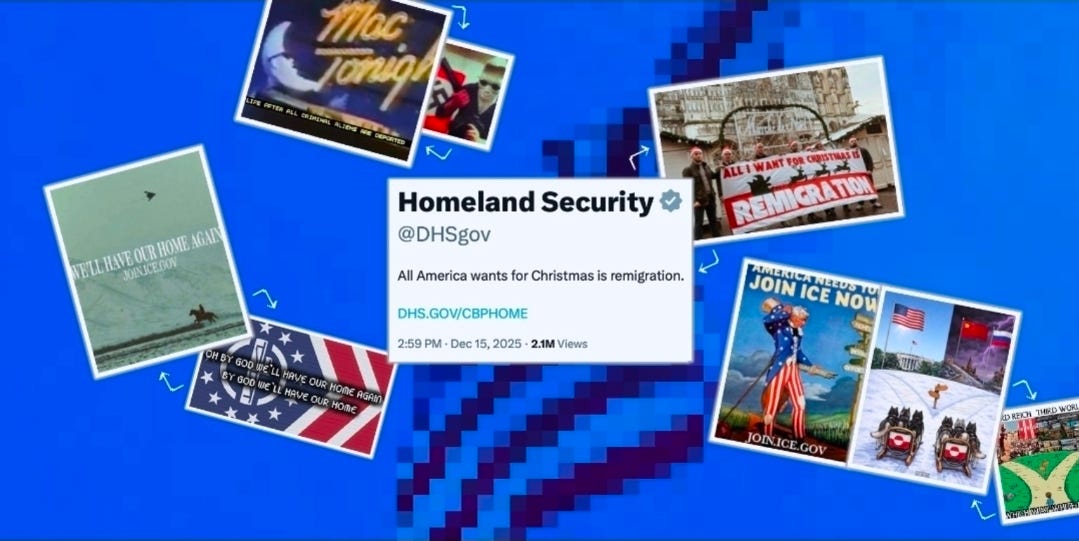
Colorado law enforcement officials warned agencies across the country that the Department of Homeland Security’s ICE recruitment campaign contained white supremacist themes dangerous enough to increase threats against immigrant communities and people perceived to be immigrants.
The warning came from the Colorado Information Analysis Center, a state fusion center that circulated an internal bulletin in March under the heading: “White Supremacy Ideology in ICE Recruitment Materials, Leading to a Potentially Increased Threat Environment.” According to the bulletin, violent extremists could read DHS messaging as permission to engage in vigilante action or violence against people they believed were immigrants.
This was not a warning about ordinary political messaging. DHS is a federal agency with armed personnel, surveillance power, detention authority, and deportation machinery. When an agency with that level of power uses language and imagery that white supremacist audiences recognize, the danger does not stay online. It moves through recruitment culture, enforcement culture, neighborhoods, workplaces, checkpoints, detention centers, and the public imagination.
For immigrant communities, the threat is not limited to raids, detention, or deportation. It is also the possibility that the agency targeting them is becoming attractive to people who already fantasize about using state power as a racial weapon.
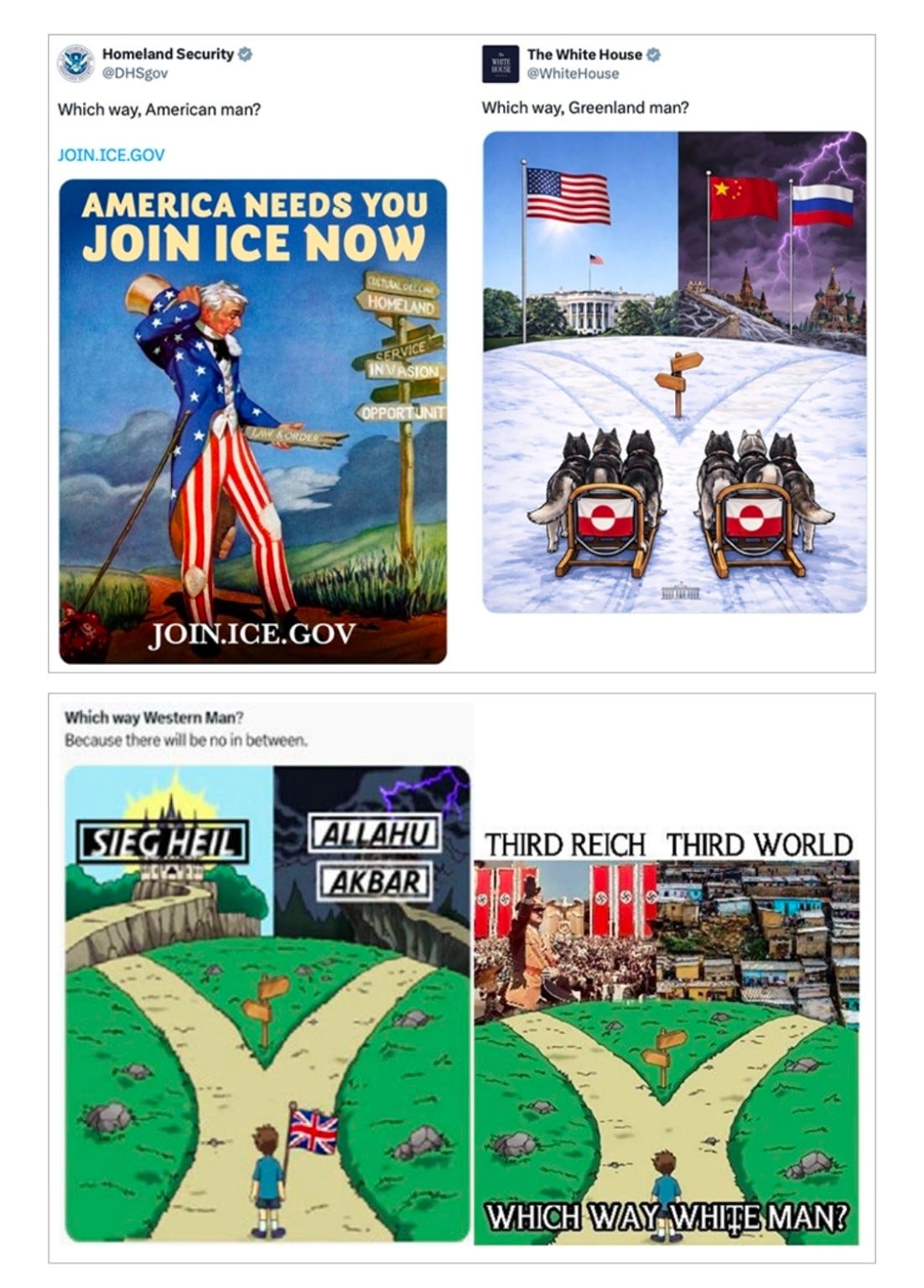
The bulletin followed months of inflammatory DHS social media posts designed to drive ICE recruitment and promote the Trump administration’s mass deportation agenda. Analysts compared federal recruitment imagery to memes popular in far-right online subcultures, including “Which way” graphics and references that have circulated in white nationalist spaces.
The issue was not only visual similarity. The deeper concern was audience recognition. DHS was using slogans, aesthetics, and coded references that extremist communities already understood. Those signals do not need to be openly explained to cause harm. Their power comes from being legible to the intended subculture while remaining deniable to the broader public.
This creates a double audience. To the general public, the material can be dismissed as aggressive branding, internet humor, or recruitment strategy. To extremist communities, it can read as recognition. When the agency sending that signal controls detention, raids, deportation, and armed enforcement, the stakes are much higher than online optics.
The Southern Poverty Law Center also accused DHS of using white nationalist imagery and language to recruit employees and arrest immigrants. DHS defended its online tactics as “bold and effective,” but the Colorado bulletin shows that law enforcement analysts saw the same material as a public safety threat.

The bulletin also flagged DHS’ use of the “Moon Man” meme, a character adopted in racist online spaces and associated with white supremacist imagery. After DHS used that style of content, extremist users responded with racist references and a genocidal anti-Black acronym.
That reaction is central to the warning. The posts were not merely offensive. They were being received by extremist audiences as a signal. The danger was not only what DHS posted. The danger was who recognized it, who felt invited by it, and what they imagined they could do with state power behind them.
Extremist culture does not always enter public machinery through open declarations. It often moves through jokes, memes, songs, slogans, recruitment posters, and coded language that allow officials to deny meaning while targeted communities absorb the threat.
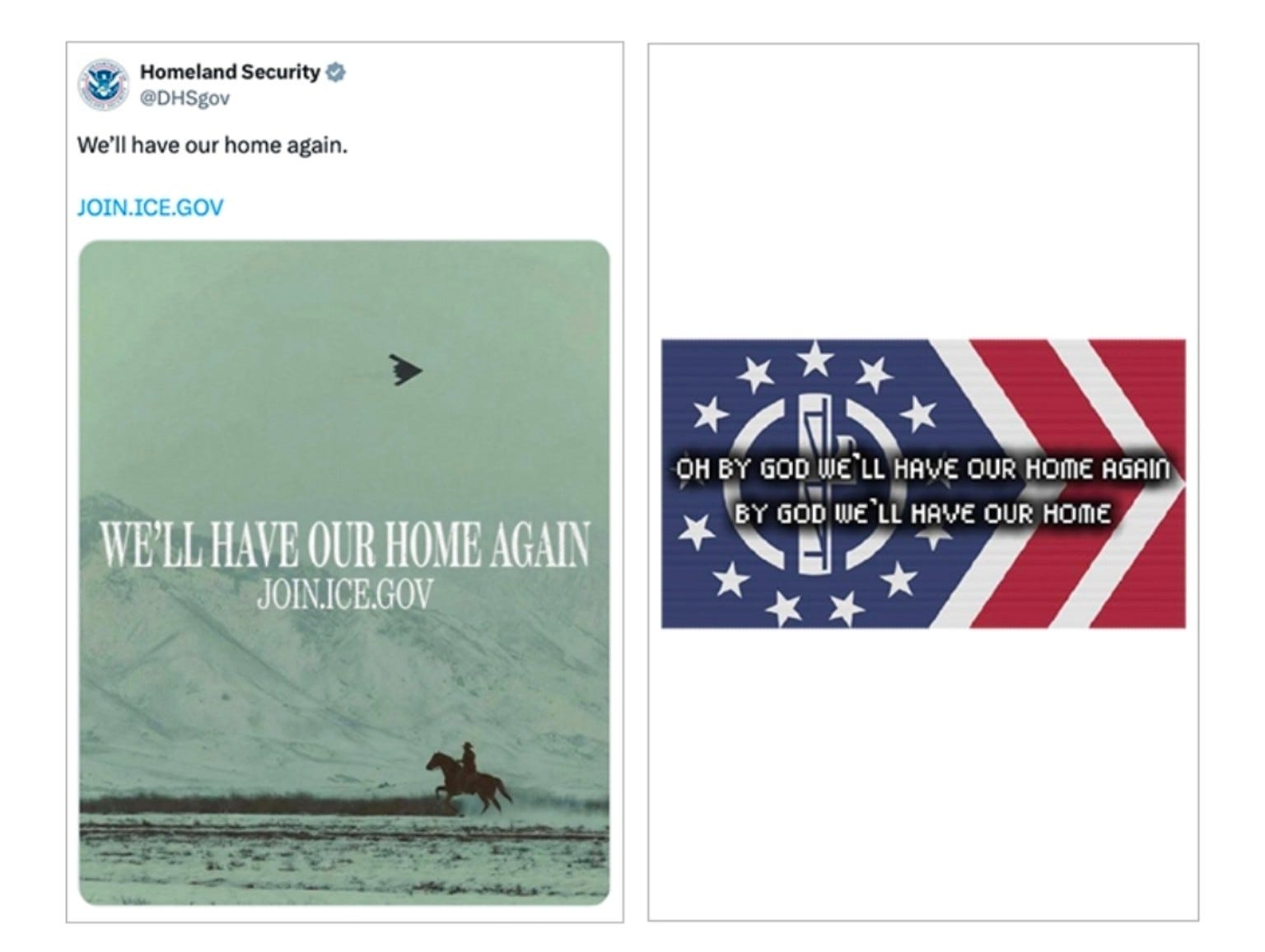
One DHS post cited in the bulletin showed a lone man on horseback with the phrase “We’ll have our home again.” Analysts warned that the phrase echoed lyrics from a song popular in white nationalist spaces. The lyrics include language about reclaiming “our home” by “blood or sweat,” a formulation often used in white supremacist rhetoric.
The phrase did not exist in isolation. Patriot Front members had reportedly chanted the refrain, and the lyrics appeared in the manifesto of the white supremacist gunman who killed Black people at a Dollar General in Jacksonville in 2023. When a federal agency uses language that has already circulated through white supremacist organizing, the consequence is not theoretical. It tells extremist audiences that their language has entered government recruitment.
Coded language works because it lets power speak in two directions at once. Officials can deny the signal while the people meant to hear it understand it clearly. Immigrant communities are then forced to live with the consequences of a message that can be sanitized in public while functioning as permission in extremist spaces.
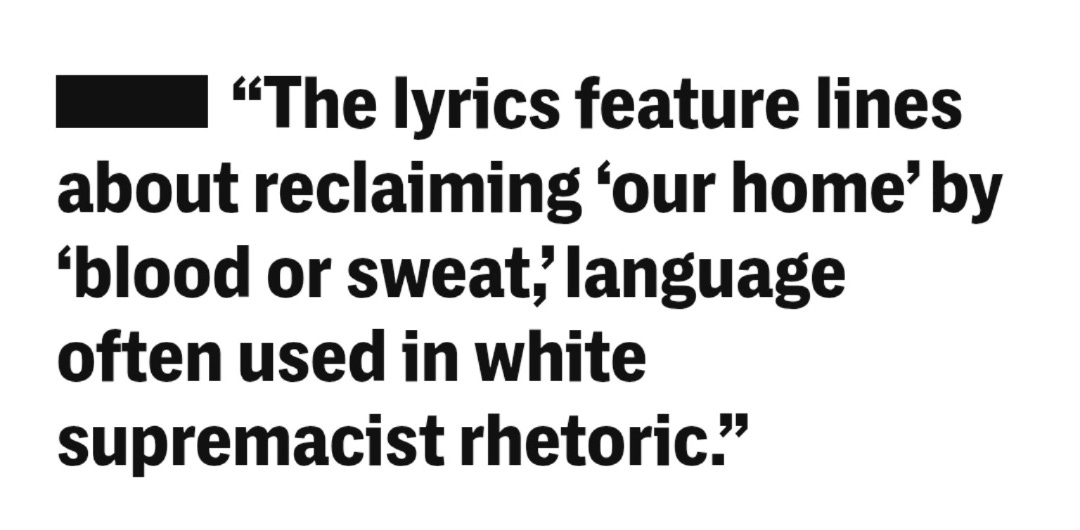
The bulletin connected DHS language to lyrics and phrases already used in white supremacist rhetoric.
DHS also used the term “remigration,” a word tied to far-right forced-expulsion politics and white nationalist organizing. In those spaces, “remigration” functions as sanitized language for mass removal and ethnic cleansing fantasies. When DHS places that word inside immigration enforcement messaging, it collapses the distance between extremist rhetoric and federal power.
The danger grew sharper in neo-Nazi and accelerationist spaces, where users discussed joining ICE, infiltrating immigration enforcement, and using state authority to escalate racial violence. Some described ICE as a pathway to power. Others framed immigration enforcement as a vehicle for violence against immigrants and perceived enemies.
This is one of the most serious parts of the record. The issue is not only that DHS posted propaganda with extremist overlap. The issue is that extremist communities appeared to understand the opening and began discussing how to step into the machinery.
For immigrant families, workers, students, and communities already living under state pressure, this is not an abstract intelligence concern. “People perceived to be immigrants” can mean Latino workers, brown families, Asian communities, Black immigrants, Muslim communities, Indigenous people, mixed-status households, and anyone a vigilante decides looks foreign enough to target.
The bulletin reportedly included a disclaimer that the materials did not prove DHS or ICE were ideologically aligned with white supremacist movements. That disclaimer does not erase the warning. Analysts still documented how the messaging could increase threats, encourage vigilantism, attract extremists, and create danger for the public, ICE personnel, and local law enforcement.
There was also an attempt in the bulletin to raise concern about violence from anti-fascists, but that framing cannot be allowed to blur the core danger. White supremacy has produced organized violence, mass killings, intimidation campaigns, and state-backed racial terror. Opposition to that danger is not the same as the danger itself.
What the Colorado warning exposed is a machinery problem. DHS recruitment messaging was not simply ugly or offensive. It risked creating a pipeline between extremist culture and federal immigration enforcement. It risked normalizing language that tells immigrants they are invaders, tells vigilantes they are defenders, and tells white supremacists that their fantasies are becoming policy.
That pipeline matters because ICE already operates through fear. It operates through raids, detention, surveillance, workplace intimidation, family separation, courthouse arrests, traffic stops, and local cooperation. When extremist-coded recruitment is added to that machinery, the danger expands beyond official enforcement and into the culture surrounding enforcement.
A government agency does not need to openly declare alignment with white supremacist ideology to create conditions white supremacists can exploit. It only needs to use language they recognize, frame immigrant communities as invaders, recruit around racial fear, and give extremists reason to believe the state is moving in their direction.
The human consequence is already visible. Immigrant communities are being forced to live under a government campaign that treats them as threats before it treats them as human beings. When federal recruitment materials overlap with white supremacist themes, the message received by those communities is clear: the state is not only targeting them; it may also be inviting the people who hate them to join.
State cruelty spreads through permission structures. A post becomes a slogan. A slogan becomes a recruiting tool. A recruiting tool becomes an entry point. An entry point becomes a person with a badge, a gun, a detention key, a patrol route, or a tip line.
Americans Against ICE exists because this pattern cannot be allowed to disappear into bureaucratic language. ICE does not operate only through raids and detention beds. It operates through recruitment, propaganda, racial fear, surveillance, and a political culture that teaches the public to see immigrant communities as threats before they are seen as human beings.
Cruelty becomes normal when the state names people as invaders, recruits around that fear, watches extremists hear the invitation, and then leaves immigrant communities to live with the consequences while officials deny the pattern everyone else can see.
This reporting keeps that record public: the raids, the detention system, the recruitment machinery, the white nationalist signals, and the immigrant communities forced to live under the danger.
Help keep Americans Against ICE independent.
DUH!