

ICE didn’t just expand operations. It changed what public space feels like.
When masked agents show up in unmarked vehicles and enforcement happens without clear identification, people learn a new reflex: don’t open the door, don’t approach the scene, don’t assume a uniform means safety. That reflex doesn’t stay contained to immigrants and mixed-status families. It spreads across neighborhoods, because fear spreads.
Now local police departments are admitting what communities have already been living. Internal emails and briefings show rising alarm that residents can’t reliably distinguish local officers and public employees from ICE. That isn’t a branding problem. It is the collapse of basic trust — and it is a predictable outcome of an enforcement strategy that operates facelessly.
This is why the “police disruption” angle matters for the public: not because police deserve sympathy, but because their concern functions as an admission. If even local departments are scrambling to prove they are not ICE, it means ICE has contaminated ordinary civic life so thoroughly that “who is this?” has become a safety question.
People stop opening the door
Cities are reporting residents refusing to answer the door for municipal workers. Inspections get turned away. City staff are instructed to identify themselves verbally and with official identification. Departments adjust procedures because the public no longer feels safe letting anyone in.
That is what this looks like on the ground: public services running into fear that ICE created. A person doesn’t have to be “political” to refuse the door. They only have to believe that a knock could bring harm.
At the same time, uncertainty spreads in the other direction: 911 calls spike around “possible ICE sightings,” while other residents avoid calling entirely because they don’t want any interaction with law enforcement. That is the public-safety consequence of anonymous enforcement: people withdraw.
“ICE or not?” becomes routine
Police departments say misidentification is affecting routine work. Officers describe being monitored or confronted by civilians who assume they are ICE. Municipal units worry their vehicles resemble ICE vans. City communications teams rush to publish “how to tell we’re not ICE” guidance because residents are filming, recording, and asking the same question in real time: who is this?
That question is not irrational. ICE’s tactics have taught people to expect denial, concealment, and refusal to identify. Once that lesson spreads, every uniform inherits the fear.
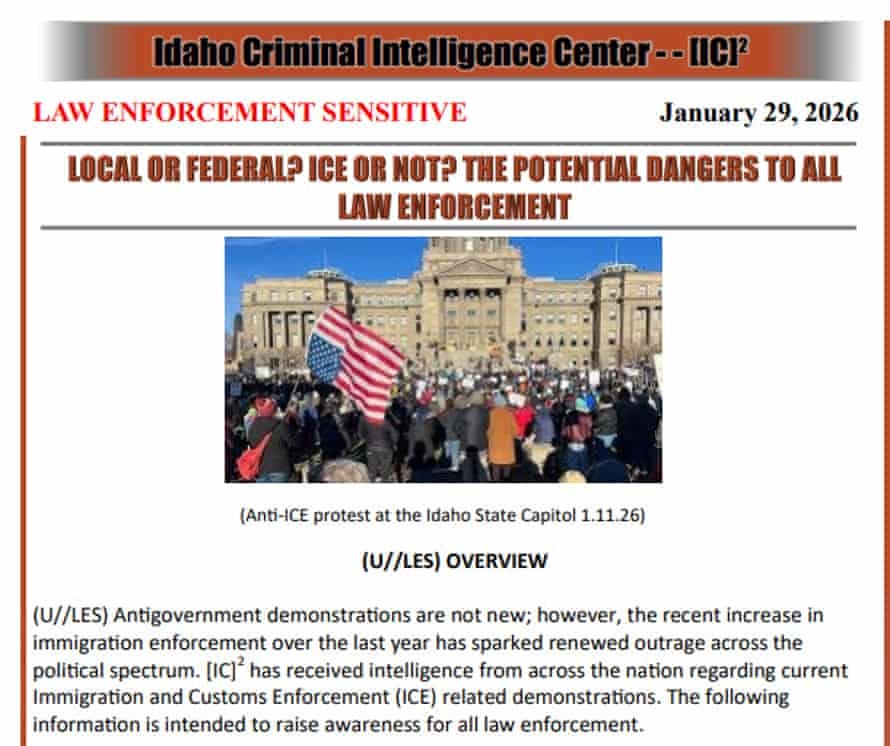
This bulletin is revealing for what it concedes: ICE-style operations are producing widespread misidentification risk. The memo frames it as an “officer safety” issue, but the underlying reality is bigger — when the public cannot reliably identify who is detaining someone, accountability collapses. A faceless enforcement model makes every encounter feel like a threat, and it teaches the public that asking questions may not protect them.
Cities are adapting to ICE’s footprint
Cities are not issuing new badges and posting vehicle photos because they love social media. They are doing it because residents are afraid. Municipal officials are being forced to show, in detail, what legitimate city vehicles look like and how city personnel identify themselves — explicitly as a contrast to ICE.
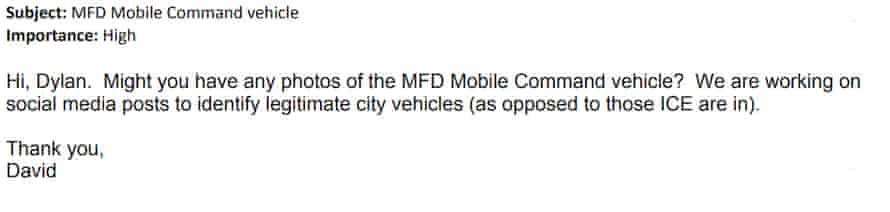
That line is the consequence in plain words. ICE’s choice to operate masked and unmarked forces cities to perform legitimacy just to keep ordinary services functioning. When legitimacy becomes a performance, the people harmed most are the people already living under the most risk: immigrants, mixed-status families, and communities treated as disposable.
A public that can’t identify power can’t hold power accountable
When masked agents seize people in unmarked vehicles, it isn’t only the detained person who is harmed. It is everyone who witnesses it and learns the lesson: you don’t know who did it, you can’t verify what you saw, and time will be used to blur the record.
Local police departments warning that immigration operations are interfering with local policing is not the moral center of this story. It is corroboration. It shows that ICE’s tactics are destabilizing the public square so severely that even other agencies are scrambling to separate themselves from it.
The solution is not better talking points. It is ending the masked, unmarked, deniable enforcement model that is training the public to fear daily life.
If people are afraid to open the door for city workers because ICE has taught them that “official” does not mean safe, then ICE has already achieved its effect: retreat, silence, and compliance.
When public space is turned into a fear response, accountability becomes harder to reach — because people retreat, evidence fades, and harm gets normalized.
Support Americans Against ICE to keep documentation, pressure, and public record-building relentless.
What a shock! If only there was some way we could have known. /s
Then quit helping them and get on the side of the citizens of we the people