
Texas Gave ICE Protest Defendants Decades in Prison. Families Say the State Took Their Futures.
Eight people tied to a protest outside Prairieland Detention Center received 30- to 100-year sentences as Trump officials celebrated the case as an “Antifa” victory.

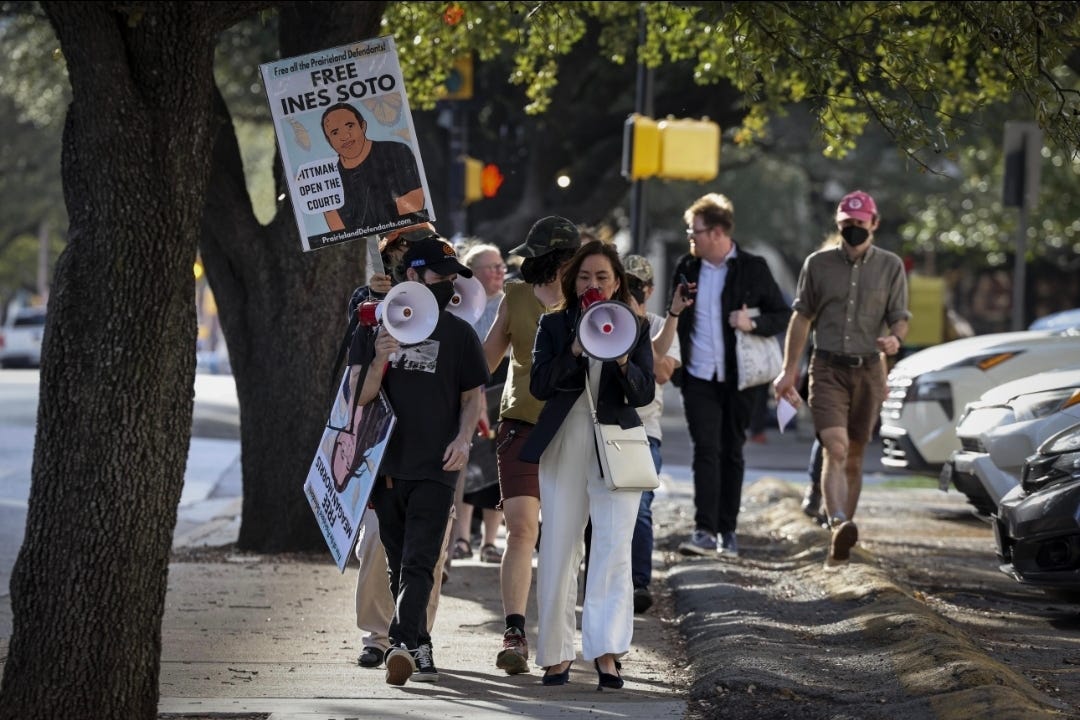
Families walked out of federal court in Fort Worth facing a reality that will shape the rest of their lives: eight people tied to a protest outside the Prairieland Detention Center had been sentenced to decades in prison.
Benjamin Song received 100 years. Seven others received sentences ranging from 30 to 70 years. Autumn Hill and Savanna Batten each received 50 years. Daniel Sanchez Estrada received 30 years, even as his attorney said he was not at Prairieland the night of the shooting and was convicted only on charges tied to concealing documents.
For their families and supporters, the sentences were not only punishments. They were decades of life taken away.
Lydia Koza, whose wife Autumn Hill was sentenced to 50 years, told AP she was livid and said the government wanted to take her wife’s entire life away because she attended a protest. She pointed to the fact that nobody died.
That is the human center of the case: spouses, families, friends, and communities watching people lose decades of their lives while the government turns the case into a political symbol.
The protest happened outside the Prairieland Detention Center in Alvarado, Texas, an immigration detention facility. The case drew national attention after a police officer was wounded and federal prosecutors described the case as terrorism linked to “Antifa.” Defense attorneys denied Antifa ties, and relatives expressed shock and anger over the sentences.
Trump administration officials celebrated the sentencing as a victory over “Antifa.” That celebration matters because it turns punishment into messaging. The state did not only sentence eight people. It held up their sentences as a warning.
For anti-ICE protesters, immigrant-rights organizers, and communities opposed to detention and deportation, the warning is clear: protest near ICE infrastructure can be branded as extremism and punished for decades.
That does not require every defendant to have done the same act. The record already shows they did not all receive the same charges, and attorneys said some were not armed, did not plan violence, or were not present at the detention center that night. What connects the sentences now is the political frame placed over them.
The government’s framing gives the sentences a reach beyond the courtroom. Supporters say the “Antifa” label turns the prosecution into a warning about what can happen when opposition to ICE detention is treated as extremism.
A police officer was wounded, and that remains part of the record. But the public harm also includes the punishment itself: 30- to 100-year sentences, families broken open, and a warning to protest movements about what the state may do when immigration detention is challenged.
Opposition to ICE is being watched, labeled, and punished. Americans Against ICE keeps the public record open.