

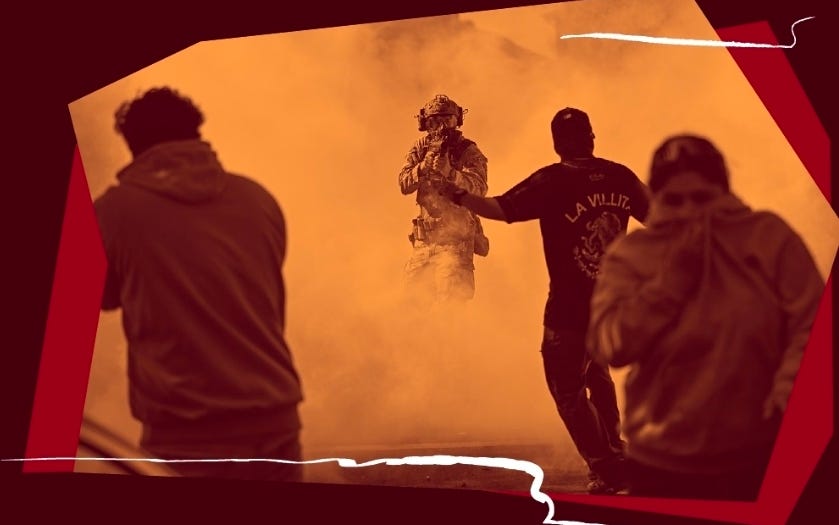
The Trump administration is amassing what the ACLU estimates as a national deportation policing force of more than 50,000 federal, state, and local officers, operating across American communities with unprecedented money, weakened oversight, and a mandate to make as many arrests as possible. This force is not confined to the border, ports of entry, detention centers, or operations against specifically identified people. It moves through residential streets, workplaces, parking lots, schools, hospitals, courthouses, shelters, places of worship, traffic stops, immigration appointments, and the ordinary spaces people depend on to live their lives.
This is not simply a larger Immigration and Customs Enforcement agency. It is an internal policing structure built from ICE and Customs and Border Protection, thousands of newly hired immigration agents, reassigned federal personnel, and state and local officers enlisted through agreements that convert ordinary police agencies into extensions of the deportation system. Congress supplied the money. Donald Trump supplied the mass-deportation mandate. Stephen Miller supplied the quota logic. DHS removed protections and weakened oversight. Together, those decisions created the scale, force, racial profiling, secrecy, and broken accountability documented across community after community.
Floridalma Sanchez-Gomez experienced that machinery in her own driveway on Florida’s eastern Treasure Coast. A Florida Highway Patrol trooper in an unmarked vehicle followed her through a largely Hispanic neighborhood in Stuart after reporting traffic violations involving tinted windows, a turn at a red light, and speeding. She pulled into her driveway, where the trooper approached with his Taser drawn, pulled the five-foot-tall asylum seeker by her shirt, pressed her against her vehicle, and issued commands in English, a language she does not speak.
Floridalma tried to comply before becoming frightened and moving toward the house. The trooper fired his Taser into her back and fired it again after she had fallen. Her brothers ran inside. Officers forced their way into the home with a crowbar and sledgehammer. Within minutes, the residential street had filled with more than a dozen state and federal officers, some carrying assault-style weapons, while a helicopter watched overhead and multiple vehicles blocked the street.
A 19-year-old U.S.-citizen neighbor was arrested for standing too close while objecting to what officers were doing. Floridalma’s 13-year-old niece returned from school to find the front door broken, federal agents on the lawn, no adult waiting for her, and members of her family gone. A neighbor described the child as wide-eyed and shaking. One of Floridalma’s brothers was deported soon afterward.
The administration can divide that sequence into the separate language of traffic enforcement, resisting an officer, immigration authority, officer safety, and interagency cooperation. The human record is more direct: a young woman was tased twice at home, armed officers overwhelmed a neighborhood, a house was broken open, a citizen observer was arrested, a child was left without her family, and responsibility was dispersed across multiple agencies.
Floridalma’s experience provides a human view of a national system. The American Civil Liberties Union reviewed more than 1,200 reported immigration-enforcement incidents during 2025 across Arizona, California, Colorado, Florida, Illinois, Louisiana, Maryland, and New Mexico. The organization described those cases as only a fraction of national enforcement activity and treated its totals as a conservative floor rather than a complete count.
Even at that floor, the pattern is extensive. The ACLU identified 432 incidents involving what its methodology classified as misconduct: force or threatened force, intimidation tactics, or retaliation against people observing or documenting enforcement. The broader incident review was not limited only to conduct already adjudicated unlawful. The report documented 375 incidents involving force or threatened force, 437 involving likely racial profiling, 372 involving masked agents, 310 involving unmarked vehicles, 119 confirmed or reported injuries following force, and 16 incidents in which agents used lethal force.
Those figures do not describe scattered operational failures inside an otherwise restrained system. They show what follows when a government demands mass arrests, eliminates enforcement priorities, expands the number of participating agencies, weakens training, removes protections around sensitive locations, and fails to create meaningful accountability.

Stephen Miller reportedly pressured ICE toward a target of 3,000 arrests a day. When an official referred to agents working through a list of targets, Miller’s reported answer exposed the governing logic: “There is no list. Everyone is fair game.” Under that approach, immigration policing ceases to be directed only at particular people supported by individualized information. It becomes a dragnet in which agents enter workplaces, parking lots, roads, neighborhoods, and gathering places to determine whom they can seize.
The report describes people targeted while buying supplies, driving to work, waiting for ride-share requests, fishing, standing near home-improvement stores, working at car washes, eating at food stands, and traveling on public roads. It documented 624 enforcement incidents in everyday locations and 252 at workplaces. State agencies with little traditional connection to immigration policing were also drawn into the system. Wildlife officers checked fishing permits while federal agents checked immigration status. Highway patrol officers converted minor traffic stops into deportation pipelines. Local police gained federal immigration authority through the 287(g) program.
Congress financed that expansion at a scale the report describes as without parallel in American history. The 2025 reconciliation law directed approximately $170 billion toward immigration enforcement over four years, including $75 billion for ICE. A subsequent 2026 law added tens of billions more for ICE, CBP, and the DHS secretary. ICE used the money to hire 12,000 agents rapidly, while training was reportedly reduced from five months to 47 days and some recruits entered training before completing vetting.
The administration also diverted personnel from agencies whose primary public missions were not immigration enforcement and offered money to state and local departments willing to join. The ACLU estimates the combined force at more than 50,000 officers, including projected state and local participation through 287(g), and warns that it continues to grow. Congressional funding made that scale possible by expanding the number of officers, agencies, vehicles, tactical resources, detention systems, and local departments capable of bringing deportation power into daily American life.
Congress did not merely increase an agency budget. It gave the Trump administration the resources to redirect law enforcement across the federal government and recruit local police into a national force whose success is measured through the volume of arrests.
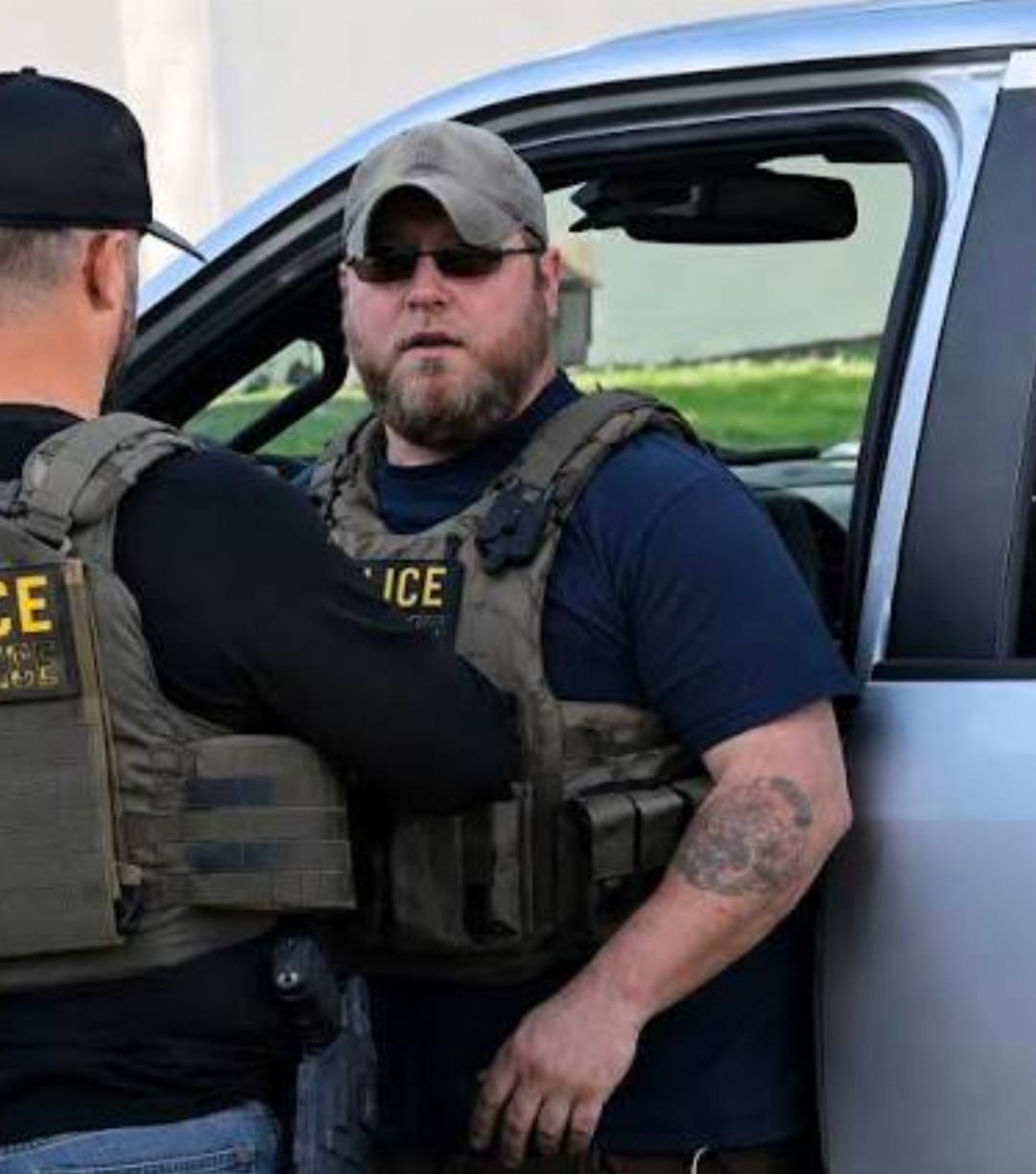
The force often operates while obscuring who its members are. The ACLU found hundreds of incidents involving masked agents and unmarked vehicles. It also identified 255 incidents involving officers whose clothing prominently displayed the word “POLICE,” sometimes while identifying the federal agency only in smaller print or not in a way bystanders could quickly understand.
For someone being surrounded, pulled from a car, chased through a neighborhood, or taken from a workplace, that concealment can make the event resemble an abduction. Witnesses may not know whether they are looking at ICE, Border Patrol, the FBI, state police, local officers deputized under federal authority, or a combination of agencies. Victims may be unable to identify the officers who injured or arrested them. Families may not know which institution took a loved one. Lawyers and journalists may struggle to trace responsibility through overlapping chains of command.
Masks and unmarked vehicles therefore do more than frighten communities; they obstruct identification and accountability. A government can expand its presence while making individual officers and responsible agencies harder to identify, investigate, sue, or expose.
The report documents force not only against people targeted for immigration arrest but also against witnesses, relatives, journalists, clergy, protesters, elected officials, legal observers, and bystanders. The ACLU identified 150 incidents involving people in those categories and found agents using force, intimidation, arrest threats, retaliation, and surveillance against people observing or documenting enforcement.
Witnesses are among the few restraints on a masked and mobile police force. A person filming an arrest can preserve evidence when officers’ identities are hidden. A journalist can compare an agency statement with video. A legal observer can document whether agents presented a warrant. A family member can record injuries. A protester can expose an operation officials would prefer to conduct without resistance.
Treating those people as threats protects the system from scrutiny. The ACLU documented agents photographing or filming people because they were watching enforcement and identified misconduct involving protesters, community observers, journalists, elected officials and their staff, and clergy. In one California church parking lot, a reverend who challenged an arrest was told, “The whole country is our property.”
That statement captures the administration’s claim to power. The force recognizes no meaningful boundary between the border and the interior, between an enforcement site and a school, between a deportation operation and a family driveway, or between the target of an arrest and the person documenting it. The whole country becomes an enforcement zone, and anyone present can become subject to command, intimidation, surveillance, force, or arrest.
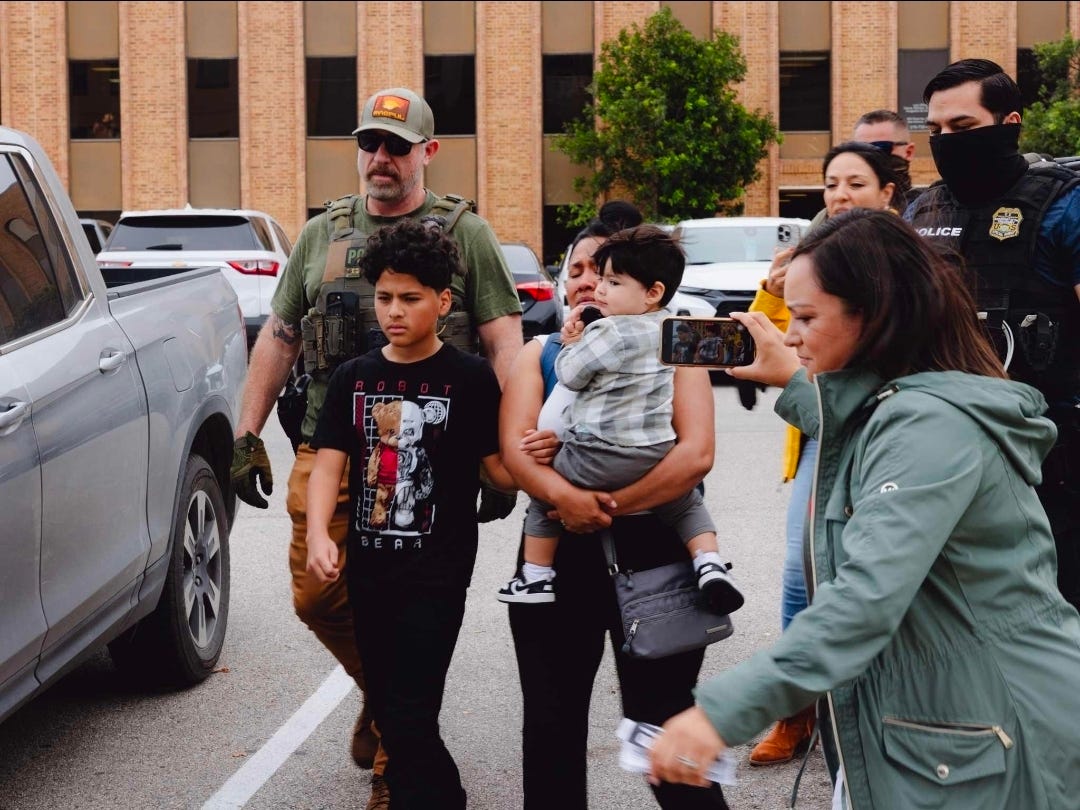
Children were not protected from that expansion. The ACLU identified 157 incidents in which children were present or targeted and 214 children who were detained, targeted for enforcement, or subjected to law-enforcement misconduct, including 32 U.S.-citizen children. Fifty-four incidents involved agents directly interrogating or detaining children.
Agents conducted operations near schools, at school drop-offs and pickups, during traffic stops, at homes, in courthouses, and at immigration check-ins. Schools entered lockdowns because enforcement was unfolding nearby. Children watched windows smashed and parents pulled from vehicles. Some were exposed to force or chemical agents as bystanders. Others were detained alongside adults.
In Bowie, Maryland, masked agents stopped a father who had just left home to drive his children to school. His three children, ages six, seven, and eight, were inside the minivan while agents smashed a window, pulled him from the vehicle, pinned him to the ground, pressed a hand to his neck, and pointed a Taser at him. The arrest reportedly occurred one day after his wife said he had completed an immigration-supervision check-in.
The administration removed the policy that had limited immigration enforcement near schools, hospitals, shelters, places of worship, and other locations where people must be able to seek education, care, safety, and assistance without fearing arrest. It also loosened restrictions on courthouse enforcement, allowing agents to target people appearing in response to government requirements.
The practical effect is to turn compliance into vulnerability. A person who appears for an immigration appointment, attends court, seeks medical care, takes a child to school, enters a shelter, or attends worship can no longer assume that the location offers even limited protection. The government tells people to appear, then positions agents where those appearances make them easier to seize.
Racial profiling is what allows a dragnet force without individualized targets to operate. When agents are sent into parking lots, roads, workplaces, and neighborhoods to find people rather than locate specifically identified individuals, they need a substitute for evidence. The ACLU found perceived race, ethnicity, language, accent, occupation, and location repeatedly serving that function.
The report identified 437 incidents involving likely racial profiling. People were questioned or detained because they spoke Spanish, worked in construction or landscaping, waited outside a home-improvement store, drove in an area associated with immigrant communities, or appeared to officers to fit an ethnic profile. This was not incidental prejudice at the system’s edges. It was an operating practice that made indiscriminate arrest goals possible.
A dragnet built around appearance inevitably reaches citizens and people with lawful status. The ACLU identified more than 200 incidents involving U.S. citizens, lawful permanent residents, green-card applicants, DACA recipients, people seeking asylum, recipients of humanitarian protection, mixed-status families, longtime residents, disabled people, people with medical needs, elderly people, pregnant or nursing people, and caregivers.
The report counted 155 U.S. citizens among those detained, targeted for enforcement, or subjected to law-enforcement misconduct, including 18 Indigenous people. It also documented lawful residents, asylum seekers, DACA recipients, people with disabilities or medical needs, pregnant and nursing people, and survivors seeking humanitarian protection.
A force advertised as targeting the “worst of the worst” was operating against citizens, children, lawful residents, people complying with immigration supervision, and people whose apparent offense was being present in a place agents associated with immigrants.
The use of force was similarly expansive. The ACLU documented agents pushing, tackling, pinning, choking, tasing, chemically spraying, striking, dragging, and threatening people with weapons. It found people pulled from vehicles, windows smashed, cars boxed in or rammed, knees and hands pressed into backs and necks, chokeholds used, and guns pointed at drivers, workers, witnesses, and crowds.
The report identified 119 confirmed or reported injuries following agent force. Sixty-nine were supported by medical visits or legal documentation; 50 were self-reported. It counted 130 instances in which agents brandished weapons and 69 in which they verbally threatened weapons or force.
The incidents reviewed by the ACLU indicate that agents used force and threatened force as default tools to compel immediate compliance rather than to respond to a threat. The force arrived armed, masked, and unidentified; boxed in vehicles; broke windows; deployed chemical irritants; and escalated routine encounters into violent scenes. In some incidents, the disorder created by those tactics was then cited to defend further escalation.
In one Colorado case, agents boxed in a father’s car as he left a courthouse with his partner and their one-month-old baby. An agent pointed a gun, another smashed the driver’s window, and flying glass cut the baby’s mother as she tried to shield the infant. In Illinois, agents grabbed construction worker Ricardo Aguayo Rodriguez as he rode his bicycle home from a grocery store, pepper-sprayed him, locked an arm around his neck, and struck his head. He was hospitalized while masked agents prevented his U.S.-citizen sister from seeing him.
These cases show a system using overwhelming force to manufacture control rather than a system occasionally losing control.
The administration further protected that force by weakening the institutions meant to monitor it. DHS oversight offices were gutted because administration officials reportedly viewed them as obstacles to operations. Training was shortened while hiring accelerated. Officers from multiple agencies were deployed under blurred authority. Victims faced restricted paths to sue federal agents for constitutional violations. Congress continued financing the expansion without repairing the accountability failures that allowed abuse to recur.
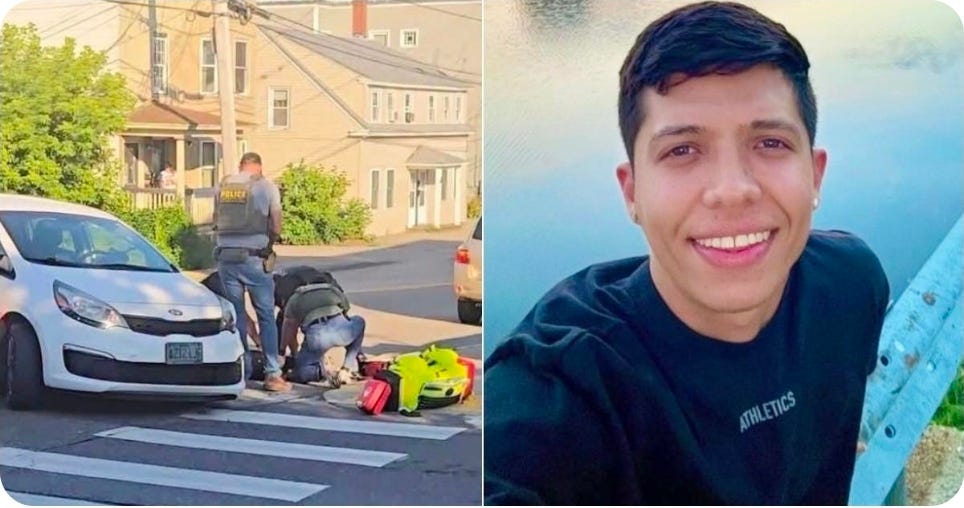
A rogue-agent explanation asks whether one officer violated policy. The documented machinery raises a more consequential question: what happens when the policy environment rewards maximum arrests, removes protected locations, reduces training, encourages concealment, expands racial profiling, disperses responsibility, punishes observation, and leaves victims without effective remedies?
The answer is visible in the ACLU’s record. Force becomes ordinary. Children become acceptable witnesses and targets. Citizens become casualties of appearance-based policing. Schools and hospitals become enforcement terrain. Journalists and clergy become threats. Masks become standard. Unmarked vehicles become routine. Accountability becomes more difficult as the force becomes larger and more violent.
The report describes this system as a blueprint for authoritarianism because its machinery extends beyond deportation. It establishes a national internal-security force capable of entering cities, overwhelming local communities, suppressing protest, monitoring observers, intimidating elected officials, retaliating against witnesses, and defining political opposition as a threat.
Anti-immigrant scapegoating provides the public justification for building that machinery, while the force assembled in its name creates a broader state capacity. Once tens of thousands of officers have been funded, deployed across agency lines, and normalized as a masked presence in American communities, the same infrastructure can be used wherever the administration decides that public movement, observation, local resistance, protest, or political opposition interferes with federal power.
Trump built this force by insisting that mass deportation required unprecedented scale. Congress gave it the money. ICE enlisted local police. Federal agencies surrendered personnel. Sensitive-location protections were removed. Internal oversight was weakened. Legal accountability remained broken. Communities were left to confront armed agents whose identities and authority were often unclear.
The ACLU recommends dismantling the national deportation policing force, removing immigration agencies from DHS, restricting 287(g) deputization, ending the diversion of police into ICE operations, and restoring the ability of victims to hold federal officers and agencies legally accountable.
Those recommendations recognize that a force built through funding, recruitment, cross-agency deployment, concealment, and impunity cannot be repaired only by disciplining individual officers after people have been injured, families separated, children terrorized, and communities taught to fear every unmarked vehicle.
Floridalma Sanchez-Gomez’s driveway showed what this system looks like when it arrives. A traffic stop became a multi-agency operation in which a young woman was tased twice, a home was forced open, a citizen witness was arrested, and a child returned to a broken door and a missing family. Responsibility was dispersed across uniforms, agencies, vehicles, and chains of command.
That was not chaos surrounding the deportation force. It was the deportation force working as built.
Trump’s national deportation police force is expanding through congressional money, federal power, local-police deputization, racial profiling, and broken accountability. The people harmed are left to document what happened while masked agents and overlapping agencies make responsibility harder to trace.
Support independent reporting that names the architects, preserves the victims’ record, and exposes the machinery behind mass deportation.
Subscribe to Americans Against ICE.
Propaganda spewed by Trump and his enablers cannot coverup the fact that Republicans are using physical violence in a desperate attempt to stay in power. ICE agents are dispatched by Donald Trump and Stephen Miller to crush Americans who expose the regime’s criminal acts.
These ICE thugs—without warrants, without trials, and in obvious violation of the Constitution and laws of the USA—have attacked, maimed, kidnapped, incarcerated, and/or deported hundreds of American citizens. They have also murdered both citizens and non-citizens—including Baby Kohen Riley.
ICE Bounty Hunters—encouraged by their treasonous supervisors—routinely employ violence to fill their racist quota of brown-skin-prey. And sometimes, because they know Trump has their backs, they murder—reminding Americans that in a Racist-Trump-Kleptocracy, Republican Fascists believe they are above the law.
Two of every three Americans recognize that convicted criminal Donald Trump is a liar, thief, grifter, fraudster, racist, sexual predator, and war criminal. This supermajority will win the midterm elections by blocking passage of Trump’s ludicrously racist, (and purposely misogynistic), “Save America Act”—a legislative obscenity designed to disenfranchise women and People of Color.
IN NOVEMBER VOTE LIKE YOUR LIFE DEPENDS ON IT! BECAUSE IT DOES! TRUMP AND MAGA NAZIS ARE DESTROYING THIS COUNTRY TO ENRICH THEMSELVES AND THEIR CRONIES AND TAKING IT FROM THE WORKING RETIRED AND POOR! STRIPPING LAWFUL PROTECTIONS AND DOING AWAY WITH THE PROCEDURES TO REDRESS OUR VALID ISSUES! WHEN IT'S GONE IT'S GONE FOREVER!