

The violence ICE carries out in the street is not separate from the violence inside detention. The street shows what ICE is willing to do in public, where witnesses can shout, cameras can record, and the agency still has to answer after the harm is visible. The records show what ICE does when the doors close, when people are already trapped in government custody and the public can only learn what happened through whistleblowers, litigation, watchdogs, families, lawyers, and investigative reporting.
That is the center of this story. The street is not the exception. Detention is not some separate administrative space where the violence becomes cleaner because the language is official. They are two faces of the same enforcement machine: public force when people can see it, hidden force when ICE controls the walls, the records, and the first version of the story.
The public usually sees ICE violence when something breaks through the wall of official language. A person is tackled on a sidewalk. Agents refuse to answer basic questions. A witness yells that the person is from here. Someone is dragged away, injured, or later dismissed as part of a “mix-up.” Those incidents are often treated by officials as confusion, field mistakes, or enforcement encounters that somehow went wrong.
But the pattern becomes harder to deny when the same logic appears inside ICE’s own detention records: force first, explanation later, paperwork after the damage is done.
The Washington Post reported that internal ICE records documented at least 1,460 use-of-force incidents from January 2024 to February 2026. The Post also reported that guards used force on nearly 1,330 detained immigrants last year, a 54% increase in the number of affected detainees from the year before. The reported force included pepper spray, takedowns, restraint devices, Tasers, punches, and kicks, with injuries including seizures, broken arms, head injuries, dislocated shoulders, and eye injuries.
Those are not abstract administrative events. Those are bodies harmed inside facilities where public witness has already been removed.
The detail that matters most is what many detained people were demanding when force was used. According to the reporting, the records included incidents involving detained people asking for food, water, medical care, or better conditions.
That fact destroys the public-safety language ICE uses to defend itself. A person asking for water is not a public threat. A detained person asking for medical care is not attacking the country. A person already confined by the government and then met with pepper spray, restraints, or physical force is not being “processed” in any morally neutral sense.
That is why the street violence matters to the detention story. When people see ICE agents use force in public, the violence has a setting, a sound, and immediate witnesses. The public can recognize the act before the agency has time to rename it. Inside detention, the same state power operates with fewer witnesses, fewer cameras, fewer immediate public consequences, and more control over the language that survives.
ICE can call it “use of force.” It can call it “detention operations.” It can call it “security response.” But the records describe detained people being harmed while already under government control.
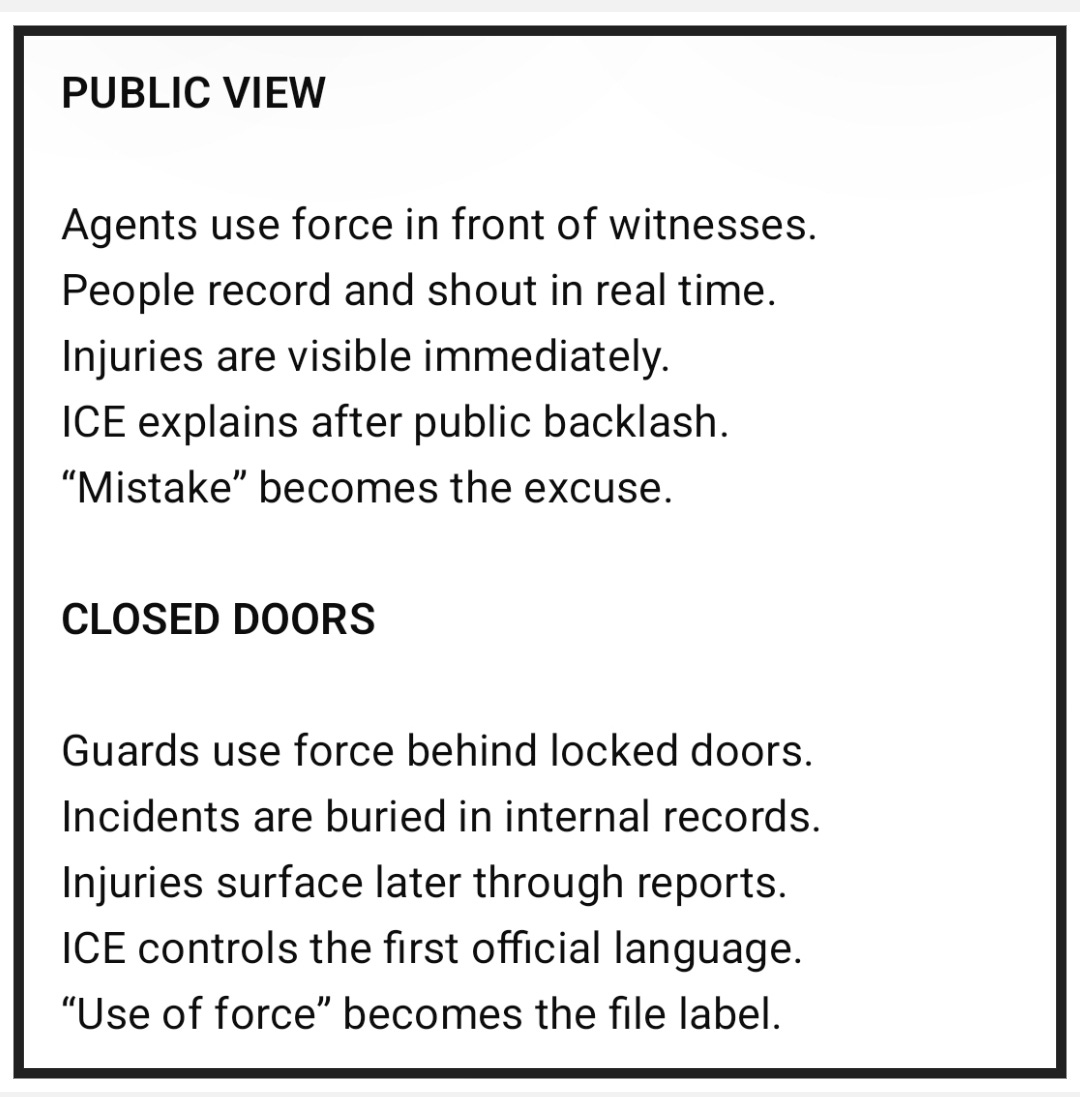
This comparison matters because ICE’s public violence gives people a visible sample of a larger hidden structure. The agency’s conduct on the street is not the rough outer edge of an otherwise clean system. It is the part of the system people can actually see.
If agents are willing to use force in public while phones are recording and bystanders are yelling, the question is not whether the same logic exists inside detention. The question is how much more dangerous it becomes when the person being harmed is already confined, isolated, and dependent on the same system for food, water, medical care, communication, and survival.
ICE detention removes public witness by design. People inside cannot simply step away from the officer, leave the facility, call a press conference, or rely on a crowd forming around them in real time. Their pain becomes easier to contain because the building itself contains them first. Their words can be reframed as disruption. Their requests for basic needs can be described as noncompliance. Their injuries can be recorded in language that protects the institution from the violence it just carried out.
That is the danger of official language. “Use of force” sounds sterile enough to pass through the public mind without stopping. It sounds like procedure, not pepper spray. It sounds like policy, not a head injury. It sounds like a necessary response, not a detained person asking for food or medical attention and being met with force.
The phrase does not show the person’s body. It does not show the burning eyes, the broken bone, the seizure, or the moment someone realizes that asking for care inside ICE custody can bring more harm.
The reporting also pointed to the opacity surrounding ICE detention, including facilities run by private contractors and records that can leave accountability unclear. That matters because privatized detention gives ICE another layer of distance from the harm committed in its name.
The public sees the federal agency. The person inside may be facing guards, contractors, medical neglect, overcrowding, isolation, and internal procedures that are nearly impossible to challenge in real time. When the record finally surfaces, the harm has already happened.
The street incident is the warning flare. The detention record is the evidence trail. One shows what state power looks like when it still has to operate in public. The other shows what the same power does when the person is already behind walls, already controlled, already dependent, and already easier to erase from public attention.
Those two realities should not be separated. The violence outside and the violence inside are connected by the same enforcement logic: seize, control, injure, rename, file, and move on.
The deaths in ICE custody make this pattern even more urgent. The ACLU reported that ICE had announced the 17th death in its custody in 2026, with deaths occurring at roughly one every six days, and said more than 40 people had died in immigration detention since the start of Trump’s mass deportation campaign.
The same report framed those deaths within a system of expanding detention, abusive conditions, impunity, delayed care, and unsafe facilities. That is not a side issue. Custody deaths are the most severe consequence of a system where public visibility comes too late.
Other reporting has pointed in the same direction. Reuters reported that a Mexican immigrant’s death in ICE custody marked the 14th known fatality in 2026 at that point, following 31 deaths in 2025. The Guardian reported that 32 people died in ICE custody in 2025, making it ICE’s deadliest year in two decades, with advocates and attorneys pointing to overcrowding, unsanitary conditions, poor nutrition, and inadequate medical care as likely contributors in the broader detention crisis.
These numbers are not separate from the use-of-force records. They show the custody environment where violence, neglect, and confinement meet behind closed doors.
This is where the public narrative has to break. ICE and its defenders want the street incident treated as a mistake and the detention record treated as bureaucracy. They want the public to see a violent arrest as a one-off and a force report as paperwork.
But when the same agency is using force in public, using force inside detention, and presiding over rising custody deaths, the pattern is no longer hidden. The only thing hidden is the full scale of what happens before the public is allowed to know.
The people inside detention are not just out of sight. They are placed inside a system that controls the conditions under which their suffering can be seen at all. A detained person can be hungry, thirsty, sick, injured, isolated, restrained, pepper-sprayed, or medically neglected while the outside world receives only fragments later.
Sometimes the fragment is a whistleblower record. Sometimes it is a family demanding answers. Sometimes it is a death notice written in detached agency language after the person is already gone.
That delay is part of the violence because it gives the institution time to shape the story before the public can confront the harm.
“Hidden from public view” is not just a description. It is part of the mechanism. The public does not see the moment someone is denied care until their condition worsens. The public does not see the pressure inside overcrowded facilities until records, lawsuits, or watchdog reports force it into the open.
The public does not see the full body count as lived human loss; it sees delayed announcements, official memos, and sanitized summaries. ICE does not need to hide every record forever to benefit from secrecy. It only needs enough delay, enough distance, and enough administrative language to make the violence feel less immediate.
The comparison between street and detention violence should be understood as a scale of visibility. On the street, ICE violence can still be witnessed in real time. Inside detention, the same violence is filtered through official systems before it reaches the public. In custody death cases, the public may only learn after survival is no longer possible.
That is the escalation: public force, hidden force, irreversible harm.
The records did not create the pattern. They exposed the part of the pattern ICE does not want people to see.
This is also why the first note matters. People do not need an internal report to understand what they are watching when federal agents tackle people, ignore identification, drag them away, injure them, and call the harm accidental.
The report matters because it confirms that the public incident is not an isolated moral shock. It belongs to a larger system of force that continues inside detention, where people are already trapped and where the state has more control over the evidence.
The central point is not that ICE sometimes makes mistakes. The central point is that ICE violence appears in public and then reappears in the agency’s own detention records.
It appears in the way agents seize people on the street, and it appears in the way guards respond to detained people asking for food, water, medical care, and basic conditions. It appears in injuries documented in internal files, and it appears in the rising number of people dying in custody while families and advocates fight for answers.
The locations change. The visibility changes. The pattern does not.
A system that can injure people in public and call it confusion will do worse behind walls where people cannot be easily seen. A system that can reduce a public beating or wrongful detention to a “mix-up” will reduce detention violence to “use of force.”
A system that can answer basic human need with pepper spray, restraints, Tasers, punches, and kicks is not protecting the American people. It is protecting its own power over people already trapped inside its custody.
The violence on the street is the warning. ICE detention records are the evidence. Custody deaths show the consequence of a system that becomes most dangerous when the public cannot watch.
The street shows what ICE is willing to do in public. The records show what ICE does when the doors close.
Support independent reporting that connects ICE street violence, detention abuse, custody deaths, and the records officials would rather keep buried.
Upgrade to a paid subscription and help keep this documentation in public view.
Sources / reporting referenced: The Washington Post reporting on internal ICE use-of-force records; ACLU reporting on ICE custody deaths; Reuters reporting on ICE custody fatalities; The Guardian reporting on ICE detention deaths and conditions.
Hard to sit with, but important.