

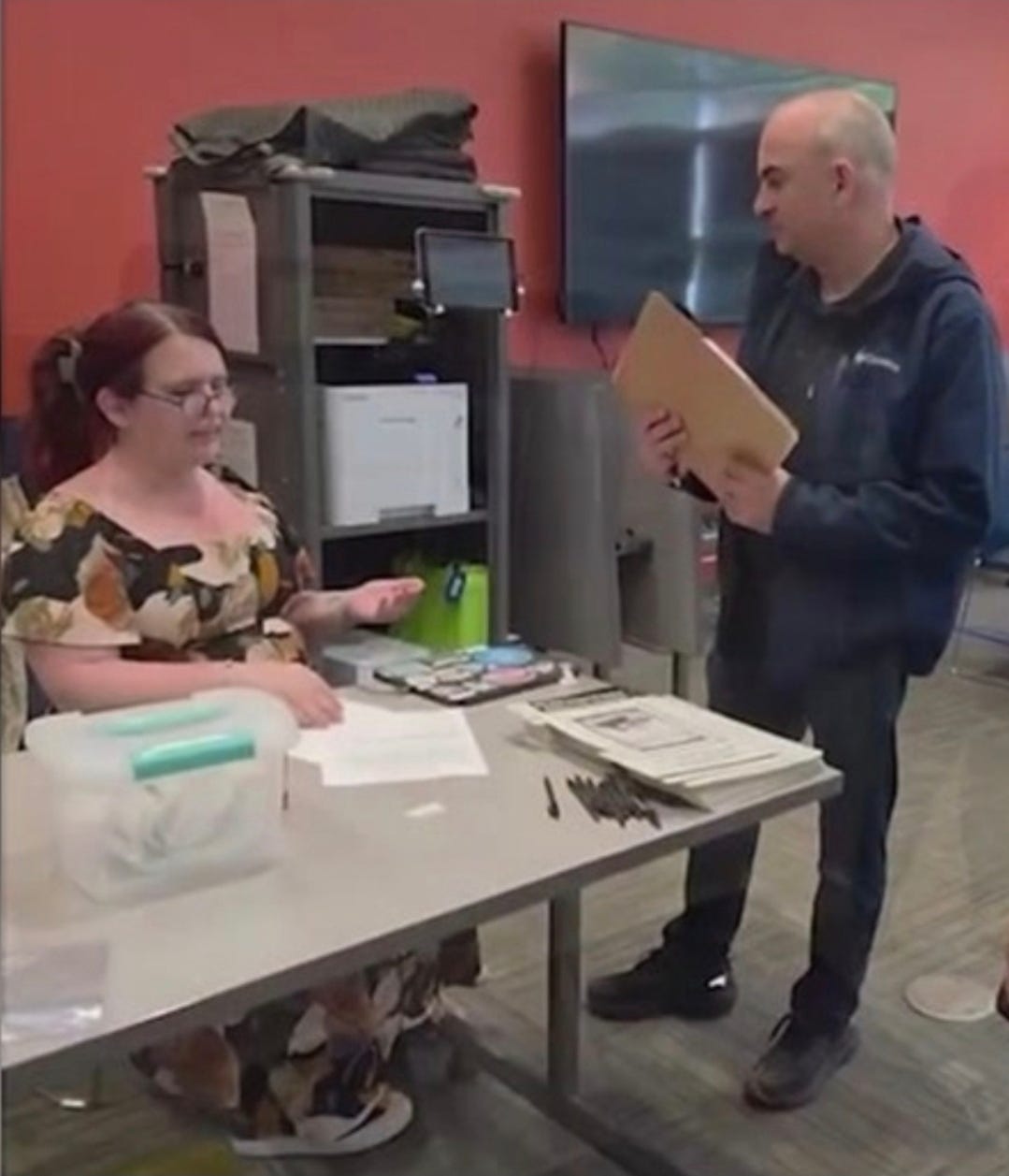
ICE agents confronted Paigelynne Gonyea at work over an Instagram post that called for Jonathan Ross to be indicted after the killing of Renee Good. The confrontation matters because it shows federal power moving directly against a person for public speech about an ICE killing. It also exposes a deeper contradiction: ICE showed visible urgency toward a woman demanding accountability, while the public has not seen that same urgency toward holding Ross accountable for Good’s death.
According to reporting, Gonyea was working as a poll worker at the Central Library in Syracuse, New York, when two ICE agents approached her during New York’s primary election. The agents were there over a January Instagram post that named Jonathan Ross, the ICE agent publicly identified in reporting as the agent who fatally shot Renee Good in Minneapolis. Gonyea’s post said, “I think today is a great day for Jonathan to be indicted.” That sentence called for legal accountability through the courts. It did not call for private violence.
The agents reportedly gave Gonyea a warning notice claiming that her social media account may have violated federal law by threatening federal officers. Gonyea said the agents had a folder containing copies of her social media posts and her driver’s license, and that they tried to pressure her into signing the notice while she was working. She refused. The warning also reportedly referenced possible federal and state prosecution, turning a political statement about indictment into an encounter with armed state authority.
🎦 Video shows ICE agents confronting Paigelynne Gonyea at work over her Instagram post calling for Jonathan Ross to be indicted.
The workplace setting made the encounter more serious. Gonyea was not being contacted through an attorney, sent a routine letter, or asked to clarify a statement through a normal channel. Federal agents appeared where she was working and confronted her in person. When the workplace is also connected to an active polling site, the public concern becomes even larger because voting spaces depend on the absence of intimidation, disruption, and unnecessary law enforcement presence.
That polling-place context cannot be treated as a side detail. Election officials told reporters that law enforcement has no ordinary role inside a polling place unless there is an emergency. State officials were also reportedly reviewing the incident after ICE agents entered a voting site to confront a poll worker. Even if the agents claimed they were there only about a social media post, the effect was still federal enforcement power entering a civic space where voters and election workers are supposed to be protected from pressure.
The free speech issue is just as direct. Calling for a publicly identified federal agent to be indicted is political speech about government violence. Indictment is a legal process. A demand for indictment is a demand that prosecutors and courts act, not a threat that private people should harm anyone. In a case involving a fatal shooting by an ICE agent, speech demanding prosecution belongs at the center of public accountability, not at the edge of criminal suspicion.
That is why the wording of Gonyea’s post matters. “I think today is a great day for Jonathan to be indicted” is not a vague threat. It is a plainly stated opinion that an agent involved in a fatal shooting should face legal consequences. If federal agents can treat that sentence as grounds for an in-person warning, then the chilling effect reaches far beyond Gonyea. It tells other people that repeating public reporting, naming an ICE agent, and calling for prosecution may bring federal agents to their workplace.
The Renee Good context is the reason this story cannot be reduced to a dispute over social media moderation. Good was shot and killed in Minneapolis during an ICE encounter, and Ross was later publicly identified through reporting as the agent involved. Coverage of the shooting, video evidence, official claims, autopsy reporting, and questions about federal investigative control made the case a national accountability issue. Americans Against ICE has already documented Good’s killing as part of a wider record of immigration enforcement violence and institutional protection after force is used.
The contradiction is institutional, not personal. ICE had the capacity to track Gonyea’s post, prepare paperwork, bring a file, appear at her workplace, invoke prosecution, and seek her signature. The public has not seen the same visible urgency applied to the core question that made her post necessary: why Renee Good is dead, what Jonathan Ross did, and whether he will face consequences outside the agency’s own protective structure. A government that responds faster to criticism than to the harm being criticized is not protecting public safety. It is protecting itself.
This is how state violence expands after the moment of force. The initial act harms the victim. The aftermath determines whether the institution will answer for it or shield itself from public scrutiny. When federal agents direct pressure toward people who keep naming the agent and the victim, the public record itself becomes a battleground. The goal does not need to be an arrest to be effective. A warning letter, a workplace visit, and a folder of personal records can be enough to make people question whether speaking is worth the risk.
The public should not have to choose between naming ICE violence and avoiding federal attention. That choice is the harm. It narrows the space for accountability at precisely the point where public pressure is most necessary: after a person has been killed and the institution responsible has every incentive to control the story. If calling for indictment can be treated as a threat, then the demand for accountability is being pushed into silence.
This article stands because the issue is larger than one outlet’s report or one Instagram post. It is about the pattern revealed by the response. ICE treated speech demanding legal accountability as something requiring an in-person warning, while the killing that prompted the speech remains the deeper public question. That pattern belongs in the record because immigration enforcement abuse does not end with raids, detention, deportation, or shootings. It continues through intimidation, paperwork, warnings, narrative control, and pressure against the people who refuse to let the harm disappear.
Renee Good deserved accountability after she was killed. Paigelynne Gonyea deserved to speak about that killing without federal agents confronting her at work. Jonathan Ross should not receive more institutional protection than the public receives answers. When ICE moves faster against speech than against the violence that speech condemned, Americans Against ICE will document it as part of the same system of enforcement abuse.
ICE agents had time to confront a woman at work for saying Jonathan Ross should be indicted — but the public still has not seen that same urgency toward accountability for Renee Good’s killing.
That is why this record has to stay public. Americans Against ICE documents immigration enforcement abuse, intimidation, and the systems that protect agents from accountability after harm is done.
Upgrade to support Americans Against ICE and help keep this documentation going.
Related report:

Not a great sign. 😕
Not only is there no noticeable justice for a woman shot by an ICE agent, but now they are allowed to send enforcers to a woman's workplace to threaten and intimidate her? This is wrong! ICE needs to be investigated and held accountable. They obviously believe that they have been given permission to act "above the law". Or maybe this regime just makes up its own laws.