

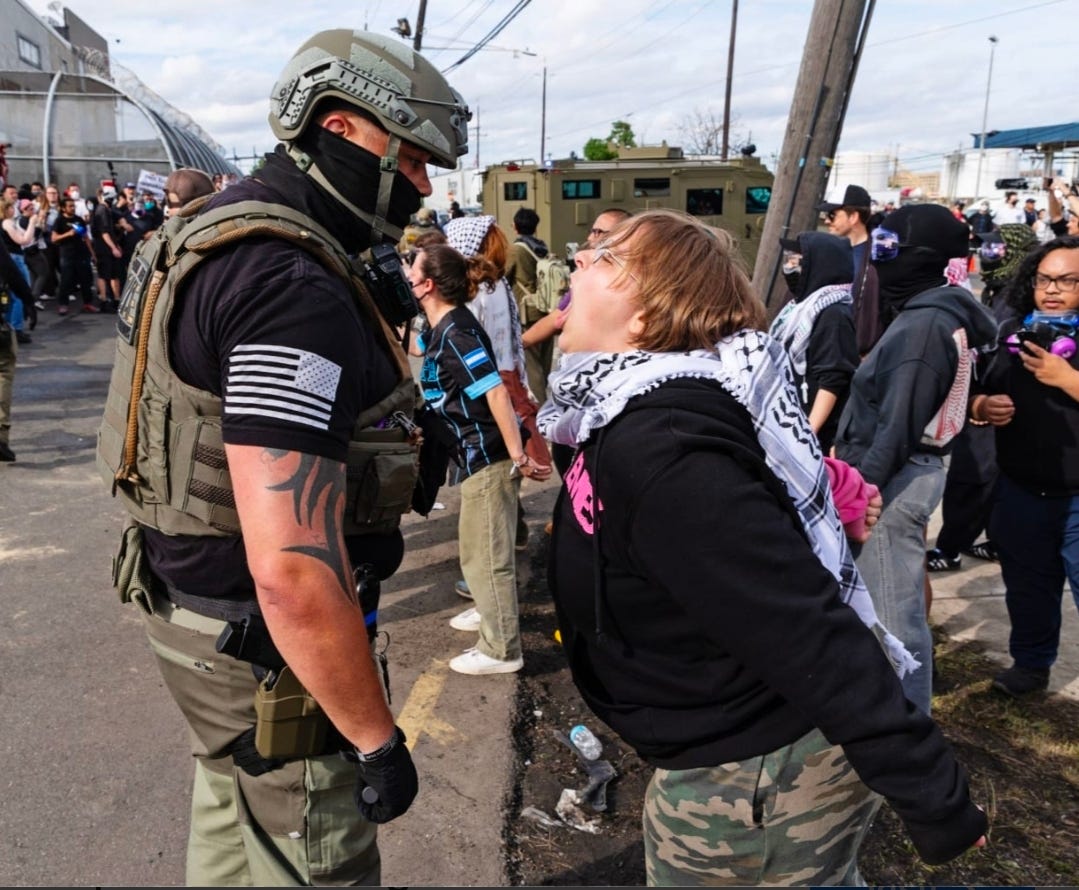
Inside Delaney Hall, detained immigrants are reportedly refusing food and labor to make the conditions inside the Newark ICE jail impossible to ignore. Outside the facility, federal officers have used chemical spray, Tasers, batons, armored lines, and force against protesters demanding answers. Between those two scenes sits the public record: people inside say they are being held in harmful conditions by a detention system that profits from confinement, while federal officials deny the strike they are using their bodies to make visible.
Delaney Hall is operated by GEO Group, one of the largest private prison companies in the United States. Advocates and detainees told The Guardian that roughly 300 to 400 people are participating in the hunger and labor strike, demanding edible food, medical care, ventilation, and movement in their immigration cases. The public record also includes lawmakers describing dire conditions inside the facility, including allegations of spoiled food, inadequate medical care, and jail-like treatment of people who have not been sentenced as criminals.
That conflict is the center of the story. DHS says there is no hunger strike and denies mistreatment. Detainees, released detainees, advocates, and lawmakers describe a facility where people are refusing food and work because they say ordinary complaint channels have failed. The government’s denial is not separate from the harm being alleged; it is part of the reason detained people are putting their bodies into the record.
A detainee letter published by advocates said people inside were demanding due process rights and improved conditions. A recently released man said the detainees are not criminals, but parents, spouses, taxpayers, and people with pending immigration cases. Another released detainee, identified as Luis, said he had been detained during a routine immigration check-in and held for months. His explanation cut directly into the profit structure of detention: if people were freed, he said, they would stop generating profit for the business holding them.
That sentence should not be buried. Immigration detention is often presented as enforcement, but Delaney Hall exposes the business model underneath that language. Every additional day inside a privately operated ICE jail keeps beds filled, contracts active, and federal money flowing through a company whose revenue depends on confinement. The detainees are not only challenging spoiled food, heat, illness, or medical delay. They are naming a structure where delay itself becomes valuable to the people paid to keep them locked up.
GEO Group has said it provides medical access, visitation, library access, meals, and other services, and that those services are monitored by ICE. The company also said it was proud of its role supporting ICE’s law enforcement mission. That statement matters because it does not separate private detention from federal enforcement. It confirms the alignment: a private prison contractor and ICE are operating through the same cage.
The reported complaints from inside Delaney Hall are specific. Detainees and advocates have described inedible food, worms or maggots in meals, poor ventilation, lack of air conditioning, illness spreading through the facility, delayed medical care, slow immigration cases, and pregnancy-related medical concerns. Those are not abstract “conditions.” They are the daily mechanics of confinement: food people fear eating, air people struggle to breathe, sickness moving through a locked population, and medical care delayed until suffering becomes crisis.
Outside the facility, the same system has turned force outward. After days of protest, federal officers sprayed chemicals and charged demonstrators outside Delaney Hall. One protester who threw something at ICE officers was chased, tased, and carried into the jail. Officers armed with guns, batons, Tasers, and pepper spray stood at the gates as official vehicles moved in and out of the property.
The force outside cannot be separated from the strike inside. The protest is not random disorder around a jail. It is the visible public response to people inside saying they are being harmed, ignored, and used. When the state denies what detained people report and then uses force against people demanding access, the question becomes larger than one facility. It becomes a question of oversight, transparency, and who gets close enough to make abuse visible.
That question sharpened after U.S. Senator Andy Kim was pepper-sprayed outside Delaney Hall. Kim has said he was trying to de-escalate the confrontation after a congressional oversight visit when federal agents used chemical spray. The fact that a sitting senator could be hit with chemical force outside an ICE jail is not the whole story. It is a signal. If federal officers will use chemical force in a confrontation involving lawmakers, journalists, protesters, and public witnesses outside the gates, the public has reason to ask what happens inside the walls when detained people complain away from cameras.

DHS has denied the hunger strike and rejected allegations of mistreatment. Federal officials have said detainees receive meals, water, clothing, bedding, showers, toiletries, medical care, and other services. DHS has also accused protesters of attacking officers and has framed criticism from Democratic lawmakers as political.
But official denial is not evidence of humane treatment. It is a claim made by the same system being accused of harm. The public record now contains two competing versions of Delaney Hall. In one version, ICE and DHS say services are being provided, the strike is not happening, and criticism is political. In the other version, detained immigrants, released detainees, advocates, and lawmakers describe a facility where people are refusing food and labor because they say conditions are unsafe, medical care is delayed, and immigration cases are not moving. The burden should not fall on detained people to starve themselves before the public believes they are suffering.
The labor strike matters as much as the hunger strike. In privately run ICE detention centers, detainees perform work that helps keep the facility operating, including cooking, cleaning, laundry, and other basic functions, often for extremely low pay. When detained people refuse labor, they are not only refusing participation in the daily operation of the facility. They are exposing how detention systems depend on the work of the people they confine.
That makes Delaney Hall a labor story too. The facility does not simply hold people. It extracts time, work, compliance, and silence from them. When people inside refuse food and labor together, they are targeting the two places where the system is most vulnerable: its public legitimacy and its daily operation. The hunger strike says the harm inside cannot be ignored. The labor strike says the jail cannot keep running smoothly while the people inside are being treated as disposable.
This is why the denial matters. If DHS can erase the strike with a statement, it can erase the reason people are striking. If federal officials can reduce the protest outside to disorder, they can erase the conditions inside. If lawmakers are framed as political actors rather than oversight witnesses, accountability becomes theater and the cage at the center of the story stays protected from scrutiny.
Delaney Hall also sits inside the Trump administration’s broader immigration enforcement expansion. The administration has pushed aggressive detention and deportation while ICE facilities and contractors absorb the human consequences. Newark’s Delaney Hall is not an isolated building. It is part of an enforcement system where immigrants can be detained during routine check-ins, families can be separated by case delay, and private companies can profit while federal agencies describe the process as lawful because it is administrative.
That “administrative” language is one of the ways harm gets laundered. People hear immigration detention and imagine paperwork. The reality described by detainees is confinement, hunger, illness, force, fear of retaliation, and months of waiting inside a facility run by a private prison company. Many people in immigration detention have not been sentenced to prison. They are fighting civil immigration cases, seeking status, appearing for check-ins, or waiting for hearings while the machinery of detention turns their pending cases into occupied beds.
That is why “We are not criminals” carries so much weight. It is not only a plea for sympathy. It is a correction to the public frame that makes detention easier to tolerate. ICE detention often depends on making the public imagine a criminal threat so confinement feels acceptable. The people inside Delaney Hall are saying they are human beings caught inside a system that turns immigration status, delay, and fear into detention capacity.
The protest outside Delaney Hall is a direct response to that machinery. People are gathering because the wall between inside and outside is doing what detention walls are built to do: isolate suffering until it becomes deniable. Demonstrators, advocates, lawmakers, and released detainees are breaking that isolation by forcing the facility into public view.
That is why the state response is so revealing. Chemical spray does not answer claims of spoiled food. Tasers do not answer delayed medical care. Armed lines outside a gate do not answer reports of poor ventilation, untreated illness, miscarriage, or case delay. Force may move bodies away from an entrance, but it does not resolve the public-harm record forming around Delaney Hall.
The central question now is not whether DHS can issue a denial. It can. The question is whether public oversight will treat detained people’s testimony, released detainees’ accounts, lawmakers’ observations, and advocates’ documentation as evidence that requires investigation. A hunger strike is not a public relations dispute. It is a warning that people inside believe the normal channels have failed so badly that bodily refusal is the only evidence left that cannot be ignored.
Delaney Hall should be understood as a warning about what immigration enforcement becomes when detention profit, federal denial, and public force operate together. Detainees say the conditions are bad enough to refuse food. Advocates say hundreds are participating. Lawmakers say the conditions are dire. GEO Group says it is proud to support ICE’s mission. DHS says there is no hunger strike. Federal officers are using force outside the jail.
That is the pattern.
Inside, detained people are trying to make harm visible with their bodies. Outside, the government is trying to control who gets close enough to see.
HELP KEEP THIS RECORD OPEN
ICE detention abuse should not disappear behind closed doors, private contracts, or federal denials.
Paid subscriptions help Americans Against ICE keep documenting these cases, connecting the pattern, and making the public record harder to bury.
Related Report:
